Adult Tajweed education occupies a special and often underserved niche in Islamic learning. The majority of Quranic educational content — curricula, platforms, marketing materials — is oriented toward children. Yet the global Muslim adult population includes tens of millions of individuals who learned to read the Quran as children without formal Tajweed instruction, or who converted to Islam as adults and are approaching the Quran’s recitation rules for the first time.
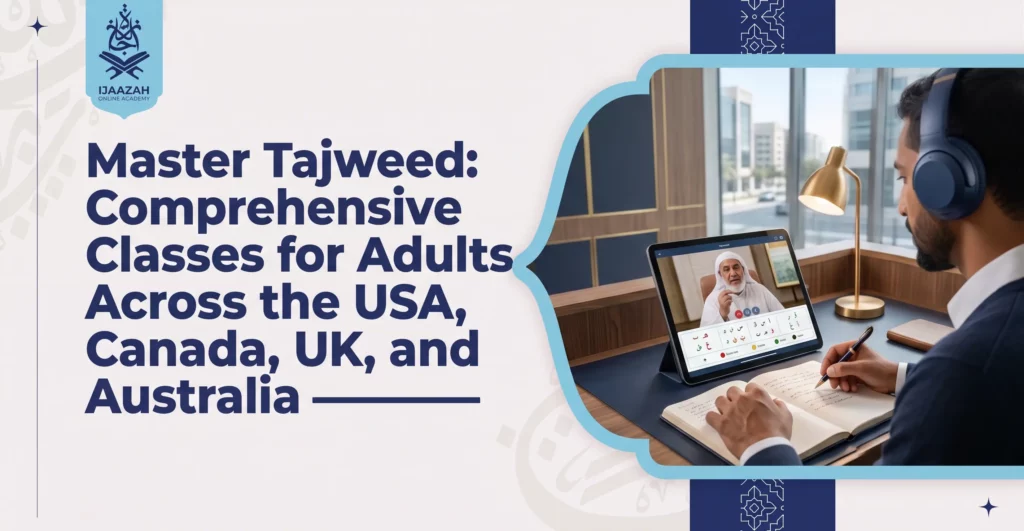
For adults in Western countries — where professional demands, family responsibilities, and the absence of embedded Islamic educational infrastructure compound the challenge — finding excellent Tajweed classes requires knowing where to look and what to expect. This guide addresses the specific needs, challenges, and opportunities of adult Tajweed learners in the USA, Canada, UK, and Australia.
Why Adults Often Need Different Tajweed Instruction
Adult learners bring both advantages and challenges to Tajweed study that distinguish them from children. Adults have fully developed metacognitive abilities — the capacity to think about their own learning, identify their specific weaknesses, and strategically allocate practice time. This makes adult learners highly efficient when well-directed. Adults also bring intrinsic motivation: they have chosen to study Tajweed for reasons they have consciously identified, which is a more reliable motivational foundation than the external incentives that often drive children’s learning.
However, adults face phonological challenges that children typically do not. After decades of using a first language, the adult brain has established strong phonological habits that resist the acquisition of new sounds. Arabic sounds like the guttural ‘ayn (ع), the emphatic letters (ص, ض, ط, ظ), and the distinction between the heavy and light pronunciations of letters have no English equivalents, and adults must work deliberately to overcome ingrained articulatory patterns. [Source: Second Language Phonology, Major, R.C., Applied Linguistics, 2001]
Unique Needs of Western Adult Learners
Adults in Western countries bring a specific set of needs that effective Tajweed programs must address. Scheduling flexibility is paramount: unlike children whose learning takes place within structured school days, adults are learning within professional and family lives that change week to week. Programs that offer not only flexible scheduling but makeup lesson policies, recorded session access, and asynchronous practice resources will retain adult students through the inevitable scheduling disruptions of Western life.
Cultural context matters significantly. Many Western Muslim adults have complicated relationships with Islamic authority and instruction — they may have experienced rigid, shame-based teaching as children in mosque schools, or may carry anxiety about their Arabic pronunciation being criticized. Adult-oriented Tajweed programs that emphasize encouragement, normalize the difficulty of phonological challenges for native English speakers, and frame errors as information rather than failure create the psychological safety that adult learning requires.
Female Tutors: A Priority for Women Adult Learners
Adult Muslim women represent a substantial portion of the demand for Tajweed classes, and the availability of female tutors is a critical factor in their enrollment decisions. Unlike children, whose parents make enrollment decisions for them, adult women are autonomous agents selecting programs that meet their comfort, cultural, and religious requirements.
Many adult Muslim women in Western countries were educated in mixed-gender secular environments and are entirely comfortable with male teachers in professional contexts. However, when it comes to Islamic education specifically — particularly recitation practice, which involves prolonged one-on-one vocal interaction — many women prefer a female teacher. This preference deserves respect and accommodation. Tajweed programs that actively recruit and credential female teachers, and that advertise this feature transparently, demonstrate alignment with the needs of female adult learners.
Curriculum Structure for Adults: What to Expect
An adult-oriented Tajweed curriculum typically differs from children’s programs in pacing, explanation depth, and content framing. Adults benefit from theoretical grounding before application — understanding why a rule exists, its Arabic name, its classical scholarly basis, and how it connects to the broader system of Tajweed, before practicing its mechanical application in recitation.
A well-designed adult Tajweed course covers four to six major rule categories (noon sakinah, meem sakinah, madd rules, heavy and light letters, rules of lam, rules of stopping and starting) over twelve to twenty-four weeks, depending on lesson frequency and student pace. Each rule category is introduced conceptually, practiced in isolation with targeted examples, and then integrated into running recitation practice. Periodic comprehensive recitation reviews ensure earlier rules remain consolidated as new ones are added.
Building a Supportive Learning Community for Adults
Adult Tajweed learners benefit from community in ways that differ from children. Where children need the social structure of a group class for motivation, adults need communities of practice — peer groups who share the specific challenge of developing Tajweed in middle age or beyond, who can share resources, discuss rules, and provide accountability.
Online communities for adult Tajweed learners have grown substantially on platforms including Telegram, Discord, and Facebook Groups. Many mosque-based study circles include adult Tajweed components that provide the in-person community dimension. National platforms like SeekersGuidance and Bayyinah TV host online communities alongside their courses that connect adult learners globally. Investing in community alongside formal instruction dramatically improves long-term retention and motivation.
Adult Tajweed learning in Western countries is both more accessible and more important than at any previous point in history. The combination of qualified online instruction, flexible scheduling, and a growing community of adult learners has transformed what was once a nearly impossible pursuit for busy Western Muslims into an achievable aspiration.
Identify a program designed with adult learners in mind, confirm the credentials and cultural experience of the teacher, begin with a trial lesson, and set realistic goals for a twelve-to-twenty-four-week curriculum. Adult learning is steady, informed, and deeply rewarding. The Quran deserves your best recitation — and your best recitation deserves proper Tajweed instruction.