The Quran occupies the center of Muslim spiritual life in a way that is difficult to fully articulate to those outside the faith. It is not merely a religious text: it is the living word of God, the criterion (Furqan) by which life is oriented, the source from which Islamic law, spirituality, and culture all flow. For Muslims living in Western countries — where Islamic culture is minority culture, where Friday is a workday and Ramadan is unrecognized on most calendars — maintaining a living relationship with the Quran requires deliberate effort.
Online Quran classes have become the primary infrastructure through which millions of Western Muslims sustain and deepen that relationship. This guide explores why online Quran classes are particularly well-suited to Western Muslim life, how to choose the best program for your needs, and how to make the most of your online learning experience.
The Value of Online Quran Classes for Western Muslims
Western Muslim communities face a paradox: their commitment to Islamic practice is often strengthened by minority status — being Muslim in a secular society requires intentionality — while structural access to Islamic education is limited by that same minority status. Mosques are unevenly distributed, Islamic schools are available in only a fraction of cities, and qualified Quran teachers are geographically concentrated in ethnic community hubs that many Muslims do not live near.
Online Quran classes dissolve this geographic barrier entirely. A Muslim woman in rural Scotland, a convert in suburban Ohio, or a second-generation Pakistani-Australian in Adelaide all have equal access to the same global pool of qualified teachers. Online classes also dissolve time barriers through asynchronous content, flexible scheduling, and recorded lesson access — making Quranic education compatible with the demanding schedules of Western professional life.
Features to Look for in Online Quran Classes
Flexible scheduling is the foundational feature for Western Muslim students. Look for platforms that allow you to schedule, reschedule, and cancel lessons within reasonable notice periods without penalty. The best platforms allow scheduling up to two to four weeks in advance with a direct online booking interface, automated time zone conversion, and reminder notifications.
Access to qualified female tutors matters enormously for a large segment of the Western Muslim population — women and families with daughters who prefer the cultural and religious comfort of female instruction. Verify that platforms explicitly maintain female teacher rosters, display credentials, and allow students to request female-only teacher matching.
Tailored learning experience distinguishes excellent platforms from generic ones. Before beginning lessons, the best programs conduct a placement assessment — evaluating existing Arabic literacy, recitation ability, and specific learning goals — and use this assessment to build a customized curriculum. Students who are assessed and placed appropriately progress significantly faster than those placed in generic beginner courses regardless of prior knowledge.
Cultural Sensitivity: Why Context-Aware Teaching Matters
A Quran teacher who has spent their entire career teaching students in Cairo or Lahore brings exceptional religious and linguistic knowledge to online teaching. However, they may initially lack the cultural frame to understand why a student in London struggles to schedule a lesson during Ramadan’s work days, why a student in Sydney feels embarrassed admitting they have never learned Arabic despite being Muslim for thirty years, or why a convert in Toronto is approaching the Quran without the cultural scripts of a Muslim-majority upbringing.
Cultural sensitivity in teaching — the ability to understand and accommodate the specific cultural context of Western Muslim students — is a genuine pedagogical skill that the best online platforms develop in their teachers through training, feedback, and student-teacher matching. When evaluating a platform, ask how teachers are trained to work with Western students and what mechanisms exist for student feedback on cultural misalignment.
Technology and Logistics: Getting Started
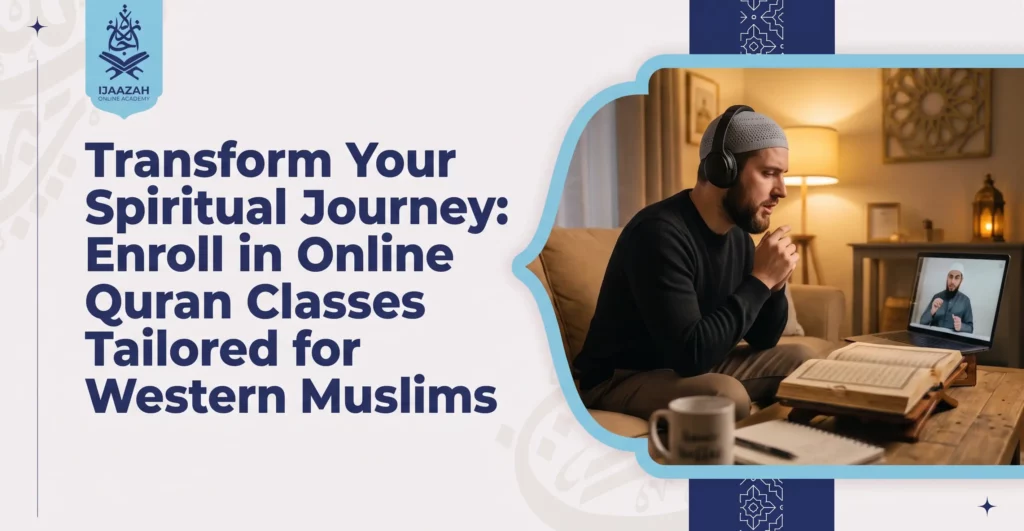
The technical requirements for online Quran classes are modest. A stable broadband internet connection (15 Mbps or higher), a device with a functioning camera and microphone, and a quiet, private learning space constitute the baseline. Many students prefer tablet-based learning for the flexibility of handwriting Arabic characters digitally during lessons.
Most reputable platforms use mainstream video conferencing tools — Zoom, Google Meet, or proprietary platforms — that are reliable, accessible, and familiar to most Western students. Before your first lesson, test your setup with a brief video call to confirm audio and video quality. Poor audio is the most common technical barrier in online Quran lessons; a headset with a dedicated microphone dramatically improves the teacher’s ability to hear and assess your recitation.
Community Building in Online Learning
One critique of online Quran classes relative to in-person study circles is the loss of communal dimension. This concern has merit — sitting in a room reciting Quran alongside other students, sharing the experience of learning and improving together, has a spiritual dimension that screen-based interaction does not fully replicate.
However, the best online platforms actively address this through group learning options, live community Q&A sessions, peer accountability programs, and online student communities. Students who supplement their individual tutoring with participation in these community features report significantly higher motivation and longer learning tenure than those who engage only with individual sessions. Think of individual tutoring as the core of your Quranic education and community features as its essential complement.
Online Quran classes represent one of the most positive developments in Islamic education in the modern era. For Western Muslims, they transform geographic and scheduling barriers into solvable logistics, opening access to qualified, credentialed instruction that previous generations could only access through migration or fortunate proximity to major Islamic centers.
Begin your journey by identifying your goals, assessing your current level, and researching two or three platforms. Take trial lessons, assess cultural fit, and commit to a structured schedule. The Quran is a lifelong companion — and online classes are the most accessible path to deepening that companionship for Western Muslims today.