The United States is home to one of the world’s most dynamic and diverse Muslim communities. Spanning nearly every ethnic background, income level, and geographic region, American Muslims represent a community with enormous internal diversity — but a shared commitment to the Quran as the foundation of Islamic practice. Whether in Detroit’s Arab-American communities, the Somali diaspora in Minneapolis, the South Asian communities of New Jersey, or the growing number of American converts across every state, the need for quality Quran tutors is universal.
Finding the right Quran tutor in the USA requires navigating a landscape that has changed dramatically over the past decade. The rise of online tutoring platforms has expanded options exponentially, while the growth of Islamic educational institutions in major cities has strengthened in-person alternatives. This guide helps American Muslims identify and evaluate the best Quran tutoring options available to them.
Why Personalized Quran Tutoring Outperforms Self-Study
The Quran is one of the very few texts in human history explicitly designed to be transmitted through oral instruction. Its recitation rules (Tajweed) cannot be fully acquired from books or apps alone — they require a teacher who can hear your pronunciation, identify errors, and model correct sounds. This is why the Islamic scholarly tradition has always prioritized the teacher-student chain (silsilah) as the authoritative method of Quranic transmission.
Beyond Tajweed, personalized tutoring accelerates every aspect of Quranic learning. A tutor who knows your specific weaknesses — whether difficulty with Arabic letters that have no English equivalent, inconsistent application of elongation rules, or vocabulary gaps that hinder comprehension — can target instruction precisely where it matters most. Self-study materials, however excellent, cannot replicate this responsiveness. Research on one-on-one tutoring consistently finds effect sizes two to four times higher than classroom instruction on equivalent material. [Source: Bloom, B.S., “The 2 Sigma Problem,” Educational Researcher, 1984]
Types of Quran Tutors Available in the USA
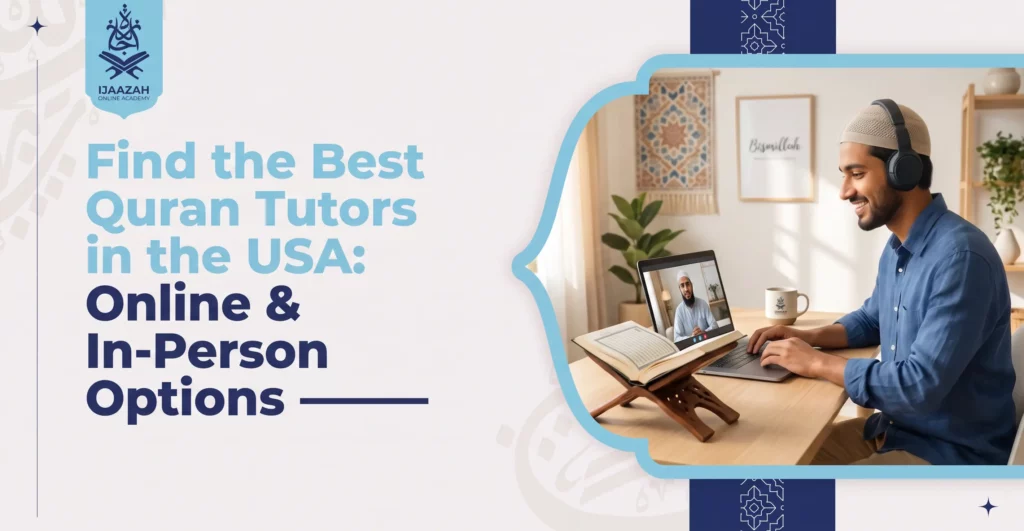
Online Quran tutors represent the majority of accessible options for American Muslims outside major metropolitan areas. Through platforms connecting students with teachers globally, an American student can access certified Quran teachers from Egypt, Pakistan, Saudi Arabia, Jordan, and beyond — teachers who hold formal Ijazah credentials and specialize in teaching English-speaking Western students. Online tutoring offers maximum scheduling flexibility and, for students without local Islamic educational institutions, is often the only viable option.
In-person Quran tutors are available primarily in cities with substantial Muslim populations: New York, Los Angeles, Chicago, Houston, Detroit, Minneapolis, and Dallas, among others. Islamic schools, masjids, and community centers in these cities often maintain registries of qualified local tutors. In-person instruction offers the social and environmental benefits of a dedicated learning space and the immediacy of physical presence, which some students — particularly children — find more engaging than screen-based learning.
Essential Qualifications to Look for in a Quran Tutor
The Ijazah is the gold standard credential for a Quran tutor. An Ijazah certifies that the holder can recite the Quran correctly and has been formally authorized to teach by a certified teacher — creating a chain of authorization reaching back to the Prophet Muhammad (PBUH). This credential is particularly important for tutors who will teach Tajweed, lead students through memorization, or prepare students for their own Ijazah certification.
Teaching experience beyond credential-holding is equally important. A tutor with five years of experience specifically teaching adult English-speaking beginners brings knowledge that no formal certification can confer: awareness of which concepts are counterintuitive for native English speakers, familiarity with common error patterns, and a toolkit of explanations and analogies that make Arabic phonology accessible. Always ask about a tutor’s experience with students at your specific level and background.
Gender Preferences and Cultural Considerations
Many American Muslim students — particularly women, girls, and families with young children — strongly prefer tutors of the same gender. This preference is religiously motivated for many and socially comfortable for others. Reputable tutoring platforms accommodate this preference by allowing gender filtering in teacher searches and maintaining balanced rosters of male and female tutors.
Beyond gender, cultural alignment between tutor and student improves learning outcomes. An American Muslim convert may relate more easily to a tutor with experience teaching converts — someone who understands the journey of approaching the Quran without the cultural scaffolding of a Muslim-majority upbringing. Second-generation immigrant students may benefit from a tutor who understands both their American cultural frame and their heritage language background. Ask about cultural experience during trial sessions.
Time Zones and Scheduling Across the USA
The continental United States spans four time zones — Eastern, Central, Mountain, and Pacific — plus additional zones in Hawaii and Alaska. This creates meaningful complexity for American students booking lessons with international tutors. An Egyptian teacher available from 9 AM to 5 PM Cairo time is available from 2 AM to 10 AM Eastern Standard Time, 11 PM to 7 AM Pacific Standard Time. Only evening-shift teachers or those who specifically accommodate Western students will have practical availability for American learners.
The best online platforms for American students either maintain substantial teacher pools with Western-hours availability, or offer asynchronous supplementary tools (recorded lesson reviews, written feedback, app-based practice) that complement limited live session times. When scheduling, account for USA Daylight Saving Time transitions — which do not occur simultaneously with time changes in Egypt, Pakistan, or Jordan — to avoid scheduling confusion.
The United States’ diverse and growing Muslim community has access to Quran tutoring resources that are arguably the best they have ever been. Whether through online platforms connecting American students with globally certified teachers, or through the expanding in-person Islamic educational infrastructure of major US cities, personalized Quran instruction is accessible to virtually every American Muslim willing to seek it.
Begin by identifying your learning goals, preferred format (online or in-person), gender preference, and realistic scheduling window. Research platforms or local Islamic centers, take advantage of free trial lessons, verify tutor credentials, and commit to a minimum of twelve weeks of consistent instruction before evaluating progress. The investment of time and resources in quality Quran tutoring is among the most rewarding an American Muslim family can make.