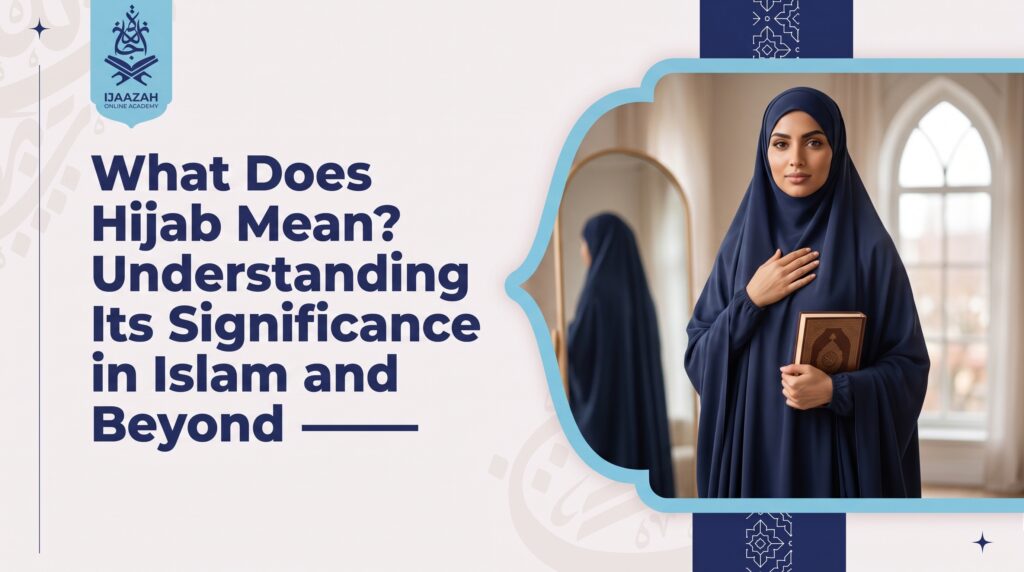
Hijab is an Arabic word commonly used to refer to a Muslim woman’s head covering. More broadly, it is connected to modesty, privacy, and conduct in Islamic life. In everyday English, the word often refers to a scarf. In Muslim communities, the practice and terminology can vary by culture, family, and personal experience.
What the Quran says
In the Quran, modesty is not presented as a single item of clothing or a single gender’s responsibility. Quran 24:31 addresses believing women and includes instructions about modest dress and conduct. Quran 33:59 refers to outer garments in a particular social setting. These verses are central to Muslim discussions of hijab, yet detailed questions of application are studied through qualified scholarship.
A helpful introduction should therefore avoid reducing hijab to a stereotype or assuming that one person’s clothing tells you everything about her faith, background, or choices.
Hijab is more than a visual label
For many Muslim women, hijab is an act of worship and a visible expression of identity. Others may be learning about it, changing their practice, or experiencing family, workplace, safety, or social pressures. Respect means leaving room for that complexity rather than treating a woman as a spokesperson for all Muslims.
Common misconceptions
Hijab is not a nationality or a measure of someone’s entire character. Muslim women are diverse in how they understand and practise modesty. Respectful questions are possible, but personal questions should be asked with care and never as a demand for explanation.
The word is also sometimes used broadly to describe modesty. In a conversation, it is useful to ask what the person means rather than assuming the same definition is shared by everyone.
Learning in a safe setting
Online Islamic studies can give learners a structured place to ask foundational questions about Islam, worship, and modesty. Women who prefer learning with female tutors can ask for a female instructor and choose a format that supports privacy and comfort. For detailed religious rulings, learners should study with qualified teachers who can explain differences of opinion responsibly.
Frequently asked questions
Do all Muslim women wear hijab in the same way?
No. Styles, terminology, and personal circumstances differ widely.
Can a non-Muslim ask about hijab?
Yes, when the question is respectful, open-ended, and does not pressure someone to share personal details.
A respectful conclusion
Understanding hijab starts with accurate language and curiosity without assumptions. If you want to learn more, begin with foundational Islamic studies and listen to Muslim women describe their own experiences in their own words.
How to speak about hijab at school or work
Use ordinary professional language and avoid treating a colleague’s clothing as an invitation to a debate. If a practical issue arises, such as dress code, safety equipment, or religious accommodation, ask what support the person needs and apply the same respect you would offer anyone else.
For Muslims explaining hijab to friends or children, a short, personal answer is enough: it is connected to faith and modesty, and people practise it in different ways. You do not owe strangers a full account of your private life.
Ready to start?
Do not leave what does hijab mean as another article you read and forget. Visit Ijaazah’s Islamic Studies Courses page, choose the level that fits you, and book your free assessment today. You will get a clear starting point, a course recommendation, and a practical plan to begin with confidence.