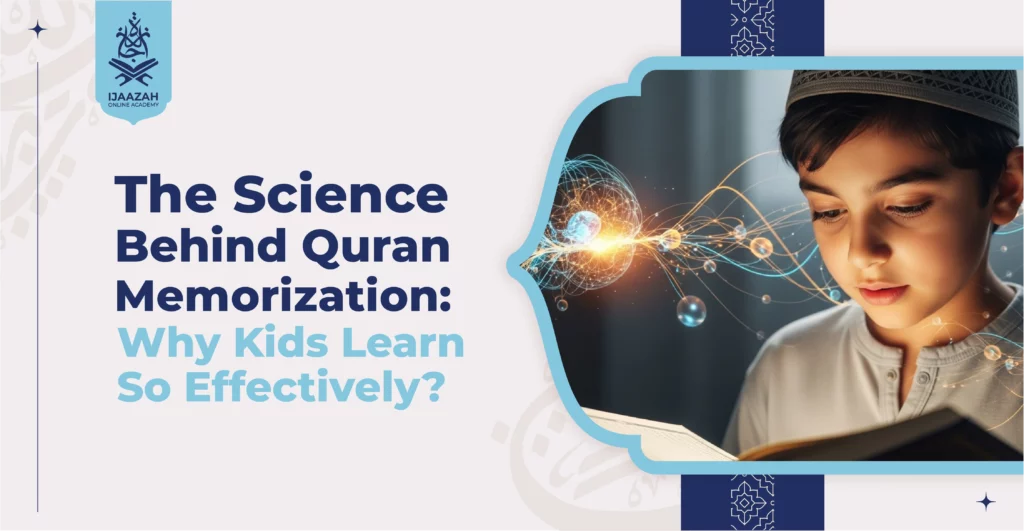
Every year, thousands of children around the world complete of entire Quran memorization for kids — a book of more than 6,000 verses — with remarkable precision.
To outsiders, this seems almost impossible. But to Muslim families and educators, this ability isn’t mysterious; it’s a combination of faith, habit, and the natural power of the developing mind.
Modern neuroscience now supports what generations of Qur’an teachers have witnessed for centuries: children have an extraordinary capacity for pattern recognition, auditory retention, and rhythmic memory. When guided with structure and sincerity, they can internalize the words of Allah faster and more accurately than most adults.
Ijazaah Academy harnesses this blend of science and sacred tradition to create Qur’an memorization programs that work — especially for young learners across the USA, Canada, and worldwide.
The Memory Advantage of a Young Mind
Children’s brains are wired for learning through repetition and sound.
According to cognitive research, the hippocampus — the part of the brain that forms memories — develops strong connections during early and middle childhood. This is when children retain languages, sounds, and patterns with little effort.
Why this helps in Qur’an memorization:
- The Qur’an’s structure includes rhythmic patterns and phonetic balance, which align naturally with how children absorb language.
- Repetition through recitation strengthens long-term recall.
- Early memorization improves overall working memory and focus.
In essence, when a child memorizes Qur’an, their brain is not only memorizing words — it’s training for lifelong cognitive discipline.
“My son started with Surah Al-Fātiḥah at age six. Within months, his focus and calm improved in everything — even school.”
— Amira, Ontario (Canada)
The Power of Sound and Rhythm in the Qur’an
The Qur’an was revealed to be heard and recited aloud, not read silently.
Every verse (ayah) has a rhythmic structure that activates both sides of the brain — logic (language processing) and emotion (musical rhythm and tone).
Children’s auditory memory thrives in this setting. When they listen and repeat after a teacher, their minds build strong neural patterns based on sound.
At Ijazaah Academy, recitation follows the classical tartīl method (“measured, rhythmic recitation”) commanded in the Qur’an itself:
“And recite the Qur’an with measured recitation.”
(Surah Al-Muzzammil, 73:4)
This balance of tone, pause, and flow enhances both retention and comprehension. It transforms memorization from mechanical repetition into a spiritual and cognitive exercise.
Repetition: The Brain’s Most Reliable Learning Tool
Modern cognitive psychology confirms that spaced repetition — reviewing material at gradually increasing intervals — is one of the most powerful ways to lock information into long-term memory.
Ijazaah Academy’s ḥifẓ (memorization) system uses the same principle.
Each lesson includes:
- New memorization (ḥifẓ jadīd): a small, fresh section.
- Recent review (murāja‘ah qarīb): revision from the past few days.
- Deep review (murāja‘ah ba‘īd): revisiting earlier sūrahs to prevent loss.
This scientific balance keeps the student’s memory active and layered — ensuring that verses remain firm over years, not weeks.
“At first, I worried my daughter would forget what she memorized. But the review plan made it stick naturally.”
— Mona, New Jersey (USA)
Emotional Safety Boosts Cognitive Performance
Children learn best in safe, encouraging environments. Stress and pressure trigger cortisol — a hormone that blocks memory retention. That’s why forcing memorization rarely works long term.
Ijazaah Academy’s teachers focus on positive reinforcement, patience, and gentle correction. Classes are small, structured, and calm — no yelling, no shaming.
The Prophet Muhammad ﷺ modeled this teaching style:
“Make things easy and do not make them difficult; give glad tidings and do not cause people to turn away.” (Sahih al-Bukhari)
By aligning emotional comfort with disciplined practice, children stay motivated and associate the Qur’an with joy, not anxiety.
Routine Creates Neurological Pathways
Neuroscience shows that habit formation solidifies memory.
When the brain recognizes a pattern of repetition (same time, same activity), it automatically reinforces neural connections that make recall smoother and faster.
That’s why Qur’an teachers emphasize routine — a consistent time and place for study.
At Ijazaah Academy, even online students follow a rhythm:
- 4 short sessions per week (20–25 minutes each).
- Same teacher, same digital classroom.
- Daily home practice of 10–15 minutes with parents or siblings.
Consistency is the real miracle ingredient. Over time, it creates a lifelong bond between the student and the Qur’an.
Parental Involvement Strengthens Retention
Children learn faster when they see their parents value what they’re learning.
Parental encouragement triggers dopamine release in children — the “motivation hormone” — which improves focus and memory.
Ijazaah Academy integrates parents into the process by providing:
- Weekly progress summaries.
- Listening assignments for parents to review at home.
- Access to live recordings for family listening.
This makes Qur’an memorization a shared spiritual routine, not just a child’s responsibility.
“I listened to my kids recite every evening. It became the most peaceful part of our day.”
— Yusuf, Dallas (USA)
Visual and Auditory Dual Encoding
Research in educational psychology shows that when students use two senses (seeing and hearing) to learn, retention doubles.
Ijazaah Academy incorporates visual and auditory learning simultaneously:
- Students recite while following the Arabic text on screen.
Teachers use highlighting tools to show makhārij (articulation points). - Audio recordings of correct recitation are shared for home review.
This approach activates the dual-coding system in the brain — meaning the same verse is stored both as a sound and as an image, creating stronger recall over time.
Sleep and Memory Consolidation
It’s no coincidence that children who memorize Qur’an early also sleep better and exhibit sharper attention. Sleep is where the brain “replays” new information and locks it into long-term storage.
Ijazaah Academy advises evening revision or early-morning sessions (before Fajr or after school), followed by calm rest.
This mirrors the Prophet’s ﷺ practice of early worship and reflection, optimizing both spirituality and neuroscience.
“Those peaceful morning sessions helped my son remember Surah Rahman faster than any other time of day.”
— Fatima, London (UK)
Faith and Intention: The Inner Dimension of Memorization
Science explains how children memorize effectively; faith explains why it transforms them.
When memorization is done with intention (niyyah) — to draw closer to Allah — it transcends memory mechanics and becomes a spiritual imprint.
Children at Ijazaah Academy are taught to begin each lesson with a short du‘ā’:
“O Allah, make the Qur’an the spring of our hearts and the light of our chests.”
This spiritual orientation strengthens emotional connection, which neuroscience calls “affective reinforcement” — learning anchored by emotion and meaning lasts the longest.
The Lifelong Impact: More Than Memory
Memorizing the Qur’an as a child is not only about recall — it shapes identity, focus, and faith. Studies have shown that children who memorize the Qur’an demonstrate:
- Higher attention spans and auditory discrimination.
- Improved emotional regulation and patience.
- A sense of moral purpose and belonging.
- Greater empathy and humility in social interactions.
At Ijazaah Academy, teachers emphasize adab (character) alongside ḥifẓ (memorization), ensuring that knowledge nurtures humility, not pride.
“My son’s teacher reminded him, ‘We memorize not to show, but to grow.’ That one line changed everything.”
— Haneen, Chicago (USA)
The Ijazaah Academy Model: Faith Meets Neuroscience
What makes Ijazaah’s Qur’an memorization programs stand out is the synthesis of traditional scholarship and modern learning science.
Program Highlights:
- Certified Qur’an teachers with verified ijāzah.
- Child-centered online classrooms (small, respectful, interactive).
- Progress tracking with customized revision plans.
- Separate programs for boys, girls, and families.
- North America–friendly schedules and global accessibility.
Learning Methodology:
- Repetition cycles based on spaced review science.
- Multi-sensory teaching (auditory + visual).
- Emotional safety and encouragement.
- Gradual, personalized pace for every learner.
Practical Tips for Parents Supporting a Young Ḥāfiẓ
- Set a Routine: Same time daily, even if short.
- Be Patient: Never rush or compare progress.
- Review Together: Listen attentively — your attention is motivation.
- Celebrate Milestones: A new surah deserves recognition.
- Stay Consistent During Breaks: 5–10 minutes daily keeps memory fresh.
- Focus on Meaning: Occasionally explain what the verse means.
Memorization as a Gift and a Responsibility
The Qur’an itself says:
“And We have certainly made the Qur’an easy to remember. So is there anyone who will remember?”
(Surah Al-Qamar, 54:17)
Children are naturally tuned to answer that call — their hearts open, their minds flexible, and their spirits pure.
Through programs like those at Ijazaah Academy, that natural potential becomes guided excellence — rooted in both divine revelation and modern understanding.
The science behind Qur’an memorization only confirms what believers have always known:
When learning begins with sincerity and love, Allah opens the mind and softens the heart.
Start Your Child’s Qur’an Journey Today
Explore Courses
Meet Our Certified Teachers
Ijazaah Academy — Where Knowledge Meets Faith, and Young Minds Memorize with Heart.