A child who reads Surah Al-Fatiha smoothly, without stumbling over a single letter, did not arrive there by accident. Somewhere behind that fluency sits a small, unassuming booklet most Muslim households have seen but few outside the Arabic-teaching tradition fully understand. That booklet is the Noorani Qaida, and its influence on a student’s entire relationship with the Quran is far larger than its size suggests.
What Noorani Qaida Actually Is , And Why It Predates Full Quran Study
Noorani Qaida is a primer, traditionally attributed to the scholar Noor Muhammad Haqqani, designed to teach the Arabic alphabet, letter forms, vowel markings, and joining rules before a student ever opens a Mushaf for continuous reading. It functions as a bridge: on one side sits a learner who may not recognize a single Arabic letter, and on the other sits a reader capable of navigating the Quran’s script with confidence. Between those two points, Noorani Qaida sequences lessons carefully , isolated letters first, then letters in combination, then short vowels, then elongations, then the more nuanced rules governing noon sakinah, meem sakinah, and qalqalah.
Students frequently ask how this differs from simply memorizing the alphabet from a chart. The answer lies in structure. A chart teaches recognition. Noorani Qaida teaches recognition and correct articulation simultaneously, which is precisely why traditional institutions have refused to abandon it in favor of shortcuts.
Why Is Noorani Qaida Important for Long-Term Quranic Literacy
Ask any Azhari-trained tutor why is Noorani Qaida important, and the answer rarely changes: it is the single text that determines whether a student reads the Quran independently for the rest of their life, or remains dependent on audio recitation and memorized sound-alikes. Skipping it, or rushing through it, tends to produce readers who guess at unfamiliar words rather than sound them out , a habit that becomes difficult to correct in adulthood.
Three specific outcomes explain its weight in the curriculum:
- Fluency groundwork , the booklet drills letter recognition until it becomes automatic, so that by the time a student reaches full Surahs, decoding no longer competes with comprehension for mental bandwidth.
- Pronunciation accuracy improves early, because Noorani Qaida embeds foundational Tajweed rules , makhraj (articulation points), sifaat (letter characteristics), and basic madd rules , directly into the reading practice rather than teaching them as a separate, later subject.
- Learners across very different starting points, whether a five-year-old raised in an Arabic-speaking home or a forty-year-old revert with no prior exposure to the script, can be met at their actual level, since the booklet’s pacing adapts to repetition rather than age.
Pronunciation deserves particular attention here. Many self-taught adult readers can recognize words visually yet mispronounce letters like ض, ظ, or ق for years without correction, simply because no one drilled the articulation point early. Noorani Qaida, taught properly with a qualified tutor listening in real time, catches these errors before they calcify.
How the Booklet Prepares a Learner to Actually Understand the Quran
Reading accurately is not the same as understanding, but it is the precondition for it. A student who mispronounces vowel length can accidentally change a word’s meaning entirely , the difference between a short and long vowel in Arabic is not cosmetic. Noorani Qaida trains the eye and tongue to register these distinctions instinctively, so that later Tafsir study, translation work, and memorization all rest on an accurate reading rather than an approximate one. Parents sometimes underestimate this step, assuming that meaning-focused study can begin immediately. Experienced tutors know otherwise: comprehension without accurate recitation produces a shaky foundation that eventually needs to be rebuilt.
The Right Age, and Why Family Involvement Changes the Outcome
Most instructors recommend beginning Noorani Qaida between ages four and six, once a child can sit for short, focused sessions and recognize basic shapes. That said, age is a guideline, not a gate , older children and adults benefit equally, provided the pacing matches their attention span and prior exposure to Arabic script. Younger learners typically need shorter, more repetitive sessions with visual aids, while adult beginners often progress faster through pure letter recognition but need extra patience with pronunciation muscle memory.
Resources for teaching children specifically have expanded considerably: illustrated Qaida editions, letter-tracing worksheets, and short audio drills now accompany most modern curricula. None of these replace a tutor’s ear, but they reinforce lessons between sessions. Family involvement matters more than most parents expect. A child who practices letter sounds with a parent for ten minutes daily, even without any Arabic background on the parent’s part, retains material noticeably faster than one who only engages during scheduled lessons. Siblings reviewing together, a parent listening to recitation homework, or simply keeping the Qaida visible at home all reinforce what the tutor builds.
Learning Noorani Qaida Online , What Actually Changes for Western Muslim Families
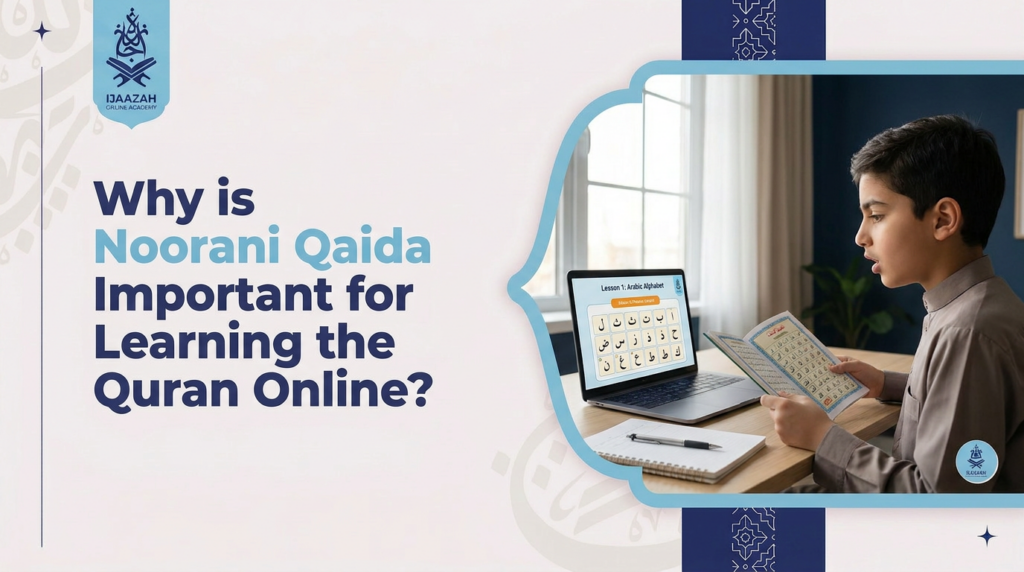
Families outside Muslim-majority countries face a specific set of constraints: limited access to qualified teachers nearby, inconsistent availability of quality print materials, and school or work schedules that leave little room for in-person commuting to a mosque class. Online instruction addresses each of these directly. A student in Toronto or Melbourne can now access the same Azhari-certified tutor a student in Cairo might reach, without either party leaving home.
Several practical benefits follow from that shift:
- Scheduling flexibility means a working parent or a student juggling exams can book sessions around existing commitments rather than reshaping their week around a fixed class time.
- Time zone coordination, handled properly by a platform with tutors across regions, allows a family in California to find a session slot that doesn’t require a 5 a.m. wake-up call.
- Female tutors are far easier to source online for mothers and daughters who prefer a woman instructor for reasons of comfort or religious preference , a need that smaller local communities often cannot meet.
- One-on-one attention through video call replaces the crowded weekend class where a single teacher manages fifteen children and can rarely correct individual pronunciation errors in real time.
Two overlooked practicalities deserve mention here as well. First, reliable internet access and basic technical support are not incidental details , a session that drops repeatedly undoes the concentration a young learner needs, so platforms with responsive technical help genuinely affect learning outcomes. Second, cultural background and learning pace vary enormously among Western Muslim families; a convert with no Arabic exposure and a second-generation immigrant child raised hearing Quran recitation at home need different pacing entirely, and a rigid one-size curriculum serves neither well.
Bridging Two Worlds , Noorani Qaida’s Role in Western Muslim Identity
For many families raising children between two cultural contexts, Noorani Qaida becomes more than a literacy tool. It represents a deliberate, structured link back to religious identity in environments where that identity is not reinforced by the surrounding culture. Online classes, somewhat unexpectedly, have also become small community spaces , recurring sessions with the same tutor, occasional group classes with peers in similar cities, and shared homework routines all create a sense of belonging that a purely local option might not offer to an isolated family.
Bringing the Foundation Home
Every fluent Quran reader once sat with this same small booklet, working through letters one at a time. Its importance is not sentimental , it is structural, shaping pronunciation habits, reading confidence, and comprehension for everything that follows. Families weighing where to start that journey now have an option unavailable a generation ago: qualified, Azhari-certified guidance delivered directly into the home, paced to the learner rather than the classroom.
Sadaqah Jariyah Share Knowledge that helps someone read the Quran correctly carries reward that outlives the moment it’s shared. If this article clarified something for you, consider sending it to a parent, a new Muslim, or anyone weighing where to begin , a single share can plant the seed for someone else’s lifelong reading habit.
The 5-Minute Challenge Open any page of a Noorani Qaida or Quran app right now and identify five letters you sometimes confuse (common pairs: ض/ظ, ح/خ, س/ص). Say each one aloud slowly, focusing on where your tongue touches. That’s the exact habit a tutor drills from lesson one.
Ready to see how a real tutor session works? Book a Free Trial. Not sure where you or your child currently stand? Take the Test Me (Assessment).