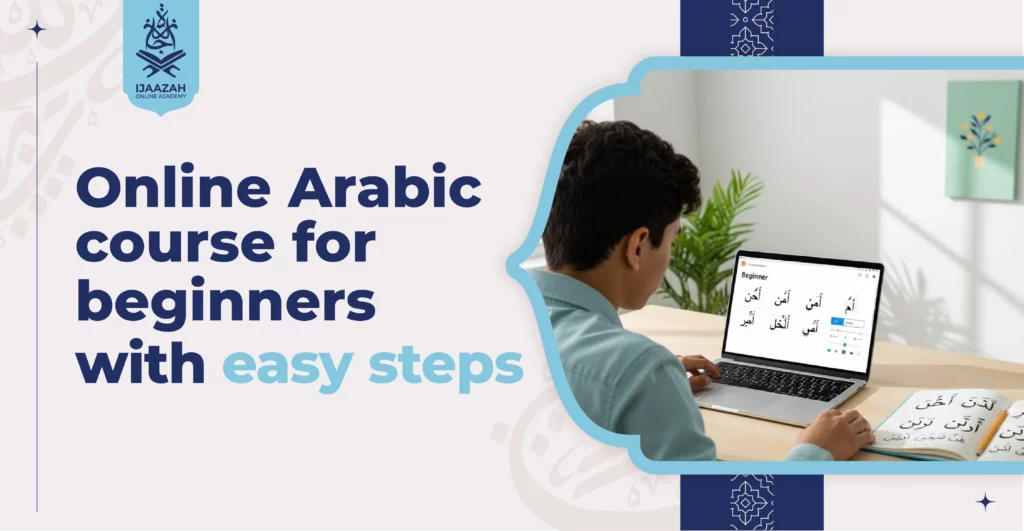
We have all stood there holding the Mushaf and looking at the script with a mix of love and frustration. You trace the beautiful curves of the letters with your eyes and wish you could understand just one sentence without looking at the translation. You feel a deep desire to connect with the words of Allah in their original form, but the language feels like a mountain you cannot climb. This feeling is completely normal, but it does not have to be permanent. Finding a structured online Arabic course for beginners is the bridge that takes you from staring at the pages in confusion to reading them with confidence and understanding.
The Myth of “Arabic is Too Hard”
There is a common misconception that spreads among non-Arab Muslims. People often say that Arabic is the most difficult language in the world and that unless you learned it as a child, you will never truly master it. This idea is discouraging and, quite frankly, it is incorrect.
Arabic is not difficult. It is simply different. It is a language built on logic and mathematical patterns. Unlike English, which is full of exceptions and irregular spellings that make no sense, Arabic follows a strict set of rules. Once you understand the formula, the language unlocks itself before your eyes. The struggle most beginners face is not because the language is impossible. It is because they are using the wrong method. They try to memorize random words or complex grammar rules before they have even mastered the sounds of the alphabet.
Allah Himself gives us the ultimate reassurance in the Quran when He says:
“And We have certainly made the Qur’an easy for remembrance, so is there any who will remember?” — [Surah Al-Qamar, 54:17] (Source: Quran.com)
This is a divine promise. The Creator of the language and the Creator of your mind has guaranteed that the path is easy for those who sincerely seek it. If the journey feels impossibly hard, it is likely that the teaching method is the problem, not your ability to learn.
Step 1: Mastering the Sounds, Not Just the Names
The first step in any successful learning journey is to stop treating Arabic letters like English letters. In English, the letter is called “C” but it sounds like “K” in “Cat” or “S” in “Circle.” This confusion does not happen in Arabic.
In our course at Ijaazah, we focus on phonics. We teach you the sound of the letter immediately. We focus on where the sound comes from in your throat or mouth. This is called Makharij. Many beginners skip this. They rush to read words while still mispronouncing basic letters. They pronounce “Ha” (from the chest) and “Ha” (from the throat) exactly the same. This is dangerous because it changes the meaning of the words entirely. Taking the time to perfect these sounds at the very beginning saves you years of unlearning mistakes later on.
Step 2: The Art of Connection
Once you know the sounds, the next step is understanding how they fit together. Arabic is a cursive language. This means the letters hold hands. A letter looks one way when it stands alone, but it changes its shape slightly when it is at the beginning, middle, or end of a word.
This scares many students, but it is actually very simple. Think of it like a string of beads. The core shape of the bead remains the same, but it has a string extending from it to connect to the next one. We teach this through pattern recognition. After just a few sessions, your eye stops seeing individual terrifying shapes and starts seeing fluid, connected words. You begin to read syllables instead of stumbling over letters.
Step 3: The Vowels are the Music
You might have noticed that Arabic text often has small dashes and symbols floating above or below the letters. These are called Harakat or Tashkeel. They are the short vowels.
Without these vowels, the letters are just silent consonants. The vowels give the letters their voice and movement. A simple line above a letter (Fatha) opens your mouth. A line below (Kasra) makes you smile. A small loop (Damma) makes you round your lips.
Understanding these symbols is the turning point for most beginners. It is the moment where the “code” suddenly turns into speech. You realize that you don’t have to guess how a word sounds. The instructions are right there on the page, telling you exactly how to move your mouth.
Step 4: The Magic of Root Words
This is where Arabic reveals its genius. Most words in the Arabic language come from a three-letter root.
Let’s look at the root K-T-B. This root carries the meaning of “writing.” From these three letters, we get:
- Kitab: Book.
- Katib: Writer.
- Maktab: Office or Desk.
- Maktub: Written (or destiny).
Do you see the pattern? You don’t have to memorize thousands of random words like you do in other languages. You only need to learn a few hundred “Roots.” Once you know the root, you can guess the meaning of dozens of other words derived from it. This system makes vocabulary acquisition incredibly fast for adults who use their logic.
Why Self-Study Apps Are Not Enough
We live in a digital age where you can download an app and learn a language in five minutes a day. While these apps are fun, they have a major flaw when it comes to Arabic. They cannot hear you.
You might think you are pronouncing the letter Qaf correctly, but to a native speaker, you might be saying Kaf. The difference between these two sounds changes the meaning of the Quran. An app will give you a gold star and let you move to the next level, cementing your mistake forever.
You need a human ear. You need a teacher who can stop you gently and say, “No, raise your tongue a little higher.” This feedback loop is essential. The Prophet Muhammad (ﷺ) taught the Quran orally. He recited, and the Companions repeated. He corrected them until they got it right. This is the tradition of Talaqqi (receiving knowledge directly), and it is the only way to truly master the recitation.
The Reward of the Struggle
It is important to remember why you are doing this. You are not learning Arabic to put it on your CV or to impress your friends. You are learning it to hear Allah’s words as they were revealed.
The journey will have moments of frustration. You will forget a rule. You will stutter. But in Islam, the struggle itself is an act of worship.
The Prophet Muhammad (ﷺ) gave glad tidings to those who find it hard, saying:
“The one who is proficient in the recitation of the Qur’an will be with the honourable and obedient scribes (angels) and he who recites the Qur’an and finds it difficult to recite, doing his best to recite it in the best way possible, will have two rewards.” — [Riyad as-Salihin, Book 9, Hadith 994] (Source: Sunnah.com)
He promised two rewards. One for the reading, and one specifically for the difficulty you are facing. Your stumbling is not a failure. It is a double blessing.
Start Your Journey with Clarity
At Ijaazah, we understand the fear of the beginner. We know what it feels like to look at a page of text and feel overwhelmed. That is why our curriculum is broken down into these small, digestible steps. We do not rush you. We do not use complex linguistic terminology that confuses you. We simply take your hand and walk you through the logic of the language, one letter at a time.
You have been thinking about this for a long time. You have promised yourself year after year that you would learn. Let this be the moment you turn that intention into action.
We invite you to book a Free Trial Session today. Come and meet one of our teachers. See for yourself how we simplify the complex. By the end of the first session, you could be reading your first word and feeling the immense joy of unlocking the key to your religion.