At some point, every Muslim faces a decision whose weight exceeds their own wisdom. A marriage proposal. A job relocation. A major financial commitment. A path that looks right from three angles and wrong from two.
Islamic theology doesn’t leave that uncertainty unaddressed. It provides a prayer for exactly that moment.
Istikhara — from the Arabic khayr, meaning goodness or what is best — is a two-rak’ah prayer performed with the intention of seeking divine guidance on a specific matter. It isn’t a request for a dream or an omen. It’s a formal act of submitting the decision to the One who knows the unseen and the seen, the present and the future, and the consequences that human calculation cannot reach.
The Prophet ﷺ did not teach Istikhara as an occasional practice. His companion Jabir ibn Abdullah reported: “The Messenger of Allah ﷺ used to teach us the Istikhara for all matters, as he would teach us a surah from the Quran.” (Sahih Bukhari 6841)
The comparison is deliberate. Istikhara wasn’t meant to be reserved for once-in-a-decade crises. It was meant to be as familiar as Quranic recitation — woven into the fabric of daily decision-making at every scale.
What Istikhara Is Not
A widespread misconception frames Istikhara as a mechanism for receiving a definitive sign — typically in the form of a dream — that tells you exactly which option to take. This framing misunderstands the prayer’s function entirely.
Istikhara doesn’t bypass human deliberation. The Prophet ﷺ was equally known for emphasizing shura (consultation) and tawakkul (genuine reliance on Allah after human effort). The proper sequence isn’t: feel paralyzed, make Istikhara, wait for a dream. The correct approach is: deliberate carefully, consult those with relevant knowledge and experience, reach a considered decision — and then make Istikhara before committing.
The prayer doesn’t deliver revelation. It reorients the decision-maker toward Allah’s will — inviting divine facilitation toward what is truly good and divine obstruction away from what is harmful, even when harm isn’t visible to the one seeking guidance.
How to Perform Istikhara
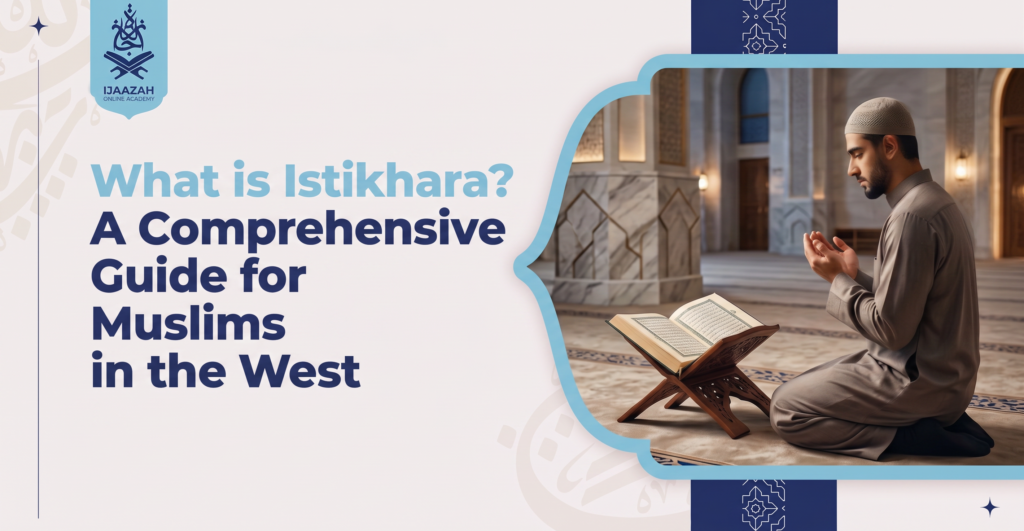
Istikhara prayer consists of two rak’ahs — preferably voluntary rather than obligatory — performed with the intention of seeking guidance on a specific matter. There is no specific surah required beyond Al-Fatiha in each rak’ah. The prayer is performed as any other two-rak’ah voluntary prayer.
After completing the prayer, the specific dua of Istikhara is made. Some scholars place the dua before the final salam; others after — both positions have scholarly support.
The Dua of Istikhara — Text and Meaning
The complete text, as recorded in Sahih Bukhari 6841:
“O Allah, I seek Your guidance by virtue of Your knowledge, and I seek ability by virtue of Your power, and I ask You of Your great bounty. You have power and I have none. You know and I know not. You are the Knower of hidden things. O Allah, if in Your knowledge this matter — [and here you name the specific matter] — is good for me in my religion, my livelihood, and my affairs in this world and the next, then ordain it for me, make it easy for me, and bless it for me. And if in Your knowledge it is bad for me and for my religion, my livelihood, and my affairs in this world and the next, then turn it away from me and turn me away from it, and ordain for me the good wherever it may be, and make me content with it.”
Every phrase carries weight. The acknowledgment that Allah knows what we do not — wa anta ‘allam al-ghuyub — is itself an act of Aqeedah embedded in the supplication, reminding the supplicant that the boundaries of human perception are not the boundaries of divine knowledge.
Common Misconceptions in Western Muslim Practice
Several misunderstandings about Istikhara circulate regularly within Western Muslim communities:
- The expectation of a specific dream or vivid sign after Istikhara has no consistent basis in the classical texts — what changes after sincere Istikhara is often the ease or difficulty that accompanies each option in the days that follow, not a dramatic experience during the prayer itself.
- Istikhara is for all matters — not only major life decisions. The hadith states this explicitly. The habit of turning to Allah before committing to significant choices, however routine, is the prophetic standard.
- Repeating Istikhara dozens of times while waiting for the “right feeling” is not the classical model. The prayer is made, a decision is reached with the best available information, and reliance is placed on Allah for the outcome.
Online Scholars and Female Guidance in Istikhara Questions
For women navigating Istikhara — particularly around marriage decisions — access to qualified female scholars offers a distinct and practical advantage. Cultural sensitivities around discussing marriage proposals with male scholars in community settings can create genuine barriers. Online platforms with trained female tutors provide guidance that is both religiously grounded and personally comfortable — addressing the full fiqh of Istikhara and its application to specific situations that require discretion.
Know someone facing a major decision and unsure how to approach it Islamically? Share this article — teaching Istikhara is a form of Sadaqah Jariyah that could change the course of someone’s life.
5-Minute Challenge: Memorize the Istikhara dua today — or at minimum in your native language — so that the next time you face a significant decision, you can perform Istikhara with full understanding of what you’re asking of Allah.
For structured Islamic education with certified tutors, Book a Free Trial Lesson or Test Your Current Level.