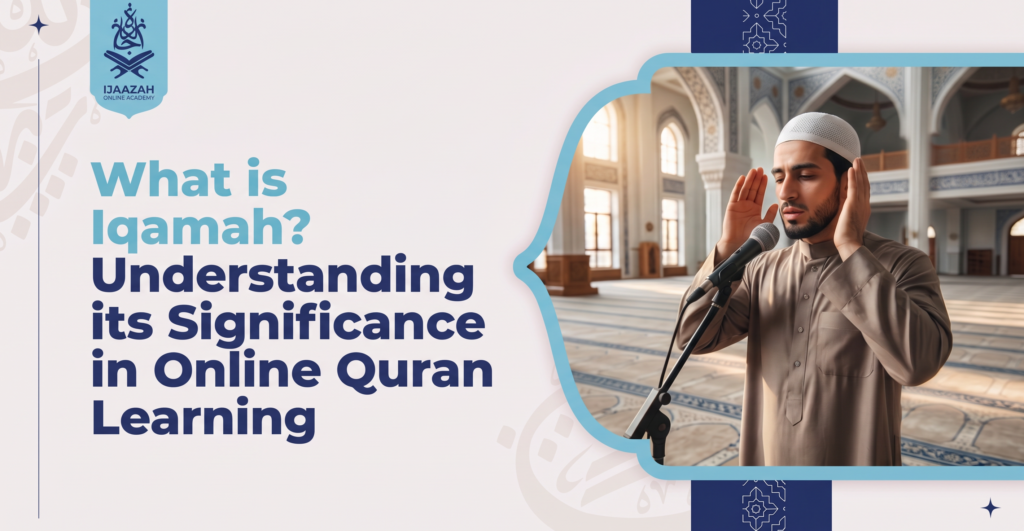
The Adhan travels outward — across rooftops, down streets, into homes and offices — summoning the Muslim community to prayer. The Iqamah travels inward.
Where the Adhan is an announcement to the world, the Iqamah is a declaration to those already gathered. It marks the transition from waiting to standing — from preparation to presence. The moment the Iqamah is pronounced, the congregation rises to form rows, the world is left behind, and the prayer begins.
Understanding what Iqamah is, what it says, and why it matters gives Muslims — particularly those learning Salah for the first time — a fuller picture of the ritual architecture that frames Islamic prayer.
Adhan vs. Iqamah — Two Calls with Different Audiences
The Adhan and Iqamah share much of their wording but serve entirely different purposes.
The Adhan calls Muslims from wherever they are to the mosque or prayer space. It announces the time of prayer and extends a public invitation, traditionally recited from a minaret with deliberate pauses between each phrase to allow the call to carry across the surrounding area.
The Iqamah — also called the second adhan — is recited inside the mosque or prayer space, directly before the prayer begins. It’s addressed specifically to those already present and serves as the final cue that the imam is about to begin leading the congregation. The Iqamah is recited at a quicker pace than the Adhan, with phrases following each other in rapid succession — an intentional contrast that signals the shift from anticipation to action.
The Words of the Iqamah
The Iqamah consists of the following phrases — with the exact number of repetitions varying between the major Islamic schools of jurisprudence:
- Allahu Akbar, Allahu Akbar — Allah is Greatest, Allah is Greatest
- Ash-hadu an la ilaha illa Allah — I bear witness that there is no deity except Allah
- Ash-hadu anna Muhammadan Rasulullah — I bear witness that Muhammad is the Messenger of Allah
- Hayya ‘ala-s-Salah — Come to prayer
- Hayya ‘ala-l-Falah — Come to success
- Qad qamat-is-Salah, Qad qamat-is-Salah — The prayer has been established, the prayer has been established
- Allahu Akbar, Allahu Akbar — Allah is Greatest, Allah is Greatest
- La ilaha illa Allah — There is no deity except Allah
The phrase Qad qamat-is-Salah — the prayer has been established — is the defining addition of the Iqamah over the Adhan. It functions as the formal announcement that the congregation is in its rows and the imam is ready to begin.
Differences Between Schools of Jurisprudence
The Hanafi school follows a version of Iqamah that mirrors the Adhan in its repetitions — most phrases doubled, with Qad qamat-is-Salah repeated twice. The Maliki, Shafi’i, and Hanbali schools follow a shorter Iqamah in which most phrases are said once rather than twice.
Both positions are supported by authentic narrations from the companions of the Prophet ﷺ. The variation reflects the breadth of authentic prophetic practice, not theological disagreement about the Iqamah’s validity or importance — a point worth noting for Muslims who encounter different Iqamah forms in different mosques and wonder whether one tradition is more correct than the other.
The Listener’s Response to the Iqamah
When the Iqamah is pronounced, the listener responds by repeating each phrase — with the exception of Hayya ‘ala-s-Salah and Hayya ‘ala-l-Falah, to which the response is La hawla wa la quwwata illa billah (There is no power or might except with Allah), and Qad qamat-is-Salah, to which the response is Aqamaha Allahu wa adamaha (May Allah establish it and make it continuous).
This practice of response — parallel to the practice during the Adhan — turns even listening to the Iqamah into an active act of worship.
Iqamah in the Context of Online Salah Education
For Muslims learning Salah through online platforms — whether adult converts, children being taught prayer for the first time, or Muslims who grew up without formal religious instruction — the Iqamah is often an overlooked detail.
A thorough Salah education covers not just the mechanics of prayer (postures, recitation, conditions, invalidators) but the complete context of prayer — including what precedes it. Understanding the Iqamah, its words, its distinction from the Adhan, and the proper listener’s responses forms part of a complete Islamic education at any level.
Teaching Children the Iqamah — Why the Detail Matters
Children who grow up hearing and understanding the Iqamah — rather than simply seeing the adults around them rise at a sound they don’t fully recognize — build a relationship with Salah grounded in understanding rather than mimicry alone.
A teacher who explains to a young child that Qad qamat-is-Salah means “the prayer has been established, now it’s time to stand” gives that child a conscious connection to the ritual. The Iqamah stops being background noise and becomes a deliberate call they recognize and respond to.
For families where parents are still deepening their own knowledge, access to qualified online tutors who specialize in teaching both children and adults ensures the family builds a shared Islamic foundation — not one where the parents’ gaps become the children’s gaps.
Know a new Muslim or a young person just starting to learn Salah? Share this article — teaching someone the details of prayer is one of the most impactful forms of Sadaqah Jariyah.
5-Minute Challenge: Recite the complete Iqamah aloud from memory — including Qad qamat-is-Salah — and practice reciting it at the pace of a real Iqamah, faster than the Adhan. If you stumble on any phrase, you’ve found exactly what to practice today.
To learn Salah completely — including the Iqamah, its conditions, and its deeper significance — Book a Free Trial Lesson with a certified tutor or Test Your Current Level.