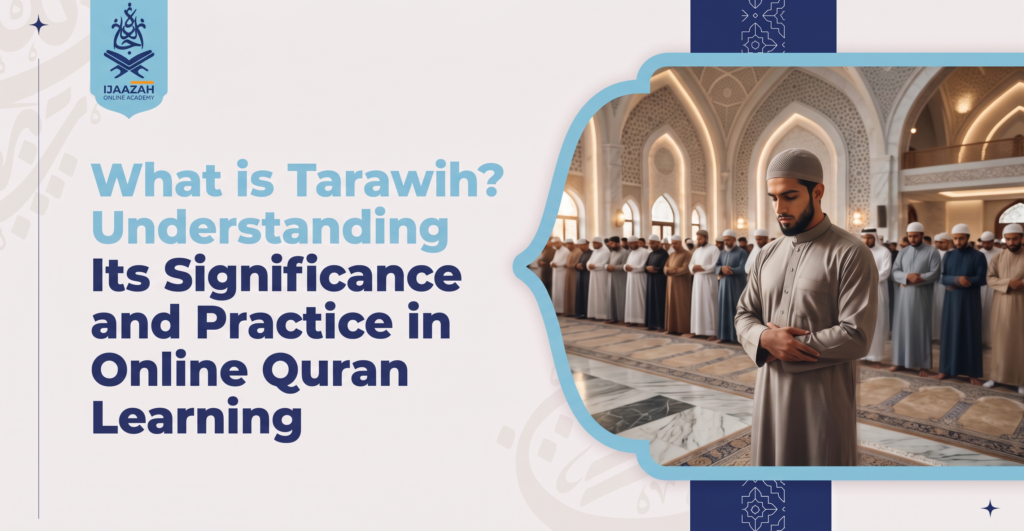
There is a particular stillness in a mosque at 10pm in Ramadan — a quality of attention that the other eleven months of the year rarely produce. The congregation is standing. The imam is reciting. The words of the Quran are moving through the air in a way that feels different from the other five daily prayers — longer, slower, more deliberate.
This is Tarawih (تَرَاوِيح), and for Muslims who experience it with full awareness of what it is and why it matters, it becomes one of the defining spiritual experiences of the year. For those who attend out of habit without that awareness, it can become twenty or thirty minutes of standing that feels long but unclear in purpose.
The difference between those two experiences is largely a matter of understanding — and intention.
The Definition and its Origin
Tarawih refers to the voluntary night prayer performed in congregation during the nights of Ramadan, after the obligatory Isha prayer. The word comes from the Arabic root ر-و-ح, related to rest and ease — specifically the brief rests (tarwiha) taken between every four Rak’ahs. Those pauses gave the prayer its name.
The Prophet ﷺ established Tarawih through direct practice. Abu Hurairah RA narrated:
“The Messenger of Allah ﷺ encouraged the standing of Ramadan without making it obligatory. He said: ‘Whoever stands in prayer in Ramadan out of faith and seeking reward, his previous sins will be forgiven.'” — (Bukhari and Muslim)
The word “encouraged” matters here. Tarawih is a confirmed Sunnah (Sunnah mu’akkadah) — something the Prophet ﷺ practiced and praised without making it obligatory. Missing it does not incur sin the way missing an obligatory prayer does; performing it consistently through Ramadan carries the specific reward named in the hadith: forgiveness of previous sins.
The Prophet ﷺ prayed Tarawih in congregation for several nights, then withdrew to pray it individually out of concern that it would become obligatory on the community. It was Umar ibn al-Khattab RA who, during his Caliphate, re-established congregational Tarawih as a community practice — finding people praying individually in scattered groups in the mosque, he unified them under one imam, saying: “This is a good innovation.” Scholars have consistently understood this as a restoration of the original Sunnah in an organized form, not a new invention.
The Number of Rak’ahs — What the Evidence Shows
This is one of the more frequently asked Fiqh questions about Tarawih, and it deserves a clear answer rather than a defensive one. The narrations do not specify a fixed number of Rak’ahs for Tarawih. The Prophet ﷺ’s own night prayer (Qiyam al-Layl) is reported in various narrations as eight, eleven, or thirteen Rak’ahs — with different scholars understanding these narrations differently.
The practice established under Umar RA and subsequently followed by the early Muslim community — including the companions who lived in Madinah — settled on twenty Rak’ahs in the majority of classical scholarly tradition. Most mosques around the world, including the Two Holy Mosques in Makkah and Madinah, follow twenty Rak’ahs.
A minority scholarly position, based on narrations about the Prophet’s ﷺ own night prayer practice, holds that eleven Rak’ahs is the sounder number.
Both positions have legitimate scholarly grounding. A Muslim who prays eight, eleven, or twenty Rak’ahs is performing Tarawih. The more important question for most people is not the number — it is the quality.
What Makes Tarawih Spiritually Significant — The Connection to the Quran
Tarawih is the prayer in which the Quran is recited. Specifically, in the full congregational form practiced in mosques with a Hafiz leading, the imam recites the entire Quran across the thirty nights of Ramadan — one Juzz per night. The congregation stands and listens to the words of Allah ﷻ being recited from memory, completely, over the course of the month.
This tradition transforms Ramadan’s nights into a complete encounter with the Quran. A Muslim who attends Tarawih every night of Ramadan in a full-recitation mosque has heard the entire Quran recited once by the time Eid arrives. That experience — standing in prayer while the words of Allah move through the air — carries a spiritual weight that description does not fully capture.
The Prophet ﷺ said:
“Whoever stands in prayer during Ramadan out of faith and seeking reward, his previous sins will be forgiven.” — (Bukhari and Muslim)
“Out of faith and seeking reward” — that phrase is the condition that determines whether the promise applies. Physical presence alone is not what the hadith is describing. The spiritual state of attending Tarawih with awareness of what you are doing and why — that is the orientation the hadith names.
Tarawih at Home — The Valid Alternative
Congregational Tarawih at a mosque is the ideal. For many Muslims in Western countries, however — particularly women with young children, people in areas with no nearby mosque, those with physical limitations, or those working night shifts during Ramadan — home Tarawih is both valid and rewarding.
The Prophet ﷺ said: “A man’s prayer in his home is better than his prayer in the mosque, except for the obligatory prayers.” — this refers to voluntary prayers generally, affirming their validity at home.
For home Tarawih:
- The format is the same: two Rak’ahs at a time, with brief pauses between every four.
- Recitation can be from the Quran (reading from the Mushaf during Tarawih is permissible according to the majority of scholars, as it allows one to recite more and follow the text correctly).
- A family can pray together with one person leading — including a wife leading her children, or a husband leading the household.
- The reward named in the hadith — forgiveness of previous sins — is not restricted to congregation.
How to Prepare Your Recitation for Tarawih — The Practical Dimension
For the Muslim who leads family Tarawih at home, or who wants to follow the imam’s recitation with real comprehension, preparation matters. Attending twenty nights of Tarawih while the imam recites Surahs you have never heard is a very different experience from attending when you recognize the words, understand the meaning, and have reviewed the Tajweed of the passages being recited.
Practical Tarawih preparation in the weeks before Ramadan:
Review the Surahs you know. The short Surahs of Juzz Amma are recited in many home Tarawih sessions and are the foundation of accessible participation. Reviewing their Tajweed and refreshing their meaning before Ramadan makes each session more present.
Learn at least the meaning of Surah Al-Fatiha and the opening Surahs of the Quran in depth. Al-Fatiha is recited in every Rak’ah — knowing its meaning completely, not just its words, transforms the repetition.
If you plan to follow a full-Quran Tarawih at a mosque, reviewing the Juzz the imam will recite that week — even just reading the translation — means you arrive with context. The words land differently when you know what they are saying.
Tarawih for Women — Participation and Inclusion
Women’s participation in congregational Tarawih has full Sunnah precedent. The Prophet ﷺ permitted women to attend the mosque for all prayers, including night prayers, with the condition of observing proper Islamic dress and conduct. Many mosques in Western countries have established separate, well-organized women’s sections specifically for Tarawih.
For women who prefer to pray at home — for comfort, child care, or preference — home Tarawih is entirely valid and carries the same reward. A mother who prays Tarawih at home while her children sleep is fulfilling the Sunnah in a form the Prophet ﷺ himself practiced and praised.
For women seeking to study the Quran they are hearing in Tarawih — to understand the recitation, to improve their own, to learn the Tajweed rules the imam is applying — the combination of Ramadan motivation and structured learning is one of the most productive environments Islamic education produces.
Share the Spirit of Ramadan’s Nights
Know a Muslim who has been attending Tarawih for years without fully understanding what it is? Share this with them before Ramadan begins. Understanding what you are standing in changes how you stand in it — and that understanding is a gift worth passing on.
Your 5-Minute Practice: Before the next Tarawih session you attend or lead, read the translation of one Surah you will recite. Approach that Surah in prayer not as words you are producing, but as words you are saying to Allah ﷻ whose meaning you understand. Notice the difference in the quality of your presence.
Prepare Your Quran Recitation for Ramadan with a Certified Teacher:
Book a Free Trial Lesson at Ijaazah
FAQ
Q1: What is Tarawih prayer and when is it performed?
Tarawih is a voluntary night prayer performed in congregation during Ramadan, after the obligatory Isha prayer. It is a confirmed Sunnah (Sunnah mu’akkadah) established by the Prophet ﷺ, who said that whoever stands in Ramadan out of faith and seeking reward will have their previous sins forgiven (Bukhari and Muslim). It is performed in sets of two Rak’ahs throughout the month of Ramadan.
Q2: How many Rak’ahs is Tarawih?
There is scholarly difference on this question. The majority classical scholarly tradition holds twenty Rak’ahs, which is the practice of the Two Holy Mosques and most mosques worldwide. A minority scholarly position holds eleven Rak’ahs based on narrations about the Prophet’s ﷺ own night prayer practice. Both positions have legitimate grounding; a Muslim who performs eight, eleven, or twenty Rak’ahs is performing Tarawih validly.
Q3: Can women pray Tarawih at home?
Yes — home Tarawih is fully valid for women and carries the same reward as congregational Tarawih. The Prophet ﷺ affirmed that voluntary prayers at home are rewarded, and the forgiveness promised in the Tarawih hadith is not restricted to congregation. Women who pray Tarawih at home — alone or leading their household — are fulfilling the Sunnah in a form the Prophet ﷺ himself practiced and encouraged.
Q4: Is it required to complete the full Quran in Tarawih?
Completing the Quran in Tarawih (called Khatm al-Quran in Tarawih) is a widely practiced tradition but not a requirement. A shorter recitation in each Rak’ah is valid. The tradition of one Juzz per night across thirty nights is an organizational practice that emerged from the companions’ generation and has remained the standard in most mosques — but a mosque or individual who recites shorter passages performs Tarawih validly.
Q5: What are the best practices for performing Tarawih at home during Ramadan?
Pray in sets of two Rak’ahs with brief rest between every four. Recitation from the Mushaf (written Quran) is permissible according to the majority of scholars. Involve household members — spouse and children — for the communal experience. Review the Surahs you plan to recite and their meanings before Ramadan begins. Prioritize quality of presence over quantity of Rak’ahs — understanding what you are reciting produces the spiritual engagement the Tarawih hadith describes.