Quran recitation — the act of reading the Quran aloud with correct Arabic pronunciation and Tajweed — is arguably the most universal practice in Islam. Five times daily, every Muslim who prays recites verses of the Quran as part of their prayer. At births and deaths, in moments of joy and grief, at the beginning of every important undertaking, the Quran is recited. It is the heartbeat of Muslim spiritual life.
For Muslims in Western countries who are still developing their recitation skills — whether they are beginners who cannot yet read Arabic, intermediate learners who read haltingly, or advanced students seeking to perfect their Tajweed — online learning has transformed what is possible. This guide explores how to learn to recite the Quran online, what to look for in recitation-focused lessons, and how to navigate the unique considerations of Western Muslim learners.
Understanding the Levels of Quran Recitation
Quran recitation encompasses several distinct levels that correspond to different learning goals. Al-Tahqiq (verification) is the foundational level — slow, deliberate recitation that emphasizes correct pronunciation of every letter and application of every Tajweed rule. This is the level appropriate for students and for teachers demonstrating correct recitation. Al-Tarteel (measured recitation) is the primary level commended in the Quran itself (Surah Al-Muzzammil: “recite the Quran in slow, measured rhythmic tones”), representing recitation at a moderate pace with full Tajweed application. Al-Hadr (speed recitation) is used by advanced reciters and those reviewing memorized material at pace.
For most Western Muslim learners, the goal is competent Tarteel — recitation that is measured, accurate, and reflects genuine Tajweed application. Perfecting Tahqiq (slow, deliberate recitation) is the foundation upon which this builds. Online lessons for Western students should orient around this progression.
How Online Recitation Lessons Work
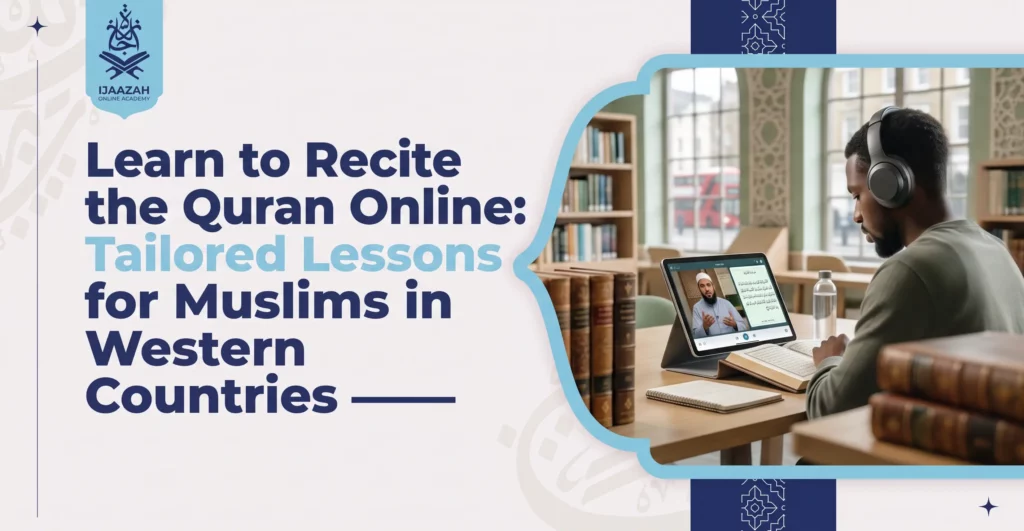
Online Quran recitation lessons typically follow a structured format across a 30-to-60-minute session. The lesson opens with warm-up recitation of previously learned material, allowing the teacher to assess retention and identify any degradation since the previous lesson. The teacher then introduces new material — typically one to three new verses or a focused review of a specific Tajweed rule — using the shared screen to display the Quran text and audio to model correct recitation.
The student recites the new material, and the teacher listens carefully, noting specific errors in pronunciation, rule application, or rhythm. Immediate feedback — identifying the exact word or letter where an error occurred, explaining the rule that governs it, and modeling the correct pronunciation — is the core pedagogical interaction of the lesson. The student repeats the corrected passage until the teacher is satisfied, and the process continues through the lesson’s material. Sessions end with a summary of new rules covered and homework for practice before the next session.
The Role of Female Teachers in Online Recitation Classes
For Muslim women in Western countries, the availability and quality of female Quran recitation teachers is a primary consideration in selecting an online learning program. Recitation lessons involve extended vocal interaction — the student recites aloud and the teacher listens closely, a deeply personal educational exchange — and many Muslim women are most comfortable conducting this interaction with a female teacher.
Qualified female Quran recitation teachers are certified through the same Ijazah system as their male counterparts, with formal chains of transmission authenticating their recitation credentials. The global pool of female teachers with strong English-language communication skills and experience teaching Western adult women has grown substantially over the past decade. When selecting a female recitation teacher, confirm that she holds an Ijazah specifically in recitation (not only in memorization) and has experience working with students at your current level.
Practical Strategies for Improving Recitation at Home
Online lessons provide the expert guidance and correction that self-study cannot replicate, but progress in recitation is largely made between lessons, through deliberate daily practice. The most effective home practice routine for recitation students involves three elements: listening, reading, and recording.
Listening to the same Quranic passages being studied, recited by a master reciter, builds the auditory model against which your own recitation is calibrated. Fifteen to twenty minutes of focused listening daily — not background listening but attentive listening while following the text — produces measurable improvements in pronunciation quality. Reading practice that applies specific rules being studied in lessons consolidates the motor patterns of correct recitation. Recording yourself reading a passage and playing it back immediately reveals errors that are invisible in the moment of recitation, providing the self-corrective feedback that accelerates improvement.
Time Zone and Scheduling Considerations for Western Recitation Students
The scheduling considerations specific to Western students attempting to learn Quran recitation online are worth addressing explicitly. The global pool of the most sought-after recitation teachers — those with formal Ijazah credentials and experience with Western students — is concentrated in the Middle East and South Asia, creating a structural time zone gap that can limit morning and afternoon session availability.
The most practical approach for Western students is to identify the two or three scheduling windows that work reliably in their weekly routine and search for teachers with availability during those windows. Late evenings (9 PM to 11 PM in Western time zones) are often the most productive matching window, corresponding to morning hours in Egypt and Pakistan. Weekend mornings offer an additional option. Platforms with large teacher rosters and sophisticated scheduling tools will have options across most of these windows.
Learning to recite the Quran online is one of the most spiritually transformative investments a Western Muslim can make. The combination of qualified, credentialed teachers, flexible scheduling, and digital tools that make practice efficient and measurable has created an educational environment that serves Western Muslim learners more effectively than most have yet realized.
Identify your current recitation level honestly, select a platform with certified teachers and scheduling flexibility for your time zone, and begin with a free trial lesson. Commit to weekly sessions supplemented by daily home practice, and track your progress over three-month increments. The Quran that you are learning to recite is the same text that has been recited, unaltered, for fourteen centuries — and your voice, trained and precise, will join that unbroken tradition.