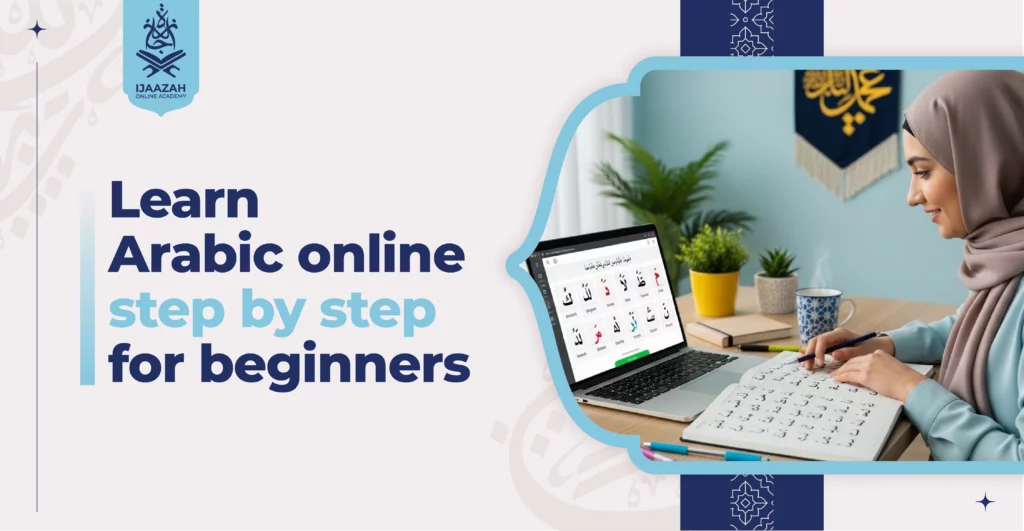
Starting the journey to master a new language can feel like standing at the foot of a massive mountain and looking up at a peak hidden in the clouds. You see the beautiful calligraphy and hear the poetic flow of the words and you want desperately to be part of that world. However, the strange script and the unfamiliar sounds can make you feel defeated before you even begin. The secret to success is not to try and sprint up the mountain in one day but to have a map that guides you through small, manageable checkpoints. When you decide to learn Arabic online with a structured plan, the impossible suddenly becomes possible. You stop seeing squiggly lines and start seeing meaning. You stop hearing random noise and start hearing distinct, beautiful words.
Step 1: Making Friends with the Alphabet
The first step is often the most intimidating because the Arabic script looks nothing like English. It is written from right to left and it has twenty-eight letters that seem to swirl and dance. Many beginners make the mistake of trying to memorize the names of the letters without mastering their sounds.
In our course, we focus on phonics first. We teach you that the name of the letter is “Jeem” but the sound it makes is “J” as in “Jam.” We spend time on the unique sounds that do not exist in English, like the deep throat letters. Mastering these sounds early is crucial because it builds the foundation for your accent. If you skip this step, you will carry a heavy foreign accent with you forever. We take the time to ensure your tongue knows exactly where to go for every single letter.
Step 2: Understanding the shapeshifters
Once you know the letters individually, the next surprise for beginners is that Arabic is a cursive language. The letters like to hold hands. This means that a letter will change its shape depending on where it sits in the word.
A letter like “Ba” looks like a boat when it is alone. But when it is at the start of a word, it loses its tail to connect to the next letter. When it is in the middle, it has two arms reaching out to both sides. This concept of “shapeshifting” confuses many self-learners who rely on apps. However, with a teacher, you quickly learn to recognize the head of the letter, which is its true identity. It is like recognizing your friend whether he is wearing a suit, a t-shirt, or a winter coat. He is the same person, just dressed differently for the situation.
Step 3: Giving Life with Vowels
You might have noticed that Arabic text often has small dashes and curls floating above or below the letters. These are the short vowels, known as Harakat. In English, vowels are letters like A, E, I, O, U that sit inside the word. In Arabic, short vowels sit on top of the consonants to tell you how to pronounce them.
This system is actually very logical. The consonants are the skeleton of the word and the vowels are the flesh and blood that give it life. We teach you how to read these signs step by step. You learn that a dash above means an “A” sound, a dash below means an “E” sound, and a curl means a “U” sound. Suddenly, a string of letters transforms into a pronounceable word. This is often the “lightbulb moment” for our students where reading actually starts to happen.
Step 4: The Logic of Roots
This is the most fascinating part of the Arabic language. Unlike English where you have to memorize thousands of unrelated words, Arabic is built on a root system. Almost every word comes from a three-letter root that carries a core meaning.
For example, the root letters D-R-S relate to studying. From this, you get Darasa (he studied), Madrasa (school), Mudarris (teacher), and Dars (lesson). Once you learn one root, you effectively unlock ten or twenty other words without even trying. This mathematical structure makes Arabic incredibly efficient to learn once you get past the initial hurdle. It respects your intelligence and allows you to expand your vocabulary rapidly.
Step 5: Putting it Together with Grammar
Grammar is often a scary word, but in Arabic, it is simply the set of traffic rules that keeps sentences from crashing. We introduce grammar gently. We start with simple nominal sentences like “The house is big.” You learn that you do not need the word “is” in Arabic, which makes sentence building much faster than in English.
We guide you through the basics of masculine and feminine words. In Arabic, everything has a gender. The sun is feminine and the moon is masculine. Learning these pairings connects you to the way Arabs view the world. We do not overwhelm you with complex tables of verb conjugations until you are ready. We feed you the rules one bite at a time so that you are always hungry for more, never full to the point of sickness.
Why You Need a Human Guide
You can try to walk this path alone using books and videos, but you will likely get stuck. You will pronounce a letter wrong and no one will correct you. You will misunderstand a grammar rule and get frustrated.
At Ijaazah, we provide you with a live, native guide who walks beside you every step of the way. We celebrate your small victories. We correct your path when you stray. We remind you of the goal when you feel tired.
Start Your Step-by-Step Journey
There is no better day than today to begin. The mountain is climbable, but you need to take that first step.
We invite you to book a Free Trial Session today. Let us show you how we break down this magnificent language into simple, easy-to-digest pieces. You will be amazed at how much you can learn in just one hour when the method is right.