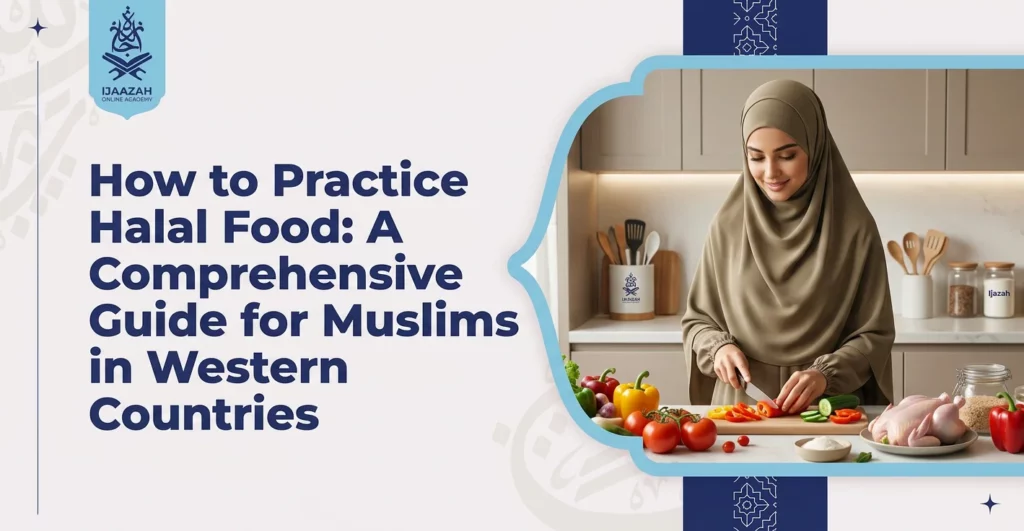
The grocery store should be simple. You walk in, you buy food, you go home. For Muslim families living in non-Muslim-majority countries, though, that trip involves a layer of scrutiny that most people around them never think about—label reading, ingredient cross-checking, quiet questions about what exactly “natural flavors” might contain.
Practicing halal is not a burden Islam placed on believers carelessly. It is a form of Taqwa made visible in the most ordinary act of daily life: eating. Understanding how to do it well—in a country where the default is not halal—takes some initial learning, but it becomes second nature faster than most people expect.
What Halal Actually Means — Beyond the Label
The word halal (حلال) means “permissible.” In the context of food, it covers a specific set of conditions established in the Quran and authenticated Sunnah. Allah ﷻ says:
“O you who have believed, eat from the good things which We have provided for you and be grateful to Allah if it is Him that you worship.” — Quran 2:172
The prohibited categories are clearly defined: pork and its derivatives, blood, animals not slaughtered in the name of Allah, intoxicants, and animals that died before slaughter. For meat specifically, the animal must be alive at slaughter, the slaughter must be performed by a Muslim (or, according to some scholars, a Jewish or Christian person following their own dietary laws), and the name of Allah must be invoked.
What confuses many people—especially in Western contexts—is the category of doubtful ingredients: gelatin, certain food colorings (like carmine, derived from insects), L-cysteine (sometimes sourced from human hair or pork), and emulsifiers with ambiguous animal origins. The general principle from the hadith of the Prophet ﷺ is instructive here: “Leave that which makes you doubt for that which does not make you doubt.” (Tirmidhi, authentic)
When an ingredient’s source is genuinely unclear and no halal certification is present, erring on the side of avoidance is the sounder approach.
Finding Halal Food Where You Live
Reading Certifications Without Being Paralyzed
Halal certifications vary significantly in rigor. In the USA, organizations like ISNA Halal, IFANCA, and the Halal Food Authority (HFA, primarily UK-based) maintain reasonably strict standards. Not every product needs third-party certification to be halal—fruits, vegetables, plain grains, eggs, and most dairy products are halal without requiring a stamp. The certification matters most for processed foods and meat.
A practical habit: check whether a product contains any animal-derived ingredients at all before worrying about certification. Many items that seem ambiguous are actually fully plant-based.
Locating Halal Butchers and Markets
Most major cities in the USA, Canada, the UK, and Australia have halal butchers—often within South Asian, Arab, or African Muslim communities. Apps like Zabihah.com (primarily USA and Canada) and HalalTrip map certified halal restaurants and grocery suppliers by location. In cities with smaller Muslim populations, Middle Eastern and South Asian grocery stores often carry halal-certified meat even when a dedicated halal butcher is not available.
For those in rural areas or smaller towns, online ordering has become genuinely viable. Retailers like Crescent Foods (USA), Al-Safa (Canada), and several UK-based online butchers ship vacuum-sealed halal meat nationwide. The logistics work—it simply requires a small upfront effort to establish a supply chain that fits your household.
Cooking Halal at Home — Where Consistency Comes From
For most Muslim families, the home kitchen is the most reliable halal environment they have. A few practices that make it easier to maintain:
- Designate separate utensils and cookware if you share a kitchen with non-Muslim housemates or family members who cook pork. Cross-contamination is a real concern, and the visual separation removes ambiguity.
- Build a pantry baseline of staples you have already verified: halal-certified stocks, sauces, and condiments. Reading labels once and then restocking the same products saves significant time over months.
- Learn to cook proteins yourself rather than relying on pre-marinated or pre-seasoned products, where ingredient ambiguity is highest. A whole chicken from a halal butcher, seasoned simply, is both cost-effective and unambiguous.
- For families with children, involving them in the label-reading and cooking process from a young age builds the habit organically—by the time they are shopping independently, they know what to look for without thinking about it.
Navigating Non-Halal Environments With Grace
Work lunches, school events, family gatherings with non-Muslim relatives—these situations come up regularly, and handling them well is a skill. A few principles that experienced Muslim expats tend to rely on:
Communicate early, not at the table. Telling a host or colleague in advance—”I keep halal, so I’ll need to know what’s in dishes, or I’m happy to bring my own”—removes awkwardness on the day. Most people, when given time to think, are genuinely accommodating.
Vegetarian and vegan options at restaurants are often halal by default (absent alcohol in sauces or non-halal gelatin in desserts). In situations where the meat status is unknown, defaulting to plant-based dishes is a practical solution that does not require lengthy explanation.
Introducing non-Muslim friends and family to halal food through shared meals—hosting a dinner, contributing to a potluck—tends to shift perceptions more effectively than any explanation. People who have eaten halal food without thinking about it rarely find the concept strange afterward.
The Deeper Practice Behind the Plate
Halal eating is ultimately about consciousness—awareness that sustenance comes from Allah ﷻ, that what enters the body has been designated carefully, that the act of eating is not separate from worship. Saying Bismillah before a meal, washing hands, eating with the right hand, not wasting food—these Sunnah practices wrap a simple physical act in intention and gratitude.
That consciousness is worth cultivating, not just for its religious merit, but because it changes how a family relates to food. Halal practice, done thoughtfully, produces a household that is deliberate about what it consumes—which has effects beyond religious compliance.
Pass This On
Know a family that just moved to a new city and is figuring out where to find halal options? Share this article. Helping a fellow Muslim eat with confidence is a small act with a lasting reward—and that reward continues for you as long as it benefits them.
Your 5-Minute Challenge: Check the ingredients list of one processed food item currently in your kitchen—a sauce, a snack, or a stock cube. Identify whether it contains any animal-derived ingredients (gelatin, L-cysteine, carmine, emulsifiers like E471). If the source is unclear and there is no halal certification, note it. That single habit, repeated over time, builds a pantry you trust.
Want to deepen your Islamic knowledge and understanding of halal principles?
Book a Free Trial Lesson at Ijaazah
Not sure where to begin? Test Your Level
FAQ
Q1: What are the basic rules of halal food according to Islam?
Halal food must be free of pork and pork derivatives, blood, alcohol, and animals not slaughtered in Allah’s name. For meat, the animal must be alive at slaughter, slaughtered by a Muslim (or People of the Book in some scholarly opinions), and the name of Allah must be pronounced. Processed foods require checking for animal-derived additives whose source may be impermissible.
Q2: How do I find halal food in a Western country with few Muslims?
In areas with small Muslim populations, online halal meat delivery services are the most reliable option. Apps like Zabihah.com help locate nearby halal businesses. Middle Eastern and South Asian grocery stores in most mid-sized cities carry halal-certified products even without a dedicated halal butcher nearby.
Q3: Is vegetarian food always halal?
Not automatically. Vegetarian food is free of meat but may contain alcohol (in sauces and flavorings), non-halal gelatin, or other impermissible additives. However, food that is confirmed fully plant-based and alcohol-free is generally halal without requiring separate certification.
Q4: What is the Islamic ruling on doubtful food ingredients?
The Prophet ﷺ advised leaving what causes doubt for what does not. When a food’s halal status is genuinely unclear and no certification or reliable information is available, the safer approach is avoidance. This applies particularly to ambiguous additives like certain emulsifiers, flavorings, and gelatin.
Q5: How can I explain halal requirements to non-Muslim colleagues or hosts?
Brief, matter-of-fact communication works best—mentioning dietary requirements in advance rather than at the event. Framing it simply (“I don’t eat pork or non-halal meat”) rather than with lengthy explanation usually results in easy accommodation. Offering to bring your own dish to social gatherings is a practical alternative that removes any burden from the host.