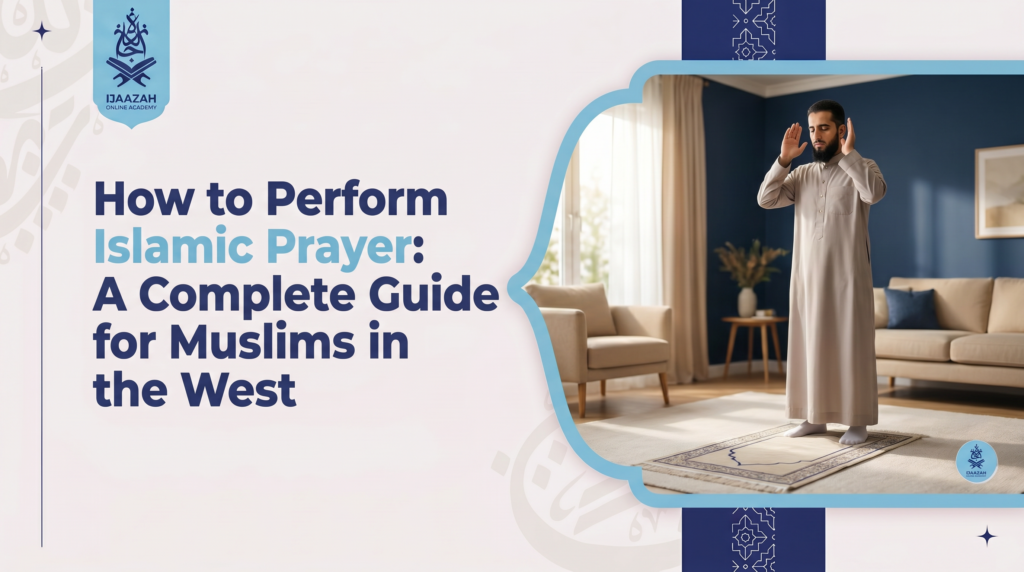
A Muslim raising children in London, Toronto, or Houston faces a question their grandparents never had to answer: how do you keep five daily conversations with Allah steady when the clock, the culture, and the community around you were never built for it? Salah is not a ritual performed once and memorized forever. It is a skill, refined through correct knowledge and repetition, and for expats and new Muslims alike, getting the mechanics right from the start prevents years of quietly wondering whether the prayer “counts.”
This guide walks through what Salah means, how to perform Islamic prayer step by step, and the practical realities of sustaining it far from a Muslim-majority country.
Why Salah Anchors a Muslim’s Day
Salah is the direct line between a worshipper and Allah, repeated five times daily regardless of mood, location, or circumstance. Unlike charity or fasting, which have seasonal or conditional dimensions, prayer is constant. That constancy is precisely its value , it interrupts the pull of work, screens, and deadlines with a mandated pause for remembrance.
For new Muslims, learning Salah correctly from day one matters because uncorrected habits calcify quickly. Someone taught the wrong Arabic pronunciation of Al-Fatiha at month two will often still be saying it wrong at year five, simply because no one corrected them early. For children raised outside the Muslim world, precise instruction is equally important since they are absorbing the prayer as a foundational habit rather than a cultural backdrop they’ve seen since birth.
The Five Pillars of the Prayer Day
Each of the five daily prayers occupies a distinct window and carries its own character:
- Fajr, before sunrise, is short and quiet, often the hardest to maintain consistently but carries particular emphasis in the tradition for that reason.
- Dhuhr arrives after the sun passes its peak, splitting the workday and pulling attention back from tasks and meetings.
- Asr follows in the late afternoon, a prayer many describe as easy to forget precisely because it falls in the middle of ordinary business hours.
- Maghrib begins just after sunset and is brief, a natural transition point between daytime obligations and evening rest.
- Isha closes the day, offering a final opportunity to settle the mind before sleep.
Understanding this rhythm is the first step. Executing it correctly is the second.
The Mechanics: How to Perform Islamic Prayer Step by Step
Purification Before Anything Else
Wudu (ablution) comes before Salah and cannot be skipped or approximated. The general sequence includes washing the hands, rinsing the mouth and nose, washing the face, washing the arms to the elbows, wiping the head, and washing the feet to the ankles, each performed with attention rather than haste. A prayer performed without valid Wudu is not valid, which is why tutors spend real time on this stage with beginners rather than rushing to the postures.
Setting the Intention
Niyyah, the intention, is made silently in the heart before beginning. It does not require spoken words or elaborate phrasing. The worshipper simply resolves which prayer they are about to perform and directs that intention toward Allah alone.
The Physical Sequence
Salah then moves through a fixed structure repeated with variations across each prayer’s cycles (rak’ahs):
- Standing (Qiyam) facing the Qibla, opened with the Takbir (“Allahu Akbar”), followed by recitation of Al-Fatiha and, typically, a short additional passage from the Quran.
- Bowing (Ruku), hands on the knees, back straight, held with a moment of stillness and specific remembrance spoken quietly.
- Returning to standing briefly before descending into Sujood, prostration with the forehead, nose, palms, knees, and toes touching the ground , the posture the tradition describes as closest a servant comes to their Lord.
- A brief sitting between the two prostrations of each rak’ah.
- At the end of the prayer, sitting for Tashahhud, a seated testimony recited before closing with Tasleem, turning the head to each side.
None of these stages should be treated as optional shortcuts. A student learning informally from videos often absorbs small errors in posture or recitation that a live tutor would catch in the first session.
Where Expats Actually Learn This Correctly
Books and video clips can explain Salah in theory, but correction requires a real person watching and listening. This is where structured, live instruction changes outcomes. Ijaazah.com pairs students with Azhari-certified tutors for one-on-one sessions, meaning a beginner’s Fatiha pronunciation, Wudu sequence, or standing posture gets corrected in real time rather than reinforced by accident.
Two details matter enormously for expat families specifically. First, finding a female tutor for learning Salah online is often a genuine barrier in local mosque settings, particularly for women who prefer instruction from another woman for reasons of comfort or religious preference. Ijaazah’s roster includes qualified female tutors precisely to close that gap. Second, flexible scheduling across time zones means a parent in Sydney or Los Angeles is not forced to choose between a lesson and their prayer window, since sessions are booked around the student’s actual day rather than a fixed regional timetable.
The Real Challenges of Praying Consistently in the West
Time Zones, Travel, and the Clock Problem
Typical prayer times for Muslims in Western countries shift daily and vary widely by latitude, meaning summer Isha in northern Europe can fall close to midnight while Fajr arrives shortly after. Adjusting prayer times when traveling adds another layer, since crossing time zones or daylight-saving boundaries can throw off a routine built around a single city’s calendar. Reliable prayer-time apps solve the calculation problem, but they do not solve the discipline problem, which is why many students pair an app with a tutor who holds them accountable to actually praying, not just knowing when to.
Community, or the Lack of It
Common challenges of practicing Islam in the West often center less on the prayer itself and more on isolation. A single Muslim family in a small town may not have a mosque within driving distance. Local Islamic centers, weekend gatherings, and even Muslim-run social media groups fill part of that gap, offering the sense of shared obligation that naturally exists in Muslim-majority countries but must be actively built elsewhere. Community events, from Ramadan iftars to weekend Quran circles, do more than socialize , they visibly reinforce that Salah is a shared communal act, not a private inconvenience squeezed between meetings.
Women and minority converts frequently face an additional layer here: mosques that lack women’s sections, language barriers in khutbahs, or simply not knowing where to ask basic questions without judgment. Programs built around private, judgment-free instruction , rather than requiring in-person attendance at an unfamiliar mosque , remove much of that friction.
Making Room for Prayer, Literally and Culturally
Addressing Misunderstanding Without Apologizing for the Obligation
Coworkers and neighbors unfamiliar with Islam sometimes misread prayer breaks as unusual or disruptive. A brief, calm explanation, offered once and not repeated defensively, usually resolves this. Salah does not need to be hidden to be respected.
Building a Space That Works
A dedicated prayer space at home does not require a spare room. A clean corner with a mat, kept free of clutter, signals to the household , including children , that this space is set apart. For families balancing cultural norms with Western housing realities, even a curtained-off corner or a marked area in a shared room accomplishes the same purpose: consistency of place breeds consistency of practice.
Fitting Five Prayers Into a Working Day
Balancing work, school, and prayer is less about finding extra time and more about protecting small windows that already exist: a lunch break for Dhuhr, a car parked five minutes early for Asr, a bedroom door closed briefly for Isha. Students who train this as a habit, rather than negotiating it fresh each day, report far less friction within a few weeks.
Starting Today, Not Someday
Salah rewards the person who begins imperfectly and corrects as they go, not the person waiting to feel fully ready. Whether the goal is fixing years-old habits or learning from zero, structured guidance from a qualified tutor shortens that path considerably and removes the guesswork that causes many people to quietly give up.
Sadaqah Jariyah Share Knowledge shared freely continues to benefit its giver long after the moment it’s read. If this guide clarified even one part of Salah for you, consider sending it to a new Muslim, a struggling parent, or a friend who’s been meaning to fix their prayer for years. That small act of sharing may become a Sadaqah Jariyah, a charity that keeps earning reward long after today.
The 5-Minute Challenge Right now, check your phone’s prayer-time app (or download one) and confirm today’s exact time for the next prayer on your schedule. Set an alarm five minutes before it. That single step closes the gap between knowing a prayer time and actually praying on time.
Service Links Ready for personalized correction from a certified tutor? Book a Free Trial. Not sure where your Quran or Tajweed level stands? Take Test Me, our free assessment.