In the chaos of Western living—professional deadlines, family logistics, financial pressures, existential uncertainty—Muslims often feel spiritually stranded. Prayer times compress. Community connections fragment. The intimate conversation with Allah that characterizes Islamic life grows distant.
Yet Islam preserves a practice so intimate, so personal, so profoundly human that it bypasses institutional religion entirely: Dua—supplication, intimate dialogue with the Divine.
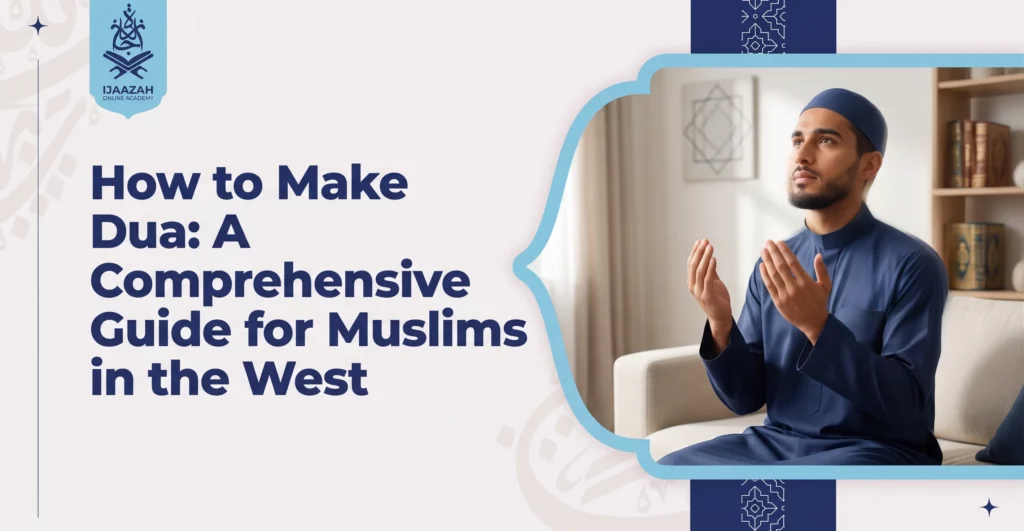
Unlike formal prayer (Salah), which follows prescribed movements and words, dua flows from your heart in your language about your reality. It’s Islam’s most democratic spiritual practice—requiring no special knowledge, no ceremonial purity, no location restrictions. A mother praying for her child’s health. A professional praying for guidance in ethical choices. A newcomer to Islam praying for clarity about faith. Each engages in dua—direct conversation with Allah.
Yet this accessibility masks a subtlety. Making dua effectively requires understanding Islamic principles, developing sincere intention, and cultivating patience when answers emerge differently than anticipated.
What Exactly Is Dua? Defining the Practice
Dua derives from the Arabic root meaning “to call” or “to invite.” Literally, it means calling upon Allah—but this terminology barely captures the phenomenon’s depth.
Dua is intimate supplication. It’s you, alone or with others, articulating your needs, desires, fears, and gratitude directly to Allah. It requires no intermediary, no clergy, no ritual apparatus. You simply speak to your Creator.
Islamic tradition distinguishes dua from formal prayer (Salah). Both are conversations with Allah, but they operate through different channels:
Salah follows prescribed forms established by Prophet Muhammad (peace be upon him). You recite specific words, perform specific movements, and pray at designated times. Salah is collective obligation; every Muslim performs identical prayers globally.
Dua, by contrast, flows from individual circumstance and need. You use your own language (Arabic or any language), speak from your heart about your specific situation, and can supplicate anytime, anywhere. Dua is intensely personal.
Yet they complement rather than replace each other. Many Muslims conclude their five daily prayers with personal dua—transitioning from obligatory collective prayer to individual supplication.
Why Dua Matters: The Islamic Foundations
The Quran emphasizes dua’s spiritual significance repeatedly. Allah states: “Your Lord has said: Call upon Me; I will respond to you.” (40:60) This isn’t conditional. It’s absolute promise—Allah responds to those who call.
Prophet Muhammad (peace be upon him) elevated dua’s status explicitly: “Dua is the weapon of the believer.” He taught that dua changes destiny, that sincere supplication moves Divine will, that asking Allah is itself an act of worship.
This isn’t magical thinking—divine decree responding to human whim. Rather, it’s recognition that humans shape their own futures through intention and effort, and that humble acknowledgment of dependence on Allah (through dua) aligns human will with Divine purpose.
For Western Muslims especially, dua serves psychological functions beyond theology. In contexts where Islamic community may be sparse, where mosque attendance feels countercultural, where Islamic identity requires deliberate assertion—dua becomes the bridge between internal faith and external practice.
Making dua regularly anchors Islamic identity. It asserts, daily, that Allah’s presence matters to your life. It cultivates awareness of Divine purpose amid secular frameworks that ignore transcendence. It combats the atomization of Western individualism by reminding you that your existence connects to something larger than personal preference.
The Step-by-Step Framework: How to Actually Make Dua
Making effective dua involves several elements—though none is absolutely mandatory. Rather, each amplifies sincerity and effectiveness.
Step One: Prepare Mentally and Physically
Preparation begins with Niyyah—intention. Before making dua, clarify internally that you’re addressing Allah, seeking His help, acknowledging His authority. This mental centering prevents dua from becoming mere habit or thoughtless repetition.
Physical preparation includes—when possible—performing ritual purification (Wudu). This isn’t mandatory for dua validity; you can supplicate without purification. Yet performing Wudu creates psychological transition from daily activities to sacred communion. It marks dua as spiritually significant rather than casual.
Facing the Qibla (direction of Mecca) is recommended when possible, though not essential. If you’re in a location where direction isn’t feasible, Allah accepts your supplication regardless. What matters is inward orientation toward Allah, not physical orientation toward a building.
Step Two: Choose Optimal Timing
While Allah accepts dua anytime—dua has no temporal restrictions—Islamic tradition identifies especially auspicious moments:
The last third of the night (pre-dawn hours) represents prime dua time. Prophet Muhammad encouraged night-time supplication, describing this period as especially receptive to Divine response. For those unable to wake for Tahajjud (night prayers), even brief supplication during these hours carries weight.
Immediately after obligatory prayers amplify dua’s power. Ritually purified, mentally focused, spiritually activated—the moments following Salah position you optimally for personal supplication.
During the final moments of Friday (Jumu’ah prayer)—particularly the time before sunset on Friday—carry special significance. Prophetic tradition emphasizes this window.
Times of emotional need—grief, fear, difficulty—aren’t privileged temporally, yet they demonstrate dua’s accessibility. You need not wait for designated hours; urgent supplication reaches Allah immediately.
Ramadan generally, and especially during the last ten nights, represents spiritually heightened dua time. Fasting heightens spiritual receptivity; the anticipated arrival of Laylat al-Qadr (the Night of Power) infuses supplications with particular earnestness.
For Western professionals unable to wake predawn or attend Friday prayers regularly, this flexibility is liberating. You can supplicate during your commute, at your desk (internally), or during evening hours. Allah’s ear isn’t bound by clock time.
Step Three: Consider Your Dua Language
A persistent misconception: dua must occur in Arabic. This misses Islamic teaching entirely.
The Quran preserves examples of dua in Arabic—yet Prophet Muhammad explicitly authorized supplication in any language. He instructed non-Arabic speakers to use their native tongues, assuring them Allah understands all languages equally.
For Western Muslims, this permission is liberation. A French-speaking Muslim can supplicate in French. A Canadian whose native language is English can pray in English. An immigrant struggling with Arabic acquisition can supplicate in her mother tongue without guilt.
That said, some Arabic phrases carry traditional weight and spiritual resonance. Learning core supplications in Arabic—particularly Subhan’Allahu wa bihamdih (Glory be to Allah and praise be to Him) or La hawla wa la quwwata illa billah (There is no power or ability except through Allah)—connects you to centuries of Muslim practice.
Many Western Muslims adopt a hybrid approach: beginning in Arabic with traditional phrases, then continuing in English with personal supplication. This synthesizes tradition with accessibility.
The Structural Elements of Powerful Dua
While dua’s beauty lies partly in its freedom—you can say anything—Islamic tradition suggests a structure enhancing effectiveness:
Opening: Praise and Invocation
Begin by acknowledging Allah’s greatness. You might say: “O Allah, You are most merciful. You are the All-Hearing, the All-Knowing.” Or in English: “God, I acknowledge Your power and Your compassion.”
This opening reorients your mind from self-concern toward Divine awareness. It establishes relationship—you’re speaking to a Being infinitely greater than yourself, whose power encompasses your needs entirely.
Many traditional duas include the Basmalah (Bismillah ar-Rahman ar-Rahim—In the name of Allah, the Most Merciful, the Most Compassionate) as opening invocation.
Middle: Sending Blessings Upon the Prophet
Islamic teaching emphasizes concluding dua with blessings upon Prophet Muhammad (peace be upon him). Many Muslims open their dua with this as well: “O Allah, send blessings upon Muhammad and upon his family.”
This isn’t polytheism (worshipping the Prophet alongside Allah); it’s recognition that Prophet Muhammad transmitted Divine guidance and honoring his role in Islamic tradition.
The Core Request: Articulating Your Need
Here, dua becomes profoundly personal. State explicitly what you’re requesting. This needn’t be elaborate or eloquent—Allah values sincerity above eloquence.
A mother might say: “Allah, protect my child’s health. Grant him recovery from this illness. I place my trust entirely in You.”
A professional seeking guidance: “Allah, grant me wisdom in this decision. Show me the path that pleases You and benefits others. Remove confusion from my heart.”
A convert seeking spiritual clarity: “Allah, deepen my faith. Help me understand Your guidance fully. Strengthen my commitment to Islam despite challenges I face.”
Specificity matters. Vague supplications—“Make my life better”—lack the clarity that genuine need provides. “Grant me a job that honors Islamic principles, pays fairly, and allows time for family and faith”—this specificity demonstrates serious intention.
Closing: Gratitude and Trust
Conclude by expressing gratitude for past blessings: “I thank You for all Your mercies.” Then affirm trust in Divine wisdom: “I rely entirely upon You. Your decision is best, whether You grant my request or guide me toward something better.”
This closing dissolves desperation into trust. It acknowledges that Allah’s wisdom exceeds your own—that what you believe you need might differ from what Divine wisdom determines is truly beneficial.
Common Mistakes Undermining Dua Effectiveness
Several patterns weaken dua’s power:
Desperation without Sincerity — Making dua only when crisis strikes, approaching Allah only as emergency resource rather than constant presence. This instrumentalizes dua, reducing it from genuine relationship to transactional request.
Impatience Regarding Response — Expecting immediate, visible answers. Islamic tradition emphasizes that Allah always responds—but responses may come through unexpected channels or timelines. Perhaps your dua for a job leads to rejection that redirects you toward something better. Perhaps your dua for health leads to illness teaching spiritual lessons more valuable than physical wellness.
Insincerity in Words — Words without heartfelt intention. You can recite eloquent traditional duas mechanically without genuine vulnerability. Allah sees hearts; eloquence without authenticity rings hollow.
Refusing Effort Alongside Dua — Making dua then expecting Allah to deliver without your participation. Islamic teaching emphasizes that dua must accompany effort. You supplicate for success in exams and study diligently. You ask for job opportunities and apply actively. You request healing and take medical treatment.
Fixation on One Outcome — Demanding that Allah answer exactly as you specify. “Allah, grant me marriage to this specific person” rather than “Allah, grant me a righteous spouse.” This presumes you know better than Allah what serves your wellbeing.
Personalizing Your Dua: Making It Your Own
Effective dua resonates with your specific life. Generic supplications lack the power of personalized vulnerability.
Begin by honestly assessing your current reality. What genuinely concerns you? What do you truly desire? What scares you? What do you feel grateful for?
Then articulate these with specificity. A parent might supplicate: “Allah, my daughter is struggling with confidence. Help her see her own worth. Grant her friends who support her faith and values. Protect her from harmful influences as she navigates adolescence in a secular environment.”
This is far more powerful than “Allah, help my children.” It demonstrates genuine engagement with her daughter’s actual situation.
Similarly, gratitude becomes powerful through specificity: “I thank You for my health, for meaningful work, for a faith community that supports me, for family who cares about me—even when they don’t understand my religious choices.”
Specific gratitude acknowledges the actual blessings in your life, counteracting entitlement and cultivating genuine thankfulness.
Dua in Community: Collective Supplication
While dua is typically personal, Islam emphasizes collective supplication as well. Group dua—whether after congregational prayer, during community gatherings, or via online platforms connecting Muslims across distances—carries particular power.
Prophet Muhammad taught: “The dua of one person is enclosed, but when three supplicate together, one of them is answered.” This emphasizes intercession—Muslims praying not just for themselves but for one another.
For Western Muslims often isolated from geographic community, virtual dua gatherings offer profound connection. Participating in group supplication via Zoom with Muslims across continents, all voicing shared needs (protection of the Ummah, guidance for leaders, healing for the sick) creates spiritual communion transcending physical distance.
Many Islamic centers now facilitate group dua circles—often during Ramadan, during times of community grief, or as regular communal practice. These transform dua from solitary activity to collective spiritual practice.
Managing Expectations: When Answers Appear Different
Perhaps the deepest maturity in dua involves accepting that Allah’s responses often diverge from our requests.
You ask for a promotion; instead, you’re laid off—leading to a career change aligning better with your values. You ask for healing; instead, chronic illness becomes spiritual teacher, deepening your faith and compassion. You ask for a specific relationship; instead, that person exits your life, allowing you to discover self-worth independent of romantic validation.
Islamic theology embraces this paradox: Allah always answers dua—but sometimes the answer is “no” or “wait” or “I’ll give you something better than you asked.”
This requires phenomenal trust. It’s the difference between praying like you expect Allah to answer your specifications versus praying with genuine openness to Divine wisdom exceeding your vision.
The spiritual work of mature dua involves cultivating this trust—learning to say, genuinely and not performatively, “Your will be done”—accepting that Allah’s way may diverge from your preference, yet trust that Divine choice ultimately serves you better.
Integrating Dua Into Your Western Life
For busy Western professionals, integrating dua into daily life requires intentional habit-building:
Morning Supplication (5 minutes) — Begin your day addressing Allah, requesting guidance and protection for the hours ahead.
Commute Dua (10 minutes) — Use driving time, train time, or walking time for supplication rather than podcasts or news.
Work-Time Micro-Dua (1-2 minutes) — Brief internal supplications before difficult meetings, when facing challenges, when grateful for small victories.
Evening Reflection Dua (10 minutes) — End your day reflecting on what went well, where you fell short, and what you’re grateful for and requesting for tomorrow.
Weekly Focused Dua — Designate one evening weekly for extended supplication—perhaps 20-30 minutes—focusing deeply on matters currently preoccupying you.
This accumulation—perhaps 30-40 minutes weekly of intentional dua—transforms your relationship with faith. Allah transitions from abstract theological concept to active presence in your daily consciousness.
Sadaqah Jariyah Share: Do you have family or friends struggling to pray effectively, uncertain whether their supplications matter, or disconnected from Islam due to life stress? Share this guide. Teaching others the power of dua represents ongoing charity—Sadaqah Jariyah—that benefits them spiritually for years.
The 5-Minute Challenge: Today, spend exactly 5 minutes in sincere dua about something genuinely concerning you. Don’t rush. Don’t worry about eloquence. Simply speak from your heart to Allah about your real need.
Next Steps:
Book a Free Trial— Connect with Islamic scholars and tutors who can deepen your understanding of Islamic practices, including the spiritual dimensions of dua and supplication.
Test Your Islamic Knowledge — Assess your Islamic understanding and discover personalized learning paths that strengthen your faith practice.