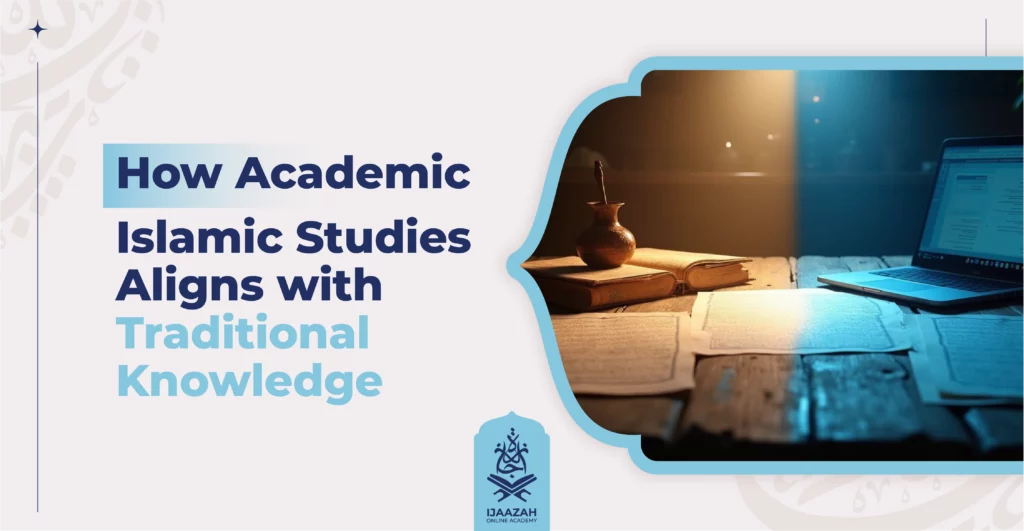
The study of Islam has always stood on two solid pillars: the traditional system of sacred transmission and the academic pursuit of organized understanding. For centuries, Muslims studied under scholars through direct instruction—learning the Qur’an, Hadith, Fiqh, and Arabic sciences with personal guidance. Today, universities and online institutions bring these same principles into structured programs that combine modern academic rigor with the integrity of classical learning.
This harmony between academic Islamic studies and traditional scholarship is at the heart of what makes institutions like Ijazaah Academy unique. They connect the depth of the classical ijazah (authorization) system with the accessibility and research-based approach of modern education.
1. The Roots of Traditional Islamic Knowledge
Before the rise of modern universities, Islamic education was preserved through a personal teacher-student model. A student sat before a teacher who traced his learning back to earlier scholars—a living chain of transmission known as the ijazah system.
This traditional approach emphasized:
- Authenticity: Direct learning from qualified teachers with proven chains of narration.
- Spiritual discipline: Adab (etiquette) was as important as intellect.
- Holistic learning: Theology, Qur’an, Hadith, Arabic, and ethics were all integrated.
- Application: Knowledge was measured by its impact on the heart and behavior.
Institutions such as Al-Azhar, Al-Qarawiyyīn, and the Dār al-ʿUlūm centers carried this model for generations.
Today, academies like Ijazaah maintain the same spirit online—preserving direct mentorship while using modern platforms to reach global learners.
2. The Academic Turn: How Modern Islamic Studies Evolved
The academic study of Islam began developing as Muslim scholars engaged with structured curricula in universities. The aim was to analyze Islam not only as faith but as civilization—through history, language, literature, and social impact.
While traditional madrasahs focused on transmission, universities emphasized methodology—critical reading, comparative study, and structured assessment.
In the United States, the UK, and other parts of the world, Islamic studies departments now train students to examine:
- Qur’anic sciences and exegesis (tafsīr).
- Historical evolution of Islamic jurisprudence (fiqh).
- Theological schools and philosophy.
- Muslim societies, languages, and cultures.
This approach provides valuable academic depth but often lacks direct spiritual mentorship. That’s where a balanced institution like Ijazaah Academy bridges the two.
3. The Common Ground: Shared Goals of Both Systems
At their core, traditional and academic methods share a common goal: understanding and living the message of Islam with precision and sincerity.
Both approaches value:
- Textual accuracy: Deep engagement with the Qur’an and authentic Hadith.
- Intellectual discipline: Clear reasoning, memorization, and critical thought.
- Continuity of knowledge: Building on earlier scholars’ works, not replacing them.
- Ethics in learning: Respect, humility, and responsibility toward truth.
When balanced, these systems complement rather than conflict. Academic analysis refines intellectual structure, while traditional guidance protects spiritual integrity.
4. How Ijazaah Academy Brings the Two Together
Ijazaah Academy is built around this balance—preserving the chain of traditional learning while offering the structured, analytical benefits of academic study.
Traditional Strengths Preserved:
- All teachers are certified scholars with ijazah, ensuring authentic transmission.
- Qur’an, tajwīd, Arabic, tafsīr, and Islamic theology are taught from primary texts.
- Spiritual etiquette (adab) remains central—students learn humility, patience, and sincerity alongside knowledge.
Academic Strengths Integrated:
- Structured syllabi and measurable milestones.
- Research-based reading for advanced students.
- Written feedback and assessments for consistent progress.
- Global access through modern online learning tools.
This model allows students from the USA, Canada, and worldwide to experience the best of both worlds: spiritual depth and academic clarity.
Enroll now for a free placement and trial lesson
5. Course Pathways That Reflect Integration
Ijazaah Academy’s courses are designed to blend traditional subjects with academic presentation—ensuring that students understand the faith both intellectually and spiritually.
A. Qur’an and Tajwīd Studies
Learn the recitation, pronunciation, and rhythm of the Qur’an with certified teachers.
- Emphasis on the tajwīd sciences and Qur’anic eloquence.
- Reinforced by linguistic analysis and grammar for precision.
B. Islamic Theology (ʿAqīdah)
Study the principles of faith in a structured, academic order.
- Explore classical texts through verified commentaries.
- Learn the theological reasoning behind core beliefs.
C. Tafsīr and Qur’anic Studies
Understand how classical exegesis connects with modern analytical reading.
- Learn how the Qur’an addresses universal human questions.
- Practice critical thinking within the boundaries of sound methodology.
D. Islamic History and Civilization
Study the evolution of Islamic thought, law, and culture.
- Explore Muslim contributions to philosophy, science, and governance.
- Connect classical Islamic values to modern contexts.
E. Arabic for Islamic Studies
Master the language of revelation with practical usage.
- Grammar and syntax paired with Qur’anic reading.
- Critical to both traditional recitation and academic interpretation.
View full course catalog
6. What Makes Ijazaah’s Method Different
Unlike generic online learning platforms, Ijazaah’s model is rooted in authentic sanad (chain of learning) while meeting the organizational standards of academic institutions.
Distinct Features Include:
- Live, two-way learning with teachers—not pre-recorded videos.
- Comprehensive course notes and reading materials.
- Regular assessments and reflective assignments.
- Flexible time slots across U.S. and Canadian time zones.
- Women-only and men-only cohorts for comfort and focus.
This model gives learners both the discipline of the madrasa and the structure of a university, without compromising authenticity.
7. Addressing Misconceptions: Are Traditional and Academic Approaches Opposed?
Some assume that academic methods weaken spirituality or that traditional systems avoid modern analysis. In truth, both can coexist powerfully when guided correctly.
Academic study encourages precision in reasoning and context. Traditional study preserves sincerity, humility, and spiritual orientation. Together, they nurture well-rounded students of knowledge—those who think critically but remain anchored in faith.
As the Prophet Muhammad ﷺ said:
“When Allah intends good for someone, He grants him understanding in religion.” (Sahih al-Bukhari, 71)
Understanding (fiqh) in this hadith includes both intellectual comprehension and spiritual insight—exactly the balance Ijazaah aims to cultivate.
8. Who Benefits Most from This Integrated Model
The Ijazaah Academy approach is especially suited for:
- University students seeking deeper understanding beyond academic textbooks.
- Reverts and lifelong learners wanting structured, authentic education.
- Professionals looking for flexible yet rigorous study tracks.
- Teachers and imams aiming to strengthen academic articulation alongside traditional grounding.
9. From Knowledge to Application: The Goal of Both Traditions
Both traditional and academic systems agree on one truth: knowledge is meant to transform.
Whether through personal reflection, improved character, or informed leadership, studying Islam must lead to ethical and spiritual growth.
At Ijazaah Academy, students are encouraged to:
- Reflect on lessons in their daily worship.
- Engage in service through what they learn.
- Maintain humility before Allah and gratitude toward teachers.
Knowledge becomes not an academic exercise but a means of living faith fully and consciously.
10. Final Reflection: Two Paths, One Purpose
The alignment of academic Islamic studies with traditional knowledge is not a compromise—it is a completion. Each fills what the other lacks. One offers analysis, the other provides authenticity; one polishes the intellect, the other purifies the heart.
Institutions like Ijazaah Academy represent this harmony in practice: technology serving tradition, structure supporting sincerity.
For Muslims in the USA and worldwide, this model ensures that Islamic learning remains authentic, accessible, and transformative—preparing a new generation of scholars, educators, and believers who think deeply and live faithfully.
Begin your learning journey today:
True knowledge lives where intellect and devotion meet—and Ijazaah Academy stands at that intersection.