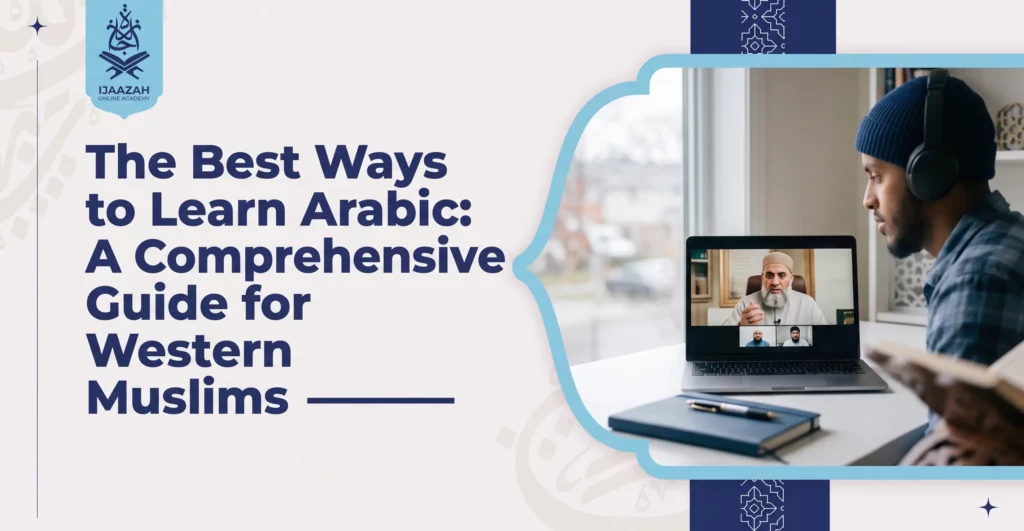
Ask ten Arabic learners how they learned the language and you’ll get ten different answers. That’s not because there’s no right approach—it’s because the best way to learn Arabic depends heavily on your goals, your starting point, and how you learn. For Western Muslims, the goal is usually clear: understand the Quran, follow Islamic scholarship, and connect more deeply with the faith. The best Arabic language learning path for this audience is more specific than most general language courses acknowledge.
Start with Your Goal
Arabic is not one language in practice. Quranic Arabic, Modern Standard Arabic, and the various spoken dialects are related but distinct. Before choosing a course or tutor, be clear about what you actually want to achieve:
- Understanding the Quran → Quranic Arabic is your focus. Classical grammar, Quranic vocabulary, and morphology are the priorities.
- Reading Islamic scholarship → Classical Arabic with emphasis on formal grammar and classical texts.
- Communicating with Arabic speakers → A spoken dialect (Egyptian, Levantine, Gulf) is more practical than Modern Standard Arabic for daily conversation.
- All of the above → Start with Quranic Arabic, which provides the strongest foundation for everything else.
Most Western Muslims are best served by starting with Quranic Arabic and expanding from there.
The Best Resources for Learning Arabic
Qualified human tutors remain the single most effective resource for Arabic learning—particularly for pronunciation, which cannot be self-corrected from a textbook. A tutor who can hear your mistakes and correct them in real time accelerates progress in ways that no app or recorded course can replicate.
For Muslim women, female Arabic tutors are often the preferred or required option. Platforms like Ijaazah.com maintain rosters of qualified female Arabic instructors available across Western time zones—removing the barrier of finding a suitable teacher locally.
Structured online courses work well as a complement to live tutoring. They provide systematic grammar instruction, vocabulary building, and self-paced review that reinforces what you’re learning in live sessions.
Quran recitation practice is itself a form of Arabic learning. Regular recitation—especially with attention to the meaning of what you’re reciting—builds vocabulary and familiarity with Quranic structures in a way that feels natural rather than academic.
Common Mistakes Western Arabic Learners Make
Skipping phonetics — Arabic has sounds that don’t exist in English. Learners who skip proper phonetic training early on develop pronunciation habits that are very difficult to correct later. Invest time in phonetics at the beginning.
Choosing the wrong dialect — If your goal is Quranic understanding, learning Egyptian colloquial Arabic first is an inefficient detour. Match your course to your goal.
Inconsistency — Arabic requires regular exposure to stick. Two sessions per week maintained over a year will produce far better results than intensive study for a month followed by a long gap.
Expecting fast results — Arabic is genuinely complex. Realistic expectations—measurable progress over months, not weeks—prevent the discouragement that causes many learners to quit.
Start learning Arabic the right way with a qualified tutor. Book a free trial class at Ijaazah.com: Register here
Not sure which Arabic track is right for your goals? Take the free assessment at Ijaazah.com and get a personalized recommendation.