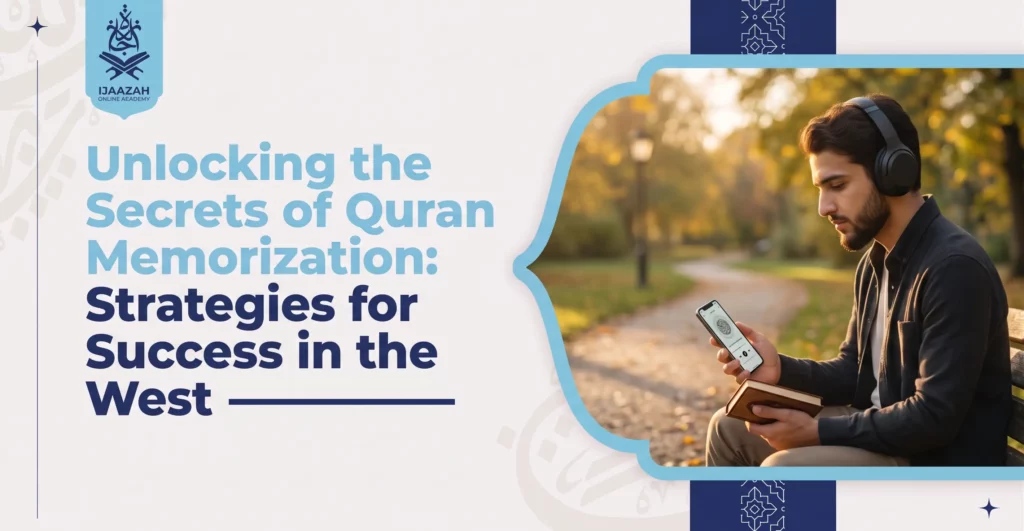
Memorizing the Quran represents one of Islam’s most noble pursuits—a commitment that transcends cultural boundaries and historical epochs. Yet Western Muslims face obstacles unique to their geographic and cultural position. Unlike students in traditional Islamic environments where memorization-centered pedagogy permeates educational structures, Western learners must construct their own frameworks, locate qualified guidance, and build support systems from near-total scratch.
The growing wave of Western Muslims undertaking Hafiz memorization, however, proves this is entirely achievable. Parents in Toronto are raising Hafiz children. Young women in London are completing their memorization in the evenings after university. Retired professionals in Sydney are finally dedicating themselves to this lifelong spiritual objective. Their success hinges on understanding what memorization actually requires—and then systematically building the conditions for that success.
Understanding Quran Memorization Beyond Rote Repetition
Memorization Is Not Mere Mechanical Repetition
The popular misconception treats Quran memorization as an endurance exercise: sit down, repeat verses thousands of times until they stick. This approach produces frustrated students who memorize three pages, forget two, and eventually abandon the effort.
Authentic Quran memorization is a multifaceted cognitive and spiritual practice. It engages auditory memory through listening and recitation. It activates visual memory through text interaction. It employs semantic memory by understanding meanings—verses grasp more securely in minds that comprehend them. It harnesses emotional resonance, as profound meanings create neural pathways distinct from meaningless repetition.
Quality memorization methodology doesn’t fight human cognition; it works with it. This is why tutors matter more than many students initially realize. A skilled educator doesn’t just listen to recitations; they diagnose exactly where retention is failing and deploy targeted techniques to address that specific weakness.
The Spiritual Dimension Sustains Long-Term Commitment
Secular cognitive science explains memory. Islamic tradition contextualizes why anyone would dedicate months or years to this endeavor. The Quran itself honors Hafiz: “And those who have been given knowledge see that what has been revealed to you from your Lord is the truth” (34:6). Hadith literature emphasizes the status of those who memorize—”The best among you are those who learn the Quran and teach it.”
This spiritual framework prevents memorization from becoming a hollow achievement. A young Muslim woman memorizing Surah Maryam doesn’t just absorb phonetic sequences; she internalizes a narrative about virtue, strength, and faith. A teenager memorizing Surah Yusuf encounters one of Islamic literature’s greatest stories. The text itself becomes a companion during the memorization journey—not merely words to be locked in memory, but eternal meanings to be absorbed into one’s spiritual consciousness.
Tutors who understand this dimension teach differently. They pause to discuss meanings. They connect verses to contemporary life. They don’t rush through difficult passages; they linger, allowing students to genuinely integrate what they’re memorizing.
The Particular Challenges Western Muslims Face
Time Zone Misalignment Creates Scheduling Complexity
A student in Los Angeles seeking instruction from an Egyptian teacher faces a nine-hour time difference. Finding a mutually suitable hour requires creative solutions. Morning for the LA student is evening for the Cairo tutor. Evening for the student is deep night for the tutor.
Platforms serving global audiences have developed responses. Some offer dawn sessions capturing “early morning” across multiple continents. Others operate evening windows spanning multiple time zones. Still others emphasize recorded instruction supplemented by asynchronous feedback—the student records their recitation, submits it, and receives detailed commentary within 24 hours.
Time zone obstacles are solvable, but they require platforms specifically designed around global synchronization rather than treating it as an afterthought.
Finding Truly Qualified Tutors Remains Genuinely Difficult
Not every Muslim who has memorized the Quran can teach it effectively. Some lack teaching skills entirely—they memorized but can’t diagnose why a student struggles. Others teach what they were taught, perpetuating pedagogical approaches that may not work for Western learners. Still others lack proper Ijazah (certification of authentic transmission), a significant credential in Quranic sciences.
Western Muslims need tutors who satisfy multiple criteria simultaneously: legitimate memorization credentials; formal teacher training; experience with students from diverse backgrounds; ideally, familiarity with Western cultural contexts. This combination exists, but it’s not common. Legitimate platforms vet their educators rigorously precisely because this scarcity demands it.
Cultural Isolation Undermines Motivation
Memorization requires sustained motivation over months or years. In traditional Islamic environments, this motivation builds through community witnessing, celebration, and collective cultural value placed on the achievement. Parents sacrifice to educate children. Mosques celebrate Hafiz. Extended families recognize the status.
Western Muslims often lack these structures. A young person completing their Hafiz memorization in a suburban UK household may face indifference from neighbors, incomplete understanding from extended family members who haven’t maintained Islamic practice, and secular education systems that don’t acknowledge the accomplishment.
This isolation is psychological, not spiritual. Yet it matters profoundly. Students who believe their achievement will be celebrated by a community persevere through difficulty. Students who fear their accomplishment will be viewed as bizarre by everyone around them require exceptional inner motivation to continue.
Quality platforms address this by building virtual community—online celebrations, peer interaction, public recognition among the student body. These replicate, in digital form, the communal support that traditional environments provide naturally.
Techniques That Actually Work in Western Contexts
Structured Memorization Plans Prevent Chaos
Effective memorization requires a realistic plan: How many verses daily? Which chapters first? How much revision accompanies new memorization? What happens during busy seasons?
A sustainable daily practice—say, memorizing three new verses while revising two previously memorized ones—produces results more reliably than intensive weekend sessions. Consistency matters far more than intensity. A student memorizing for twenty minutes daily completes the Quran faster than one attempting three hours weekly, because daily engagement prevents forgetting what was already learned.
Tutors establish these plans collaboratively, adjusting for the student’s actual life circumstances rather than imposing theoretical ideals. A university student might reduce daily targets during exam season, then increase them afterward. A parent of young children might extend the overall timeline while protecting non-negotiable daily practice.
Technology as a Genuine Memorization Tool
Apps, recording software, and digital Qurans aren’t distractions—they’re legitimate pedagogical tools when used intentionally. A Quran app that highlights current Ayahs while you recite creates visual reinforcement. Recording yourself and listening back reveals pronunciation errors you hear differently when producing versus listening. Digital flashcards target specific difficult passages. Spaced-repetition algorithms optimize revision scheduling based on neuroscience.
The key is intentional deployment. Scrolling mindlessly through Islamic content differs fundamentally from using technology strategically to reinforce memorization.
Group Accountability Structures Create Sustainable Momentum
Some students thrive in complete isolation; most don’t. Online memorization circles—even virtual ones—change the equation. Five students, each memorizing one portion of a Surah, then reconvening weekly to recite for each other, create accountability. Missing a week becomes obvious. Progress becomes visible. Struggles can be shared and addressed.
These groups don’t require geographic proximity. Five Western Muslims in different cities can gather online weekly, creating community that feels authentic despite the digital format.
Resources That Support the Memorization Journey
Platforms Specifically Designed for Memorization
Not all Islamic education platforms are equal for memorization. The best ones feature tutors with specific Hafiz experience, structured curriculum that builds progressive memorization, tracking systems that make progress visible, and ideally, group support opportunities.
Platform evaluation requires asking concrete questions: What qualifications do tutors have? How do they diagnose memorization obstacles? What’s the revision strategy? How do they handle when students hit walls? What community features exist?
Local Community Resources Often Remain Underutilized
Most Western cities contain mosques or Islamic centers with memorization programs. These might not match the quality or structure of premium online options, yet they offer irreplaceable elements: local community, in-person feedback, perhaps specialized Quran recitation instruction unavailable online.
The optimal approach often combines both. Online tutoring from a qualified educator provides systematic progression and personalized attention. Local community participation provides social reinforcement and cultural belonging.
Family as Co-Educators
Parents who don’t memorize themselves can still deeply support a memorizing student. They can listen to recitations, offer encouragement, create protected time and space, celebrate progress. Children memorizing Quran with family support embedded in that effort maintain motivation more reliably than isolated students.
This doesn’t require parents to understand Arabic or know the Quran in depth. It requires presence, interest, and consistent affirmation.
Overcoming the Inevitable Walls
Memorization plateaus are universal. Students progress steadily, then hit a wall—suddenly a particular Surah refuses to settle, or previously memorized material starts slipping. Panic often follows.
Yet these plateaus serve a pedagogical function. They’re the moment when memorization methodology adapts. The techniques that worked for Surahs 1-10 may need adjustment for Surahs 11-20. Revision strategies that sufficed at 3 Surahs memorized won’t maintain 15 Surahs. Students must graduate from approach to approach.
Experienced tutors recognize this progression. They don’t treat plateaus as failure; they recognize them as transition points requiring explicit strategy shifts. This mentorship—the tutor saying “this is normal, and here’s how we adjust”—is irreplaceable.
Building the Hafiz Identity in Western Space
Completing Quran memorization transforms identity. A person becomes known as a Hafiz. Yet Western culture offers no existing framework for this status. Unlike traditional societies where Hafiz carry clear social roles and recognition, Western Muslims must actively construct what it means to be a memorizer in their context.
Some become Quran teachers themselves. Others serve as community Imams. Still others maintain their private spiritual practice while continuing secular careers. The point isn’t what role emerges, but that the student—with supportive tutors and community—consciously chooses.
Beginning the Memorization Journey Today
Quran memorization in the West isn’t a romantic fantasy or an unrealistic aspiration. Hundreds of Western Muslims—people with jobs, families, and secular education—have completed their memorization. They created the conditions: finding qualified tutors, building sustainable practice routines, locating community support. They persevered through plateaus and challenges.
You can do the same. The first step isn’t downloading an app or memorizing your first verse. It’s connecting with a qualified tutor who can assess your readiness, design your plan, and begin guiding your journey.
3-PART CTA FRAMEWORK
1. The Sadaqah Jariyah Share
Do you know a Muslim young person contemplating Hafiz memorization, or a parent hoping their child will complete the Quran? Share this article. Providing others with a realistic roadmap toward memorization—acknowledging both the challenges and solutions—is a gift whose spiritual benefit continues long after you’ve shared it.
2. The 5-Minute Challenge
Sit quietly for five minutes this week and honestly assess: Would memorizing the Quran serve my spiritual growth right now? Do you have the life stability for a multi-year commitment? Is this truly your intention, or is it someone else’s expectation? That clarity—not the decision itself—is what matters. Write your answer down.
3. The Soft Sell (Direct Links)
Ready to explore Quran memorization with a certified guide?
— Book a Free Trial: Meet with an Azhari-certified Hafiz educator who can assess your readiness, discuss your goals, and outline a personalized memorization pathway.
— Test Your Level: Gauge your current Quranic knowledge and recitation ability. This assessment clarifies exactly where your memorization journey would begin.