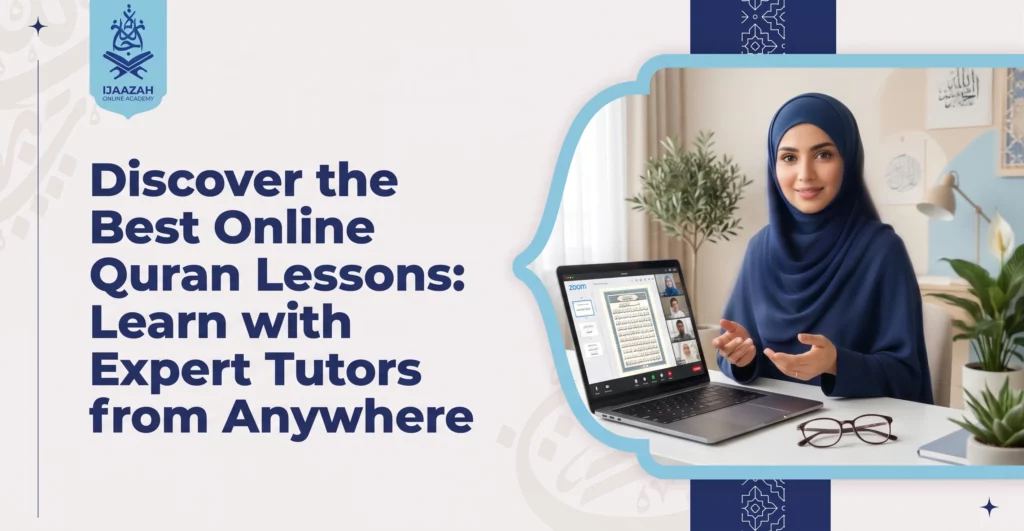
Distance no longer separates a student from genuine scholarship. Families in Toronto, London, Sydney, and Dallas are sitting with Azhari-certified tutors through a single screen — and the quality of instruction has never been more accessible.
For Muslim expats raising children outside Muslim-majority countries, finding a qualified Quran teacher locally was once a logistical challenge. Masjids are often understaffed, schedules conflict with school runs and work shifts, and cultural compatibility between tutor and student is never guaranteed. Online Quran lessons have dismantled each of these barriers, one by one.
What “Qualified” Actually Means in Quran Education
Not every online platform is equal. The most critical factor when choosing Quran lessons online is the tutor’s chain of knowledge — their Ijazah. An Ijazah is a formal authorization from a qualified scholar, tracing back through an unbroken chain to the Prophet ﷺ himself. Without it, a tutor may be fluent but not certified to teach Quranic recitation with the same scholarly weight.
Platforms staffed by Al-Azhar graduates bring that certification to every session. Students are not learning from someone who watched videos and self-studied. They are learning from scholars trained in the oldest Islamic institution in the world — a distinction that matters enormously when Tajweed rules govern every breath and elongation.
Choosing Online Quran Lessons That Match Your Life
The average Muslim expat parent is balancing school pickups, late conference calls, and weekend commitments. Quran lessons online work precisely because they bend to life rather than demanding life bend to them.
- Sessions scheduled at 6 AM before school starts are just as available as sessions at 9 PM after the children are in bed — tutors span multiple time zones, so someone is always available
- Female tutors are available for sisters and young girls, creating a learning environment that is both comfortable and culturally appropriate without any compromise on scholarship
- Children as young as five can begin with Noorani Qaida and Tajweed basics, while adults starting from scratch receive a structured program that respects their existing pace and commitments
Building the Right Learning Habit at Home
The physical environment shapes concentration. A dedicated prayer corner or study desk, free from television and notifications, signals to the mind that this time belongs to the Quran. Many families have found that placing the lesson at the same time each day — right after Fajr or immediately after Maghrib — anchors the habit in an existing rhythm rather than creating a new obligation from nothing.
Technology should simplify, not complicate. A stable internet connection, a working camera, and a quiet space are the only true requirements. Some platforms provide interactive digital whiteboards where students trace Arabic letters during the session, a feature particularly valuable for children learning to write.
What Progress Actually Looks Like
Parents often ask how quickly a child can complete the Quran. The honest answer depends on lesson frequency, daily revision, and the student’s aptitude — but a child attending five sessions per week with consistent home practice typically completes recitation in eighteen months to three years. Adults starting from the alphabet often reach independent recitation within a year.
More meaningful than speed is accuracy. A student who recites with proper Makharij (articulation points) and observes the rules of Madd (elongation) has learned something permanent. Rushing to complete the text without internalizing Tajweed produces a habit that is far harder to correct later.
Know someone struggling to find consistent Quran lessons online? Share this post. Spreading knowledge is a form of Sadaqah Jariyah.
The 5-Minute Challenge: Tonight, sit with your child for five minutes and recite Surah Al-Fatiha together. Focus on one Tajweed rule — the Ghunna in the Noon mushaddad. That single, deliberate minute of attention does more than an hour of passive listening.
Ready to Begin? Book a Free Trial