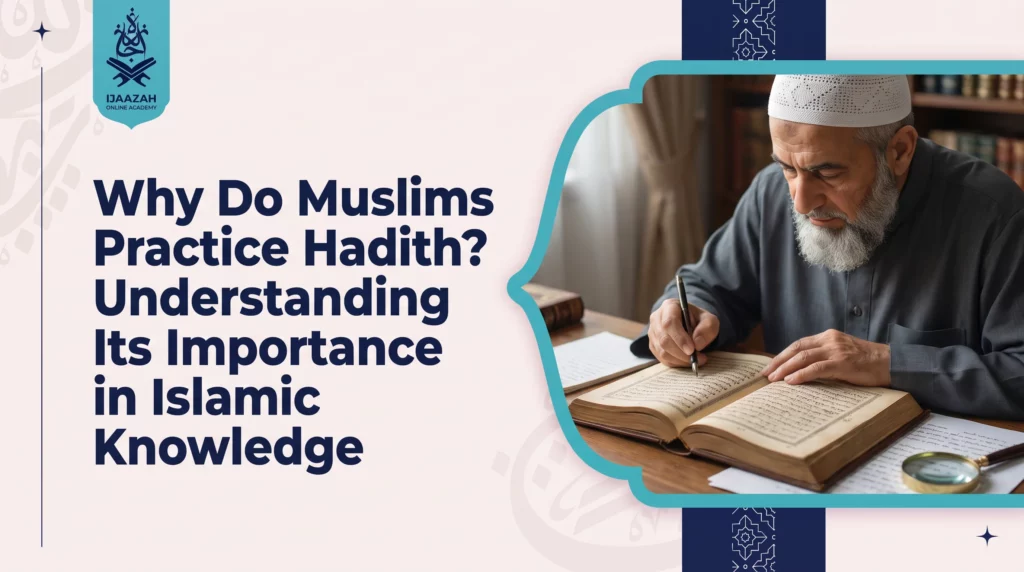
A curious coworker, or eventually your own teenager, asks a version of the same pointed question: how do you actually know a saying attributed to the Prophet ﷺ fourteen centuries ago is real, and not just something invented later. Why do Muslims practice hadith rests entirely on the answer to that question, and it is a stronger answer than most people, Muslim or otherwise, realize.
Dismissing the question defensively helps no one. Explaining the actual verification science behind hadith usually settles it far more effectively than insisting on faith alone.
What Hadith Actually Are
Words, Actions, and Approvals, Carefully Distinguished
Hadith encompass three categories: things the Prophet ﷺ said, things he did, and things he witnessed others doing without objecting to. Scholars distinguish carefully between these categories, since the weight and application of a ruling can depend on which type of report it comes from.
Why This Sits Beside the Quran, Not Above It
The Quran gives principles; hadith show how the first generation actually applied them in practice. Prayer’s obligation comes from the Quran, but its specific form, the number of units and their sequence, comes almost entirely through hadith. Neither source functions completely without the other.
The Science That Answers the Skeptic’s Question
Chains of Narration, Checked Person by Person
Every hadith carries an isnad, a chain naming each person who transmitted it, generation by generation, back to the Prophet ﷺ. Scholars developed an entire discipline dedicated to investigating each narrator’s reliability, memory, and honesty, cross referencing biographical records spanning centuries.
Grading Reports by Evidentiary Strength
Hadith get graded sahih, hasan, da’if, or fabricated based on the chain’s continuity and each narrator’s documented trustworthiness, exactly the kind of source criticism a historian would recognize as legitimate methodology. Allah’s own instruction to investigate a report before acting on it (Quran 49:6) describes precisely the spirit behind this entire verification system.
Why This Predates Modern Fact Checking by Centuries
This isnad based verification system developed in the early Islamic centuries, well before comparable source criticism methods existed in most other historical traditions. Muslims were cross checking oral transmission chains systematically while much of the ancient world simply repeated stories without any equivalent verification process.
Practicing Hadith in a Western, Skeptical Environment
Handling the Question With Confidence, Not Defensiveness
A confident, informed answer acknowledges that not every reported saying is equally reliable, and that Islamic scholarship itself built the tools to distinguish strong reports from weak or fabricated ones. This honesty, paradoxically, tends to build more credibility than an unquestioning insistence that every reported saying is equally certain.
Teaching Children to Ask This Question Themselves
Children raised with some understanding of hadith grading grow up less vulnerable to fabricated quotes circulating online, since they learn early to ask which collection a saying comes from and how it was graded, rather than accepting any attribution at face value.
Learning Hadith Sciences With Proper Guidance
Female Scholars and Tutors in This Field
Women have taught and transmitted hadith since the earliest generation, Aisha chief among them, and that tradition continues today. Ijaazah’s Azhari certified female tutors teach hadith alongside Quran study, grounding students in both sources together.
Fitting This Study Into a Real Weekly Schedule
Sessions scheduled around your actual time zone across the USA, Canada, UK, and Australia let this deeper study happen steadily, rather than only in reaction to an uncomfortable question you were not ready to answer.
Confidence Built on Verified Ground
- Learn the basic categories, sahih, hasan, and da’if, so grading conversations make sense to you.
- Ask which collection a quoted hadith comes from before repeating it yourself.
- Teach children this same habit early, so fabricated online quotes lose their power over them.
An Answer Worth Actually Knowing
Why do Muslims practice hadith? Because a rigorous, centuries old verification system separates reliable reports from weak ones, and that system holds up under honest scrutiny far better than most people, including many Muslims, currently realize. Learn it well enough to explain it confidently, whoever eventually asks.
What to Do When a Weak Hadith Is Already Circulating
Correcting Misinformation Without Sounding Defensive
A relative forwards a message attributing a moving but unverified saying to the Prophet ﷺ, and pointing out the grading issue can feel like picking an unnecessary fight over something well intentioned. A gentle correction, focused on the verification method rather than criticizing the person who shared it, usually lands better than a blunt factual correction alone.
A Habit Worth Building Before Sharing Anything Religious
Checking a quote’s source and grading before forwarding it yourself, using a reputable hadith database rather than a social media caption, takes under a minute and prevents you from becoming part of the same misinformation chain you might otherwise correct in someone else.
Why This Discipline Matters Beyond Religious Circles
A Transferable Habit of Source Checking
The instinct to verify a source before repeating it transfers directly into evaluating news, historical claims, and viral online content generally, making hadith verification training a genuinely useful habit well beyond its original religious context.
Modeling This for Children Early
Children who watch a parent pause to check a source before sharing something online absorb that habit far more effectively than children who only hear the instruction stated abstractly without ever seeing it practiced.
Carry This Forward
Sadaqah Jariyah Share
Someone dismissed this topic once, assuming it rests on blind acceptance. Share this article and correct that assumption with the actual methodology behind it.
The 5 Minute Challenge
Look up one well known hadith and check which collection it comes from and how it is graded. Write down what you learn, and share it with one family member tonight.
Take the Next Step
Book a Free Trial with an Azhari certified tutor, or Take the Test Me Assessment to deepen your study.