A father is told in a dream to sacrifice his only son, and both of them submit. That single moment, recorded in the Quran, gives the second Eid of the Islamic year its shape. So, what is Eid al-Adha? It is the festival of sacrifice, celebrated on the tenth of Dhul Hijjah, when Muslims remember the obedience of Ibrahim (peace be upon him) and offer an animal in gratitude to Allah.
In Western countries the day arrives without a public holiday, without school closures, and often in the middle of a working week. Muslim families still find ways to honour it, and the details of that adaptation deserve careful attention.
What is Eid al-Adha? Meaning, History, and Place in the Islamic Year
The Story of Ibrahim and Isma’il
Allah tells of Ibrahim’s dream in Surah As-Saffat: he says to his son that he sees himself sacrificing him, and asks for his view. The son answers with calm submission and tells his father to do as commanded (Quran 37:102). When both had surrendered, Allah called out to Ibrahim, declared that he had fulfilled the vision, and ransomed the son with a great sacrifice (Quran 37:103 to 107).
The lesson is not about blood. Allah states this plainly: “Their meat will not reach Allah, nor will their blood, but what reaches Him is piety from you” (Quran 22:37). The heart of Eid al-Adha is obedience, gratitude, and generosity.
Where the Day Sits in the Calendar
Eid al-Adha falls after the day of Arafah, when the pilgrims stand on the plain and Muslims elsewhere are encouraged to fast. The Prophet ﷺ said that fasting the day of Arafah expiates the sins of the previous year and the coming year (Sahih Muslim 1162). The days that follow, known as the days of Tashreeq, are described as days of eating, drinking, and remembrance of Allah (Sahih Muslim 1141).
The Significance of Eid al-Adha: Sacrifice, Charity, and Family
Qurbani as an Act of Worship
Allah commands the believer to pray and to sacrifice (Quran 108:2). The Prophet ﷺ taught the order of the day: “The first thing we do on this day is to pray, then we return and sacrifice. Whoever does so has acted according to our Sunnah” (Sahih al-Bukhari 951 and 5545). He himself sacrificed two horned rams, saying the name of Allah and the takbir (Sahih al-Bukhari 5558 and Sahih Muslim 1966).
The animal must be of the required age and free from clear defects such as blindness, evident illness, obvious lameness, or extreme thinness (Sunan Abi Dawud 2802). Many scholars recommend dividing the meat so that the family eats from it, relatives and neighbours receive gifts, and the poor are fed, following the instruction in the Quran to eat from it and feed the needy (Quran 22:28 and 22:36).
Family, Charity, and Gathering
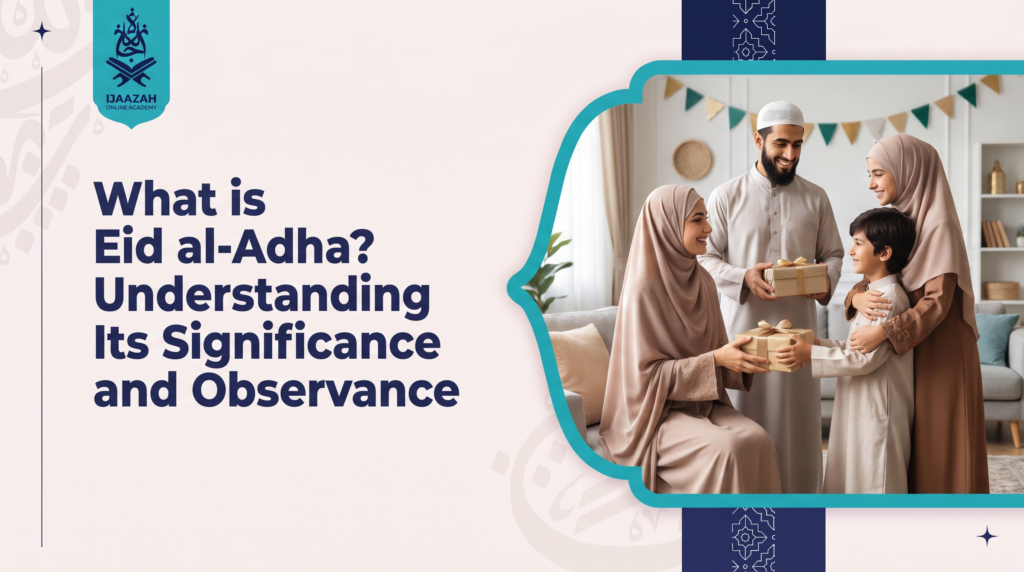
The day is also a family occasion. New clothes, shared meals, visits to relatives, and gifts for children make the day festive. The Prophet ﷺ even instructed that women, including those who are menstruating, should attend the Eid gathering and witness the good, with menstruating women staying away from the prayer area itself (Sahih al-Bukhari 324). Eid is meant to include everyone.
Celebrating Eid al-Adha in the West: Cultural Adaptation and Community
How Muslims in the USA, Canada, the UK, and Australia Adapt
Local mosques and Islamic centres organise Eid prayers in large halls, parks, or sports arenas, often in several sittings because of crowds. Families book time off work in advance, check the announced date, and arrive early. After the prayer, many households gather for breakfast, visit relatives, and take children to community celebrations.
Adaptation does not weaken the day. It shows the resilience of a community that keeps the Sunnah alive while working within a different social calendar. Parents who explain the reasons behind the customs help children hold the day as their own, instead of viewing it as an obligation their parents impose.
Learning the Rulings Before the Day Arrives
Eid raises questions that many families prefer to settle before the day itself: who must sacrifice, when does the time begin, and how does one fulfil the obligation from abroad? An online tutor can answer these questions in a private lesson. Ijaazah’s Azhari certified tutors, including female tutors for mothers and young girls, explain the rulings and their evidence step by step, and lessons are scheduled around your time zone instead of your holiday plans.
Time Zones and Moon Sighting
Australia celebrates many hours before North America, and different communities may follow local sighting or the calculation adopted by their national council. Choose the date that your community announces and follow it consistently, so that the family observes the fast of Arafah, the prayer, and the sacrifice on matching days. When lessons or gatherings run online across borders, confirm the local time of each participant.
Practical Questions About Qurbani and Eid Prayer
How Do I Find a Halal Source for Qurbani in the West?
Sourcing halal meat for the sacrifice is a real logistical challenge. Some Muslim farms allow families to select an animal and witness the slaughter, while licensed slaughterhouses perform the sacrifice on your behalf. Local regulations on slaughter and animal welfare differ by state, province, and country, so use facilities that operate lawfully and ask your community which providers are trusted.
If you prefer to give in a place of greater need, you can entrust a reliable charity to perform the sacrifice on your behalf. Confirm that the animal will be slaughtered within the proper days and that the meat reaches those who need it.
What Time Is the Eid Prayer?
Eid prayer takes place after sunrise, in the morning, once the time for voluntary prayer has begun. Most Western communities publish exact times a few days ahead, and many hold multiple sittings. Check with your mosque and arrive early, as parking and space fill quickly.
What If I Cannot Sacrifice Myself?
The sacrifice is a confirmed Sunnah for those who can afford it, and scholars hold different views about whether it is obligatory. Anyone unsure of their own situation should ask a qualified scholar. Those who intend to sacrifice are also instructed not to cut hair or nails from the start of Dhul Hijjah until the sacrifice is done (Sahih Muslim 1977).
Spreading the Understanding: Neighbours, Children, and Virtual Gatherings
Explaining Eid to Neighbours and Colleagues
A neighbour who asks about your day off deserves a warm and clear answer. Explain that Muslims remember a prophet’s obedience, share meat with the poor, and spend time with family. A small gift of sweets or a card, sent with a kind note, builds understanding better than a long lecture.
Involving Children and Gathering Online
Children learn the meaning of the day through participation. Let them help choose gifts for the needy, prepare food, and practise the takbir. Families separated by distance can gather on video, recite together, and share stories of Ibrahim, which keeps relatives in different cities and countries connected on the same day.
The Sacrifice That Stays in the Heart
Every believer has something beloved that competes with obedience: time, comfort, reputation, or wealth. Eid al-Adha asks each of us to check what is in that place, and to offer it up for Allah’s sake. Take this Eid as a chance to renew your gratitude, ask forgiveness for your shortcomings, and forgive those who have wronged you.
Carry Eid Forward
Sadaqah Jariyah Share
A friend, cousin, or colleague may be wondering what the day means and how to mark it. Share this article with them. Knowledge passed on with sincerity brings reward each time it helps someone understand their faith.
The 5 Minute Challenge
Take five minutes today to teach a child or relative the takbir of Eid. Say it together three times, explain one line in your own words, and agree on one person you will send a warm greeting to on the morning of Eid.
Take the Next Step
Book a Free Trial to learn the rulings of Eid with an Azhari certified tutor, or Take the Test Me Assessment to see your current level.