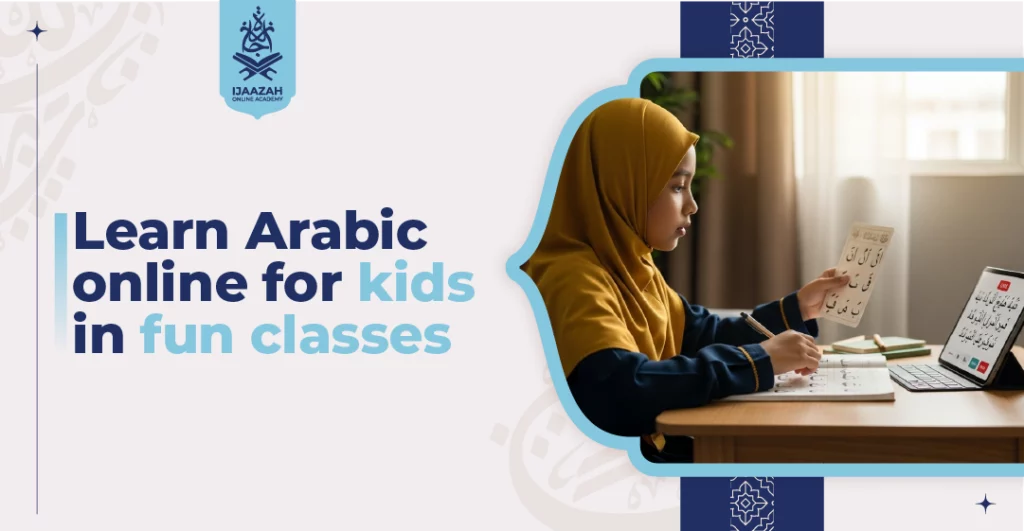
Every parent wants their child to connect with their roots, their religion, and the beautiful heritage of the Arabic language. But let us be honest: handing a seven-year-old a traditional black-and-white grammar workbook is the fastest way to make them dread the subject. Children are wired for play, curiosity, and movement. When they are forced to sit through dry, monotonous lectures where they just repeat words after a teacher, they tune out. You want them to love the language, not view it as a punishment. The secret lies entirely in the delivery. When you choose to learn Arabic online for kids in fun classes, you transform a daunting educational requirement into an exciting weekly adventure that your child will actively look forward to.
Gamifying the Arabic Alphabet
To a child, the Arabic alphabet can look like a complex puzzle. We do not teach it through endless, boring repetition. We turn it into a game.
In our classes, identifying letters and connecting sounds is treated like unlocking levels in a video game. We use colorful digital whiteboards, interactive matching games, and visual rewards. When a child successfully connects the letters to form the word Kalb (Dog) or Qitt (Cat), we celebrate the win. This gamification triggers a dopamine release, making the child eager to solve the next linguistic puzzle.
Speaking Before Spelling
Many traditional programs make the mistake of forcing kids to write perfectly before they are allowed to speak. We flip this method.
Children learn their native language by listening and mimicking, long before they hold a pencil. We apply this natural sequence to Arabic. We focus on high-energy conversational practice first. We teach them how to greet their grandparents, name their favorite colors, and talk about animals. By giving them words they can actually use around the house immediately, we build their confidence and show them that Arabic is a living, breathing language.
High-Energy, Smiling Teachers
It takes a very specific, rare skill set to hold a child’s attention through a computer screen for thirty minutes. A scholar with a monotone voice will lose a child in five seconds.
We carefully select teachers who are naturally energetic and expressive. Our tutors use Total Physical Response (TPR)—meaning they use hand gestures, facial expressions, and even props to explain words. If we are learning the word for “jump” (Qafaza), the teacher and the student are physically moving. This dynamic interaction burns off excess energy and locks the vocabulary into the child’s physical memory.
Bite-Sized Sessions for Short Attention Spans
A child’s attention span is roughly two to three minutes per year of their age. Expecting an eight-year-old to sit perfectly still for a solid hour is a recipe for frustration.
We design our kids’ classes to be short, sweet, and highly impactful. We change the activity every few minutes—moving from a quick story to a pronunciation game, and then to a visual quiz. This rapid pace ensures that boredom never has a chance to set in.
Turn Screen Time into Growth Time
Your child already loves being on a screen. Instead of passive watching, turn that screen time into an interactive, brain-building activity that connects them to their faith and culture.
We invite you to book a Free Trial Session today. Let your child meet one of our fun, energetic teachers and watch their eyes light up as they discover the joy of learning Arabic.