Your child can name three video game characters and half a dozen songs, but can they recite Surah Al-Fatihah without stumbling? That question quietly troubles many Muslim parents in the West. School, sports, and screens fill the afternoon, and the Quran gets whatever time is left over.
Online Quran classes for kids offer a way to change that balance. The right class arrives at your kitchen table at a time that suits your family — taught by someone qualified and patient. A poor fit becomes another chore that everyone quietly abandons. This guide explains how to tell the difference.
Why Quran Education Matters for Children Growing Up in the West
Children absorb what surrounds them, and in Western countries the surroundings rarely include daily Quran. Parents therefore carry the responsibility deliberately. Allah commands the believers to protect themselves and their families (Quran 66:6), and the Prophet ﷺ said that the best of people are those who learn the Quran and teach it (Sahih al-Bukhari 5027).
Early exposure builds a relationship with the Quran that lasts. A child who recites correctly at eight is more likely to stay connected at eighteen, when peer pressure, secular schooling, and identity questions grow louder. Structured learning also gives children a place of belonging in an environment where they may be the only Muslim in the classroom.
Benefits of Online Quran Classes for Kids
Flexibility Across Time Zones and Routines
A family in Vancouver has different evenings than a family in Melbourne, and both differ from a household in Birmingham. Online lessons can be scheduled after school, before dinner, or on weekends, in whatever slot your child is alert and calm. Parents can adjust when exams, sports seasons, or Ramadan change the rhythm of the week.
The prophetic guidance on training children in worship supports gradual habit building: the Prophet ﷺ told parents to command their children to pray at seven (Sunan Abi Dawud 495, graded hasan sahih). Regular, predictable lesson times help build the same gradual habit for Quran.
Qualified Female Tutors for Girls and Mothers
Many Muslim families feel most comfortable when a girl studies with a female teacher, and mothers who want to learn alongside their daughters often prefer the same. Ijaazah has Azhari certified female tutors who teach children and women directly. Girls tend to speak more freely, ask questions without embarrassment, and build confidence when the environment is comfortable.
Interactive Learning That Holds Attention
Young children cannot sit through a lecture, and a good tutor knows it. Effective lessons mix short recitation, repetition games, flashcards, quizzes, and visual aids, with a change of activity every few minutes. A learning management system with videos and practice tasks between lessons gives the child something to revisit without the parent needing to be an expert.
What Ijaazah Offers Young Learners
Customised Learning Plans
A five year old learning the Arabic letters needs a completely different path from a twelve year old who has finished the Qaidah and wants to refine tajweed. Ijaazah builds each child’s plan around age, pace, and prior knowledge. Nobody is pushed ahead before they are ready, and no one is held back when they are ready to move.
One on One Attention
Every session is one to one, so the tutor’s attention stays entirely on your child. Mistakes are corrected immediately, shy children are not overshadowed by louder peers, and the tutor learns exactly how your child thinks. That direct relationship often makes all the difference — between a child who dreads lessons and one who asks when the next one starts.
Progress You Can See
Regular assessments and progress reports tell you what your child has learned, where they struggle, and what comes next. You are never left guessing. If a tutor notices that a child pronounces one letter incorrectly, the next lesson addresses it, and the report explains what changed.
Raising a Young Muslim in a Western Setting
Classes That Speak Your Child’s World
A child in a Western school lives between two vocabularies: home and playground. Lessons work best when the tutor connects the Quran to what the child sees, such as honesty when a classmate copies homework, or gratitude while a family shares a meal. Quran classes then feel like part of daily life instead of a separate subject.
Our guide to Quran lessons for beginners explains how the early stages fit together, so you can see where your child sits on the path.
Parents as Partners
The parent’s role does not end when the lesson begins. Sit near the child for the first few sessions, greet the tutor, and ask what to revise during the week. Praise effort, not perfection, and let your child hear you recite too. Children who see a parent open the Quran are far more likely to open it themselves.
Practical Details Parents Ask About
What Age Should a Child Start?
Many families begin with letter recognition around four or five, and readiness matters more than the number on the birthday cake. Signs that a child is ready include the ability to sit for a short session, imitate sounds, and follow simple instructions. Start with short lessons of twenty minutes or so and extend gradually as attention grows.
Are Online Quran Classes Effective for Young Learners?
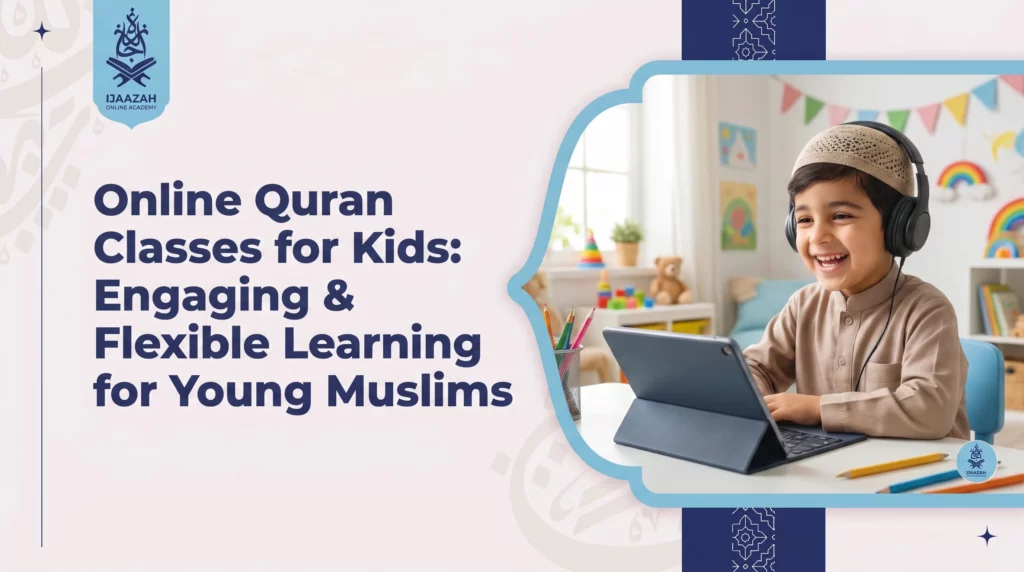
They can be, with the right tutor and a stable routine. Live interaction, immediate correction, and structured practice matter more than the medium. A quiet space, a functioning headset, and a screen large enough for the child to see the mushaf clearly remove most of the obstacles.
What About Internet and Devices?
A stable internet connection and a tablet or laptop are the basics. Test your connection before the first lesson, place the device on a table at eye level, and keep a copy of the Quran nearby. If technology troubles you, ask the tutor for a short setup call before the first session begins.
How Do I Find a Qualified Female Tutor?
Ask about the tutor’s credentials, teaching experience with children, and the way lessons are structured. Request a trial session so that your daughter can meet the tutor before you commit. At Ijaazah, families can request a female tutor directly during booking.
Planting Habits That Last
A child who learns the Quran with kindness remembers it with love — and carries that love into adulthood. Give them short, regular lessons, celebrate every small milestone, and let them hear the sound of your own recitation at home. Make dua for them by name, and ask Allah to make the Quran the light of their chests.
Carry the Quran Into Your Child’s Week
Sadaqah Jariyah Share
Another parent in your circle may be looking for a way to start. Send them this article. Every child who begins to recite because of a shared link adds to your reward, and to theirs.
The 5 Minute Challenge
Sit with your child tonight for five minutes. Ask them to recite the shortest surah they know, listen without interrupting, and tell them one thing they did well. Then choose a regular time for tomorrow.
Take the Next Step
Book a Free Trial with an Azhari certified tutor for your child, or Take the Test Me Assessment to find your child’s starting level.