A child who can sound out Arabic letters is not automatically a child who understands the Qur’an. That gap , between recitation and comprehension , is exactly where Quranic Arabic for kids earns its place in a Muslim household’s priorities, especially one raising children thousands of miles from a mosque-dense neighborhood. Parents in Toronto, Manchester, Sydney, or Houston are not facing the same conditions their own parents faced. Their children are absorbing English (or French, or another dominant language) eight hours a day at school, and Arabic has to compete for cognitive real estate in the evenings and weekends. Quranic Arabic for kids, taught deliberately and early, is how that competition gets won.
Why Western Muslim Households Need a Different Approach
Families in the USA, Canada, UK, and Australia are not simply “Muslims living abroad” , they are raising a generation whose default inner language is English, whose friend groups are largely non-Muslim, and whose exposure to classical Arabic is often limited to weekend classes squeezed between soccer practice and birthday parties. Traditional rote-memorization methods, imported wholesale from Cairo or Karachi classrooms, frequently fail in this setting. Children raised with Western pedagogical norms respond better to explanation, dialogue, and visible progress markers than to repetition alone.
Respecting Tradition Without Ignoring Context
None of this means diluting the material. Tajweed rules remain Tajweed rules, and the meaning of a verse does not change because a child lives in Ottawa instead of Alexandria. What changes is the delivery. A tutor who understands that a nine-year-old in Melbourne has already sat through six hours of a Western curriculum that day will pace a lesson differently than one teaching in a country where Arabic surrounds the child constantly. Culturally sensitive teaching also means recognizing that Muslim families arrive with different backgrounds , Bosniak, Somali, South Asian, Malay, convert households with no Arabic exposure at home , and a rigid, one-size lesson plan serves none of them well.
The Case for a Qualified Female Tutor
Finding a qualified female tutor for Quranic Arabic lessons is not a preference some parents hold quietly , it is, for many households, a non-negotiable condition, particularly once daughters reach late-childhood and early adolescence. A female tutor changes the emotional register of a lesson. Young girls tend to open up more freely about mispronunciations, ask questions without embarrassment, and build the kind of rapport that keeps them returning to lessons willingly rather than under protest. Sons benefit too, especially in the early years, from the patience and nurturing tone many female Azhar-certified teachers bring to foundational Arabic instruction.
More Than a Classroom: A Support Network
Community involvement matters here as much as curriculum. A single weekly session, however well taught, cannot replace the reinforcement that comes from parents, siblings, and a broader circle of families pursuing the same goal. Reputable academies now build small cohort groups, parent check-ins, and shared milestones into their programs so that a child’s Quranic Arabic journey feels less like an isolated chore and more like participation in something communal , a modern echo of the study circles that have always surrounded Qur’an learning.
Scheduling Across Six Time Zones Without Losing Momentum
One of the most persistent obstacles Western parents describe is simply logistics. Online classes accommodating different time zones have solved much of this problem, but only when the platform is built for it rather than retrofitted. A well-run academy offers live sessions at hours that make sense for a family in Los Angeles as well as one in London, plus recorded lessons for the inevitable week when a school concert or a sick day disrupts the routine. Flexibility is not a luxury feature in this context , it is the difference between a child finishing the year fluent and one who quietly drops out after three missed sessions.
Turning a Screen Into a Study Circle
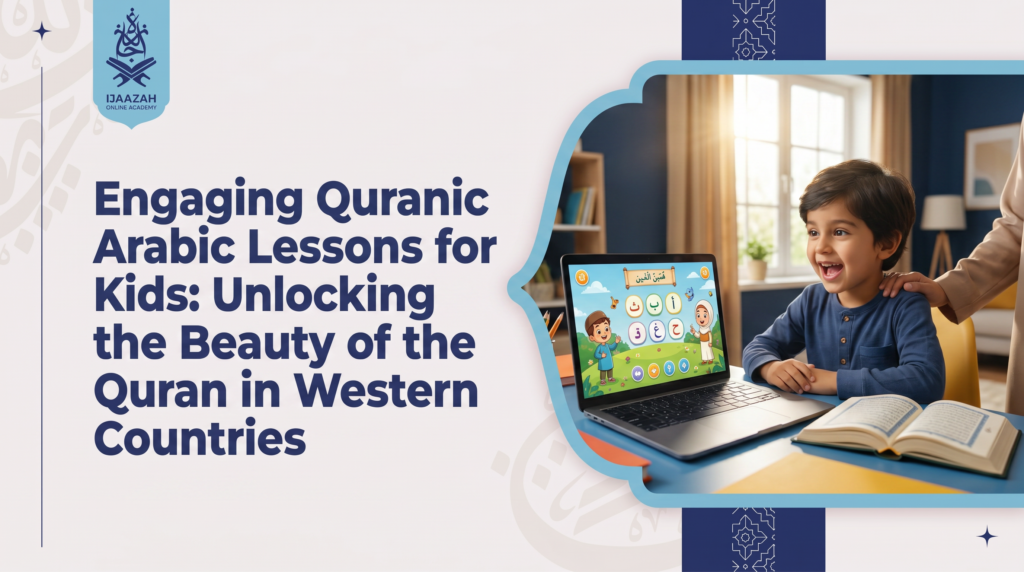
Interactive learning resources have changed what a Quranic Arabic lesson can look like for a seven-year-old. The best resources for teaching Quranic Arabic to kids in Western countries now combine live, one-on-one instruction with digital whiteboards, letter-tracing games, and short recorded stories that reinforce vocabulary between sessions. A tutor might introduce the letter ع through a short animated story, then reinforce it the following week with a simple song built around its sound. None of this replaces disciplined Tajweed instruction , it simply makes the path to that discipline less punishing for a child whose attention span is still developing.
Games, Songs, and Stories as Real Pedagogy
Skeptical parents sometimes worry that games and songs signal a “lite” version of Qur’an education. The opposite tends to be true. Children retain root letters and short surahs far more durably when the material arrives through a memorable melody or a story with characters than through flashcards alone. A structured LMS lets a tutor track exactly which songs, games, and recordings a child has completed, so playfulness never comes at the cost of measurable progress.
Why Earlier Is Genuinely Better
The appropriate age to start learning Quranic Arabic is earlier than most parents assume , many academies begin structured instruction around age four or five, when a child’s ear for phonetics is at its most flexible. Cognitive research on early language acquisition consistently shows that children absorb unfamiliar phonemes, including the guttural sounds unique to Arabic, with far less effort before age seven than after. Spiritually, early exposure means a child’s first sustained relationship with language is bound up with the Qur’an itself, not layered on top of an already-formed linguistic identity years later. Families who start young routinely describe children who approach Arabic with curiosity rather than dread , a pattern that repeats often enough among successful students to be treated as a reliable outcome, not an exception.
When Home Life and Hifz Compete for the Same Hour
Parents rarely fail to enroll their children in Quranic Arabic lessons. They fail to sustain them, usually because homework, extracurriculars, and a tutor’s fixed schedule collide. Common obstacles include inconsistent practice between sessions, siblings competing for the same device, and children who associate Arabic study with punishment because it was introduced as a consequence rather than a choice.
Practical fixes exist for each of these, and none require heroic effort:
- Anchor the weekly lesson to a fixed slot on the family calendar before school schedules are finalized each term, rather than fitting it in afterward.
- Keep practice sessions between lessons to five or ten minutes , a single verse reviewed daily beats an hour reviewed once.
- Let the tutor, not a parent, correct pronunciation mistakes during formal practice, so the parent-child relationship at home stays free of tension.
- Treat Ramadan and Eid as built-in curriculum enhancers: a child memorizing surahs recited nightly in Taraweeh, or learning the vocabulary behind Eid greetings, absorbs meaning that no worksheet can replicate.
A Closing Thought for Parents Weighing This Decision
Quranic Arabic for kids is not a supplementary activity competing with soccer and piano , it is the mechanism by which a child inherits a relationship with scripture rather than a memorized sound pattern detached from meaning. Choosing a tutor who understands both the Western school calendar and the discipline of Tajweed, who happens in many cases to be a woman your daughter trusts instantly, and who teaches through a platform built for flexible time zones, removes nearly every practical excuse that derails good intentions. Consistency, not intensity, is what carries a child from the alphabet to fluent recitation.
Sadaqah Jariyah Share Knowledge that reaches another parent searching for the same answers becomes a small, ongoing charity in its own right. If this guide clarified even one decision about your child’s Quranic Arabic journey, consider sending it to another family weighing the same question , the reward for guidance shared quietly outlives the message itself.
The 5-Minute Challenge Right now, open your family calendar and block a fixed 20-minute slot, three times this week, labeled simply “Arabic.” Do not fill it yet , just protect the time. A schedule that exists on the calendar before a tutor is even chosen is far more likely to survive the school term.
Ready to see how a real lesson feels before committing? Book a Free Trial. Unsure where your child’s Arabic currently stands? Take the Test Me assessment.