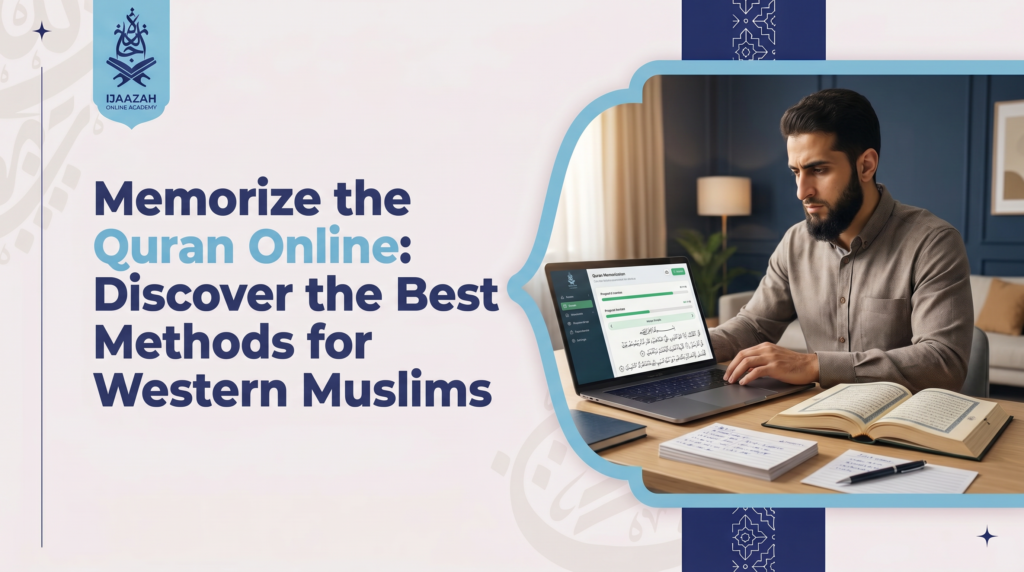
A parent in Toronto scrolls through six different Quran academies at midnight, each promising the fastest results and the most “certified” tutors. She closes her laptop no closer to a decision than when she opened it. This scenario repeats itself daily across Muslim households in North America, the UK, and Australia , not because families lack motivation, but because nobody has handed them a clear framework for evaluating what actually works.
Memorizing the Book of Allah carries weight that transcends any single household’s schedule. The Prophet ﷺ said that the best among us are those who learn the Quran and teach it, and every generation of Muslims has treated hifz as a trust passed from teacher to student. Yet that trust becomes harder to uphold when you live in Manchester rather than Madinah, when your child’s school day ends at 4 PM and homework, sports, and sleep all compete for the remaining hours. Living as a minority community changes the calculus. Local Quran circles may not exist within driving distance. Finding a teacher who understands both classical tajweed and the rhythm of a Western school calendar requires searching beyond your postal code.
Why the Screen Solved a Problem the Mosque Couldn’t
Online instruction did not emerge as a trend , it emerged as a response to genuine scarcity. Families in smaller cities across the Midwest or rural Australia often have no qualified hafiz within reasonable distance. A screen removes that barrier entirely, connecting a student in Sydney with an Azhari-trained tutor whose primary qualification is decades of ijaazah-chain teaching, not proximity.
Scheduling flexibility matters just as much as access. A working parent in Chicago can book a 6 AM session before the household wakes, while a university student in London might prefer late evening slots after lectures end. Because tutoring happens through a platform rather than a physical room, sessions stretch across time zones without anyone commuting. This is precisely where time zones affect online Quran classes for Western Muslims in a practical, day-to-day sense: a well-run academy staffs tutors across multiple regions specifically so a family in Vancouver isn’t forced into a 3 AM lesson just to match a teacher’s daytime hours in Cairo or Amman.
Female representation also improved dramatically once instruction moved online. Finding a qualified female Quran tutor online used to mean waiting for a rare local opportunity; now a mother in Houston can select from dozens of credentialed sisters who teach tajweed and hifz with the same ijaazah rigor as their male counterparts, and daughters can learn from a teacher who shares their gender without any compromise on qualification.
Digital tools add a dimension classical circles rarely offered: instant recitation playback, mistake tracking across sessions, and quiz-based revision that turns passive listening into active recall. None of this replaces a teacher’s ear , but it reinforces what the teacher hears.
Reading Your Own Learning Style Before Reading a Sales Page
Every platform claims to suit every learner, which is a claim worth doubting. A visual learner retains surah structure through color-coded mushaf pages and repetition charts. An auditory learner needs a tutor who repeats ayahs patiently and encourages shadowing before independent recitation. Before comparing academies, sit down and honestly assess which category describes your child, or yourself, because the “best” platform is only best relative to how a specific brain absorbs new material.
Tutor qualification should never be assumed from a polished website. Ask direct questions:
- Does the tutor hold an ijaazah with a documented chain of transmission (sanad), and from which institution?
- How many years has this person taught hifz specifically, as opposed to general Arabic or tajweed only?
- Can the academy connect you with a current student’s family for an honest reference, not just a curated testimonial on the homepage?
- Is there a trial session available so you can evaluate teaching rhythm before committing?
Reviews matter, but read them with a critical eye. A five-star rating tells you little; a review describing how a tutor handled a distracted eight-year-old, or adjusted pace for an adult beginner, tells you everything.
What Separates a Real Curriculum From a Booking Calendar
Some services amount to little more than a scheduling tool bolted onto a video call. Others operate a genuine learning management system that tracks progress, assigns revision, and gives parents visibility into what actually happened during a session. That distinction should sit near the top of your comparison checklist.
When you compare best online platforms for memorizing the Quran, weigh these factors rather than marketing copy:
- Structured curriculum progression , does the academy move students through a defined hifz plan with measurable checkpoints, or does each session feel improvised?
- Tutor-to-student ratio, meaning whether sessions are genuinely one-on-one or crowded group calls dressed up as personalized instruction
- Pricing model , subscription-based billing suits families wanting predictable monthly costs, while one-time package payments suit those who prefer to pay per block of lessons; neither model is inherently superior, but know which one you’re signing up for before entering payment details
- Availability of a trial lesson before financial commitment, which remains the single clearest way to judge tutor-student fit
- Technical requirements, since a platform demanding constant high-bandwidth video will frustrate a family in an area with inconsistent internet service
That last point deserves attention many articles skip entirely. Access to fast, stable internet is not universal even within wealthy countries , rural households, shift-working parents with limited screen time, and families sharing a single device all face friction that urban reviewers rarely mention. A genuinely inclusive academy offers low-bandwidth options, flexible rescheduling, and audio-only fallbacks for connectivity dips.
Setting a Pace You Can Actually Sustain
Ask ten scholars how long it takes to memorize the Quran and you’ll get ten different timelines, because the honest answer depends entirely on daily consistency rather than raw talent. Full-time students in intensive programs sometimes complete hifz within two to three years; a working adult or a child juggling school might reasonably plan for five years or longer. Neither pace is a failure. What matters is building a realistic weekly rhythm , perhaps half a page daily with weekend revision , rather than chasing a timeline borrowed from someone else’s circumstances.
Build the schedule around your actual week, not an idealized one:
- Anchor sessions to an existing routine, such as directly after Fajr or immediately following Maghrib, so memorization attaches itself to a habit already in place
- Set incremental goals measured in verses or lines rather than vague weekly targets
- Protect revision time as fiercely as new memorization, since forgotten pages undo more progress than slow pages ever could
- Use free resources for memorization , recitation apps, printable mutashabihat charts, and recorded qari audio , to reinforce what the paid tutor session covers, without expecting free tools to replace structured teaching
Staying Rooted While Learning Through a Screen
Memorizing Quran from a bedroom in Birmingham or a basement in Minneapolis can feel isolating if the surrounding culture offers no visible reinforcement. Countering that isolation matters as much as choosing the right tutor. Seek out local mosque halaqas even if your primary instruction happens online, since community recitation circles provide the social accountability a screen cannot replicate. Online forums connected to your academy, or general Muslim parenting groups, offer another layer of support , a place to ask what worked for someone else’s distracted nine-year-old.
Cultural sensitivity deserves explicit mention here, because Western Muslim communities are not monolithic. A Somali family, a Bosnian convert household, and a second-generation Pakistani-American family will each bring different accents, different levels of Arabic literacy, and different comfort with local customs into the same virtual classroom. A tutor worth choosing adapts pronunciation correction and cultural references to the student in front of them rather than applying a single template to everyone.
Making the Decision Rather Than Postponing It
None of this analysis matters if it stays theoretical. Pick the platform whose trial session felt right, whose tutor answered your qualification questions without hesitation, and whose schedule genuinely fits the week you actually live , not the week you wish you had. Ijaazah.com was built around exactly this standard: Azhari-certified tutors, private one-on-one sessions rather than crowded group calls, and a learning management system that lets parents track real progress instead of guessing at it.
Sadaqah Jariyah Share Knowledge that reaches another household continues earning reward long after you’ve closed this page. If this guide helped clarify how to evaluate a hifz program, send it to another parent still stuck scrolling at midnight , sharing sound guidance toward the Quran is a small act with lasting return.
The 5-Minute Challenge Open a notebook right now and write down your household’s actual weekly schedule, hour by hour, for the next three days. Circle two fifteen-minute blocks that already exist but currently go unused. Those two blocks are your real starting point for memorization, not some idealized hour you don’t have.
Ready to test a program firsthand? Book a Free Trial. Unsure where your current level stands? Take the Test Me Assessment.