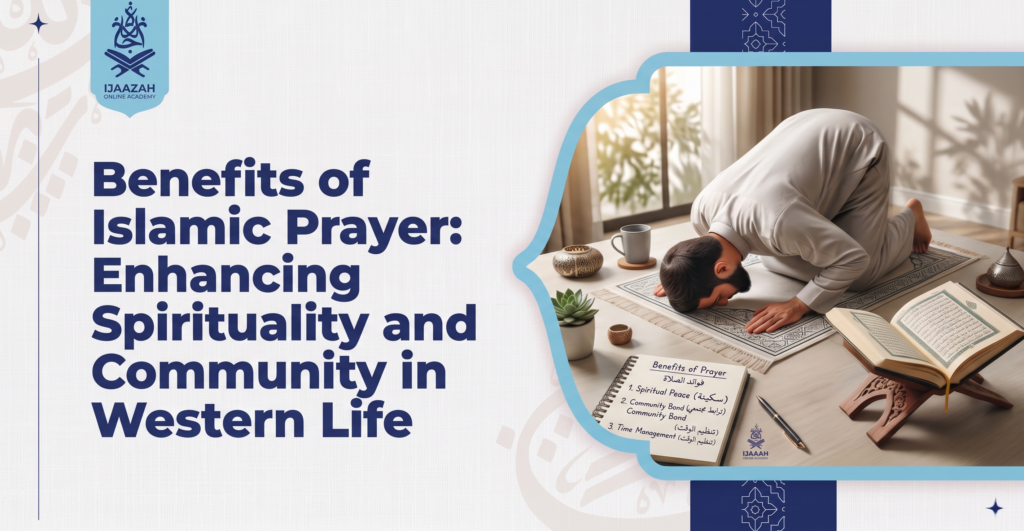
Five times a day, across every time zone on earth, Muslims face the direction of the Ka’bah in Makkah and stand before their Creator. No board meeting overrides Dhuhr. No social engagement cancels Asr. No amount of exhaustion — in most positions of fiqh — excuses abandoning Fajr.
The discipline is deliberate. Salah isn’t designed to fit into life — it’s designed to structure it.
The Prophet ﷺ identified prayer as the first matter of accountability on the Day of Judgment: “The first matter that the slave will be brought to account for on the Day of Judgment is the prayer. If it is sound, the rest of his deeds will be sound. And if it is corrupt, the rest of his deeds will be corrupt.” (Sunan Abu Dawud 864)
Understanding the benefits of Islamic prayer isn’t just a matter of spiritual curiosity. It’s essential context for why Muslims in the West continue to build their lives around Salah, regardless of how inconvenient secular schedules make it.
The Spiritual Core — Remembrance as a Purpose
The primary purpose of Salah is remembrance of Allah. Not acknowledgment — active, focused, structured remembrance. Allah states: “Indeed, I am Allah. There is no deity except Me, so worship Me and establish prayer for My remembrance.” (Quran 20:14)
The word used — dhikr — carries more depth than the English “remembrance.” Dhikr is the active maintenance of Allah’s presence in consciousness. Salah structures this maintenance five times a day, preventing the drift into pure material preoccupation that secular life constantly promotes.
Each prayer carries its own character. Fajr, performed in the quiet before the world’s noise begins, sets the spiritual tone of the day. Isha, performed as the world winds down, closes the day in the same orientation in which it opened. The spiritual symmetry is intentional.
What Research Suggests About Prayer and Mental Health
Western psychology has increasingly examined the relationship between religious practice and mental health outcomes. Consistent findings point to structured religious practice — including prayer — being associated with reduced rates of anxiety and depression, and meaningfully lower reported stress levels.
Islamic prayer offers a particularly structured form of what psychologists call “mindfulness” — the deliberate focusing of attention on the present moment. The physical postures of Salah, the rhythmic recitation, the directional orientation toward Makkah — all redirect attention away from rumination and toward present-moment engagement with worship.
The Prophet ﷺ himself demonstrated the role of prayer in managing emotional weight. When distressed, he would turn to Salah: “He used to seek relief in prayer.” (Sunan Abu Dawud 1319)
The Quran confirms this function directly: “And seek help through patience and prayer, and indeed, it is difficult except for the humbly submissive [to Allah].” (Quran 2:45)
The Social Architecture of Congregational Prayer
Salah isn’t only an individual practice. The congregational prayer — Jumu’ah (the Friday prayer) and the five daily prayers performed in the mosque — carries significant communal weight.
The Quran repeatedly pairs prayer with Zakah, suggesting that spiritual practice and social responsibility are inseparable in Islamic theology. Congregational Salah creates horizontal solidarity among Muslims — reinforcing that faith isn’t a private affair but a communally lived reality.
For Muslims in Western countries without large Muslim-majority communities nearby, congregational prayer at a local mosque becomes one of the few reliable points of contact with the broader Muslim community. Its value extends well beyond the religious act itself.
Salah as a Physical Practice
The postures of Salah — standing, bowing (ruku’), prostration (sujud), sitting — constitute a regular physical engagement with worship that few religious traditions match in frequency and precision. Five prayers across the day involve multiple cycles (rak’ahs) of these postures.
Sujud — the prostration — holds a particular place in Islamic spirituality. Placing the forehead on the ground before Allah is the physical embodiment of submission, the meaning of Islam itself. The Prophet ﷺ described sujud as the closest a servant can be to his Lord: “The closest that a servant can be to his Lord is when he is prostrating, so make much supplication in it.” (Sahih Muslim 482)
Managing Salah in a Western Routine
Prayer times shift throughout the year based on the sun’s position — meaning a Muslim in London faces vastly different Fajr times in June than in December. In Scandinavian countries, extreme seasonal variation in daylight hours creates fiqh questions that Islamic scholars address specifically for those communities.
Prayer time apps — Muslim Pro, Athan, and others — help Western Muslims track accurate prayer times for their precise geographic location. Many Western workplaces have become increasingly accommodating of prayer breaks as Muslim employees have advocated more openly for their religious practice.
Female Participation and Online Prayer Education
Women who want to learn the complete prayer — its conditions, pillars, obligatory elements, and sunnahs — benefit significantly from access to qualified female tutors. Online Quran academies provide exactly this, with sessions tailored to women’s specific fiqh questions about prayer during menstruation, prayer dress requirements, and leading prayer within family settings.
Accessible, qualified female Islamic scholars — available through online platforms regardless of time zone — have made this dimension of Islamic education meaningfully available to Western Muslim women who previously lacked access to it.
Someone in your circle is probably praying five times a day without ever having been taught the full fiqh of their Salah. Share this article — knowledge that improves someone’s prayer is Sadaqah Jariyah of the highest order.
5-Minute Challenge: Take one prayer today and, before you begin, recall the meaning of each phrase you’ll recite — starting with Surah Al-Fatiha. If you struggle to explain even one phrase in your own words, that’s your next lesson.
To learn the complete fiqh and spiritual depth of Islamic prayer, Book a Free Trial Lesson with an Azhari-certified tutor or Test Your Level today.