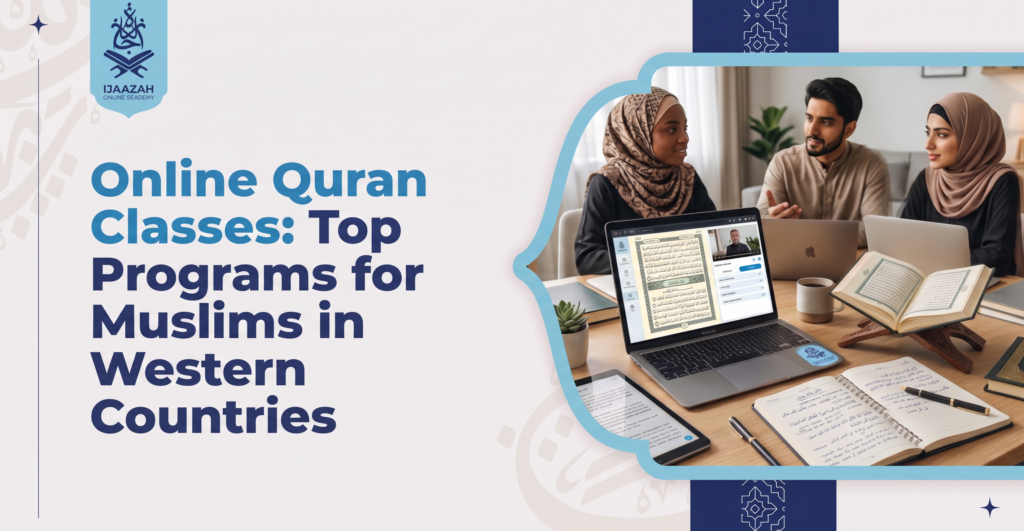
The market for online Quran classes has expanded dramatically in the last decade. For Muslim families in the USA, Canada, UK, and Australia, this is largely good news — qualified instruction that was once geographically out of reach is now available from home. But that expansion has also produced programs that look similar on the surface and perform very differently in practice. A platform with a polished website, professionally produced promotional videos, and a long list of course names is not necessarily one that will teach your child or yourself to recite correctly.
This article is a practical framework for evaluating online Quran programs before you commit — and for knowing what to demand once you do.
The Non-Negotiable: What a Qualified Online Quran Teacher Actually Looks Like
Before evaluating features, pricing, or scheduling options, the question that matters most is this: Who is the teacher, and what are their credentials?
The gold standard in Quran teaching is the Ijazah (إجازة) — a certified, unbroken chain of transmission connecting the teacher’s recitation back through their own teachers to the Prophet ﷺ. An Ijazah in recitation (Ijazah bit-Tajweed or Ijazah bil-Qira’at) means the teacher was formally examined by a certified scholar, recited the Quran completely with correct Tajweed, and was authorized to teach and transmit. This is not a certificate anyone issues to themselves — it requires oral examination, correction, and approval from an already-certified chain.
When evaluating any online program, ask directly: Do your teachers hold an Ijazah? In which recitation? Who granted it? A program that cannot answer this question clearly is a program whose teachers’ qualifications are unverifiable.
For Azhari-certified teachers specifically — those trained at or examined by Al-Azhar University in Egypt, the world’s oldest continuously operating center of Islamic learning — the credential carries centuries of institutional weight. Azhari certification is not a marketing term; it reflects a specific examination process and a specific standard of classical training.
Scheduling That Actually Works for Western Families
The second axis on which online Quran programs differ most sharply is scheduling. A program with excellent teachers is useless if those teachers are only available during Cairo business hours — which translates to roughly midnight to 8am EST, or 3am to 11am PST.
Muslim families in Western countries need programs that have organized their teaching staff around Western time zones — not programs that leave you to negotiate individually with teachers whose availability happens to include a 6am slot on Saturdays. Specifically:
- USA (EST/CST/MST/PST): Most viable slots are weekday evenings (5pm–9pm) and weekend mornings (8am–12pm).
- Canada: Overlaps significantly with US time zone requirements; same windows apply.
- UK (GMT/BST): Afternoons and early evenings (3pm–8pm) work for school-age children and working adults.
- Australia (AEST/AWST): Morning slots (7am–9am) before school and Saturday mornings are the most practical windows.
Ask any program you are evaluating: What specific time slots do you have available in my time zone? Get a concrete answer, not a generic “we’re flexible.” Scheduling ambiguity is one of the most common reasons families drop out of otherwise good programs within the first three months.
One-on-One vs. Group Classes: The Quality Gap Is Real
Group online Quran classes are more affordable and provide a sense of community. They are also significantly less effective for recitation correction, and the reason is simple arithmetic: in a group of ten students with a one-hour session, each student receives roughly six minutes of direct attention. In a one-on-one session, every minute is instruction directed at your specific errors.
Tajweed correction is inherently individual. Your mispronunciation of ض (Dad) is specific to your mouth and your habits — it is not the same error the student next to you is making. A teacher who is managing ten students simultaneously cannot hear your specific errors with the attention required to correct them reliably. They correct what they catch; they cannot catch everything.
For Quran memorization (Hifz) specifically, one-on-one instruction is even more critical. A Hifz student needs their new material checked, their recent material reviewed, and their older material tested — every session. That three-tier review structure cannot be maintained in a group class without leaving someone behind in every session.
The recommendation: use group classes for community, motivation, and supplementary exposure. Use one-on-one instruction for actual recitation correction and memorization.
Female Teachers: Why Representation Changes the Learning Environment
For families with daughters, and for women learning Quran as adults, the availability of qualified female teachers is not a secondary consideration — it is often the primary one. Many Muslim families in Western countries have a strong preference for female teachers for their daughters and younger children, for reasons rooted in Islamic modesty principles and in the practical reality that children (and many adult women) learn more freely and comfortably in same-gender instruction.
A qualified female Quran teacher who holds an Ijazah, teaches with correct Tajweed, and is available in your time zone is not a rare resource — but not every platform has invested in building a roster of them. When evaluating programs, ask:
- How many of your teachers are female?
- Do your female teachers hold Ijazah credentials?
- Can you guarantee a female teacher for our sessions, or is assignment dependent on availability?
Platforms that can answer these questions confidently are the ones that have deliberately built that capacity. Platforms that offer vague reassurances are the ones where female teachers are an afterthought.
The Trial Lesson: The Only Evaluation That Actually Counts
All of the above research — credentials, scheduling, teacher gender, curriculum structure — narrows the field significantly. But the evaluation that counts most is the trial lesson.
In a trial session, pay attention to:
Does the teacher listen more than they talk? A Tajweed lesson should be mostly you reciting and the teacher correcting — not the teacher explaining rules while you listen. If the first session is primarily lecture, the teaching methodology is likely passive.
Do they identify specific errors, or give general feedback? “Your recitation sounds good, mashallah” is not feedback. “Your ص is being produced from the wrong position — move it back to the teeth” is feedback. Specificity is the marker of a teacher who actually heard you.
Does the child (or adult learner) seem engaged? Engagement in the first session is a reliable predictor of consistency. A teacher who creates genuine engagement in a trial session is a teacher the student will want to return to.
The Role of Family in Making Online Learning Stick
Online Quran classes are most effective when the household treats them as a priority — not an optional enrichment activity. Practically, this means:
A dedicated, quiet space with reliable internet for each session. The technical baseline matters; poor audio quality directly undermines Tajweed correction because neither teacher nor student can hear precisely.
Parents present or nearby for younger children’s lessons — not to interfere, but to reinforce what was covered afterward. A parent who asks “What did you learn in your session today?” and reviews a few lines with their child between sessions doubles the retention rate without additional cost.
Quran recitation in the home environment, separate from the formal lesson, is what converts a class into a living practice. Children who grow up hearing the Quran recited at home by their parents do not experience online lessons as an isolated school subject — they experience them as part of a household culture that takes the Quran seriously.
Share This With a Family Who Is Still Searching
Know a Muslim family in your community who keeps saying they need to find a Quran class but hasn’t made the move? Share this article. Helping them evaluate rather than just search is the gift that gets them to actually start — and the reward of every lesson that follows belongs partly to you.
Your 5-Minute Challenge: Write down the three most important criteria for your family’s ideal Quran class — specific time slots, teacher gender, credential type, or curriculum focus. Then use those three criteria as your filter when evaluating any program. Clarity before searching saves weeks.
Start With One Free Trial — No Commitment Required:
Book Your Free Trial Lesson at Ijaazah
FAQ
Q1: What are the benefits of online Quran classes for Muslims in Western countries?
Online Quran classes remove the geographical barrier to qualified instruction, provide flexible scheduling around Western time zones and working hours, make one-on-one teaching accessible at lower cost than in-person instruction, and allow families to access Azhari-certified or Ijazah-holding teachers regardless of their city or country. For families in areas with small Muslim populations, online instruction is often the only practical path to qualified Quran education.
Q2: Are there female Quran tutors available for online classes?
Yes — reputable online programs maintain rosters of qualified female teachers who hold Ijazah credentials. For families with daughters or women seeking same-gender instruction, confirming the availability of certified female teachers before enrolling is a reasonable and straightforward question to ask any program.
Q3: How do I choose a good online Quran learning platform?
Evaluate four things:
(1) teacher credentials — specifically whether teachers hold an Ijazah in recitation,
(2) scheduling — whether the platform has genuine availability in your time zone,
(3) format — whether one-on-one instruction is available for recitation correction, and
(4) trial access — whether you can evaluate a teacher before committing. Platforms that are confident in their quality offer transparent credentials and free trial lessons without hesitation.
Q4: What time zones are online Quran classes offered for students in the USA, Canada, UK, and Australia?
Reputable platforms organize teaching staff specifically around Western time zones: weekday evenings and weekend mornings for North America (EST through PST), afternoons and early evenings for the UK, and morning slots for Australia. Confirm specific available time slots in your actual time zone before committing — vague assurances of flexibility are not the same as confirmed availability.
Q5: Can I learn Quran online with my family — children and adults together?
Most programs accommodate both children and adults but structure their curricula separately by age and level. Family enrollment under the same platform is practical and often discounted; same-gender teachers can be requested for daughters and female family members. A shared household commitment to Quran learning — parents and children studying simultaneously, even with different teachers — significantly improves the consistency and culture that makes both succeed.