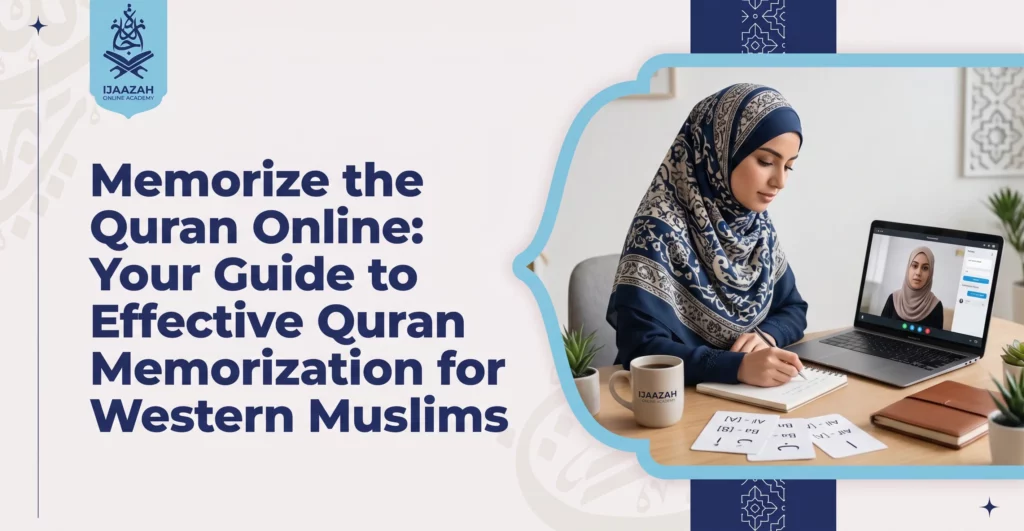
Quran memorization stands as one of Islam’s highest spiritual pursuits—yet for Western Muslims juggling careers, family commitments, and geographic isolation, traditional methods feel impossibly distant. Online memorization programs have fundamentally altered this landscape, enabling Muslims across North America, Europe, and Australia to pursue this noble goal from home.
The statistics tell a compelling story. A growing cohort of Western Muslims now recognizes that Tahfiz (memorization) isn’t reserved for scholars in traditional madrassas. It’s an attainable dream—provided you have the right guidance, structured approach, and technological tools backing your effort.
Why Online Quran Memorization Matters Now More Than Ever
Memorization transforms your relationship with the Quran. Unlike casual reading, memorizing locks the Quranic text into your consciousness—activating deeper neural pathways and spiritual connection simultaneously. Prophet Muhammad (peace be upon him) emphasized this practice, and many of his companions became Huffaz (those who memorized the entire Quran) within years.
For Western Muslims, the obstacle has never been intention or capacity. It’s been logistics—finding qualified tutors, synchronizing time zones across continents, and accessing structured curricula that respect your Western lifestyle.
Online platforms eliminate these friction points entirely.
The Flexibility Factor: Scheduling Across Time Zones
Consider this scenario: You’re a Canadian professional working 9-to-5. Traditional classes demand rigid schedules. Online memorization inverts this problem—you control when lessons occur.
Programs catering to Western Muslims deliberately structure their tutor availability around North American, UK, and Australian time zones. A professional in Toronto can book a 6 AM session before work. A mother in London can schedule post-bedtime lessons at 9 PM. This granular flexibility doesn’t diminish rigor—it enhances sustainability.
Memorization isn’t a sprint. It’s an 18-24 month commitment for most learners aiming to complete the entire Quran. Flexibility ensures you don’t abandon progress midway due to scheduling conflicts.
Access to Qualified, Female-Friendly Tutors
A significant challenge for Western Muslim women involves finding female instructors who combine deep Quranic knowledge with pedagogical skill. Traditional institutes in majority-Muslim regions often lack this infrastructure.
Top online memorization platforms employ specifically vetted female tutors—women with Ijazah (formal certification in Quranic recitation) who’ve trained specifically to teach Western learners. These instructors understand cultural nuances, communication preferences, and the specific challenges faced by diaspora Muslims.
This isn’t a minor feature. For many women, learning from female educators removes cultural barriers, builds confidence, and ensures teaching styles respect gender-specific preferences.
Tailored Learning Plans: Your Personal Memorization Blueprint
Not all students learn identically. A university student with a cognitive science background might absorb Quranic text through spaced repetition apps. A parent with limited study time might benefit from shorter, high-intensity sessions distributed across the week.
Premium platforms diagnose your learning profile—assessing current Quranic familiarity, memorization history, cognitive strengths, and weekly availability—then custom-engineer a plan matching your neurology and lifestyle.
One student might memorize 2-3 verses daily. Another progresses at 1 verse every two days but demonstrates superior long-term retention. Tailored plans respect these differences, eliminating the demotivation that comes from arbitrary, one-size-fits-all curricula.
Interactive Technology: Beyond the Traditional Repetition Model
The old memorization model: sit with a tutor, recite repeatedly, move forward. This works—but it’s passive regarding student agency and leaves no digital footprint of progress.
Modern platforms integrate:
- Spaced repetition algorithms that resurface previously memorized verses before neural decay sets in
- Voice recognition technology flagging pronunciation inconsistencies in real-time
- Progress dashboards visualizing memorization milestones and retention rates
- Peer interaction forums connecting students across regions for accountability and motivation
Technology doesn’t replace human instruction; it amplifies the tutor’s effectiveness by automating routine feedback and tracking.
Overcoming Time Management Challenges
“I want to memorize the Quran, but I work 50 hours weekly and have two kids.” This refrain echoes across Western Muslim communities.
Successful online memorization requires strategic time blocking—not marathon sessions. Consider this architecture:
- Tuesday & Thursday evenings (6-6:30 PM): Tutor-led memorization session—new content
- Monday, Wednesday, Friday (20 minutes each): Mobile app review sessions during your commute
- Saturday morning (30 minutes): Revision with a memorization partner via video call
- Sunday (15 minutes): Listening to your memorized sections via podcast-quality audio
This model accumulates roughly 150 minutes weekly—substantial enough for 2-3 new verses per week—while distributing cognitive load across the week rather than concentrating it.
The psychological advantage is profound: frequent, brief exposure to material outperforms cramming, and the distribution prevents burnout.
Building Community: The Underestimated Accelerant
Memorization feels solitary on the surface. In reality, it thrives within community. Successful Huffaz across Western regions cite their memorization cohort—not just their tutor—as the primary retention mechanism.
Online platforms increasingly facilitate peer accountability through:
- Structured memorization groups meeting weekly to recite together
- Mentorship pairings between advanced students and beginners
- Community challenges during Ramadan or specific Quranic chapters
- Success celebration rituals marking milestones (completing a Juz—chapter—becoming a Hafiz)
These elements transform memorization from an isolated, grueling task into a collective spiritual practice. You’re not memorizing alone; you’re part of a diaspora movement reclaiming Islamic literacy in Western contexts.
Addressing Cultural Sensitivity in Teaching Approach
Western Muslims arrive with diverse backgrounds—converts, second-generation immigrants, recent arrivals. Each cohort brings different linguistic capacities, religious literacy levels, and cultural assumptions.
Tutors trained for Western contexts intentionally:
- Scaffold Arabic concepts for non-native speakers, explaining grammatical structures before expecting pronunciation perfection
- Contextualize Quranic themes within contemporary dilemmas Western Muslims face—navigating identity, maintaining faith in secular environments, raising Muslim children
- Validate learning paces without imposing guilt-based comparisons to “traditional” memorizers
- Accommodate diverse learning modalities—some students memorize visually, others through auditory repetition, others through kinesthetic movement
This cultural attunement doesn’t dilute rigor. Rather, it ensures teaching methods activate rather than alienate the learner.
Debunking the “Online Versus Traditional” False Binary
A persistent misconception: online memorization is somehow inferior to traditional madrassah settings.
This misses the functional distinction. Traditional models excel in immersive, full-time environments where students spend 4-6 hours daily on Quranic sciences. They’re designed for young people with no competing obligations.
Online models optimize for different constraints—working professionals, parents, people in regions without access to qualified teachers. Within those parameters, efficacy matches or exceeds traditional methods when students demonstrate genuine commitment.
The Quran doesn’t memorize itself differently based on whether instruction occurs in Cairo or Calgary. What matters is quality of teaching, student discipline, and consistency—all of which online platforms deliver when chosen wisely.
Charting Your Path Forward
Beginning an online memorization journey requires three concrete steps:
Step One: Assessment. Evaluate your current Quranic familiarity. Can you recite Surah Al-Fatiha cleanly? Do you know basic Tajweed rules? This baseline determines curriculum entry point.
Step Two: Tutor Vetting. Research platforms offering trial lessons. Speak directly with prospective tutors about their Ijazah lineage, teaching philosophy, and experience with Western learners. Chemistry matters enormously.
Step Three: Commitment. Establish your weekly memorization schedule before enrolling. Protect those hours jealously. Memorization demands consistency more than intensity—showing up faithfully for 20 minutes daily outweighs sporadic 3-hour weekend binges.
The Broader Significance
Memorizing the Quran as a Western Muslim carries symbolic weight beyond personal piety. You’re asserting that Islamic learning isn’t geographically bound to traditional Muslim lands. You’re demonstrating that Western infrastructure—technology, individualized education, flexible scheduling—can serve Islamic purposes. You’re becoming a living bridge between your ancestral spiritual heritage and your contemporary reality.
This matters. When your children witness a parent completing Tahfiz, they see Islam not as inherited tradition but as active, deliberate practice. When your community learns you’ve memorized the Quran while managing a full-time career, they glimpse what’s possible.
Online memorization platforms make this vision concrete. They’ve democratized access to an Islamic practice once reserved for the privileged few. Now, anyone with commitment and internet connection can pursue this highest spiritual calling.
Sadaqah Jariyah Share: Struggling to find time for Quranic memorization? Know someone inspired to memorize online but unsure where to start? Share this post with your community. Spreading Islamic knowledge—especially about accessible pathways to Tahfiz—represents ongoing charity (Sadaqah Jariyah) that benefits countless Muslims for years.
The 5-Minute Challenge: Today, spend 5 minutes listening to any Surah you know partially. Notice which verses stick and which blur together. This awareness is your memorization starting point.
Next Steps:
Book a Free Trial — Connect with an Azhari-certified tutor matched to your goals and schedule.
Test Your Quranic Level— Discover where you stand and what memorization pathway aligns with your current knowledge.