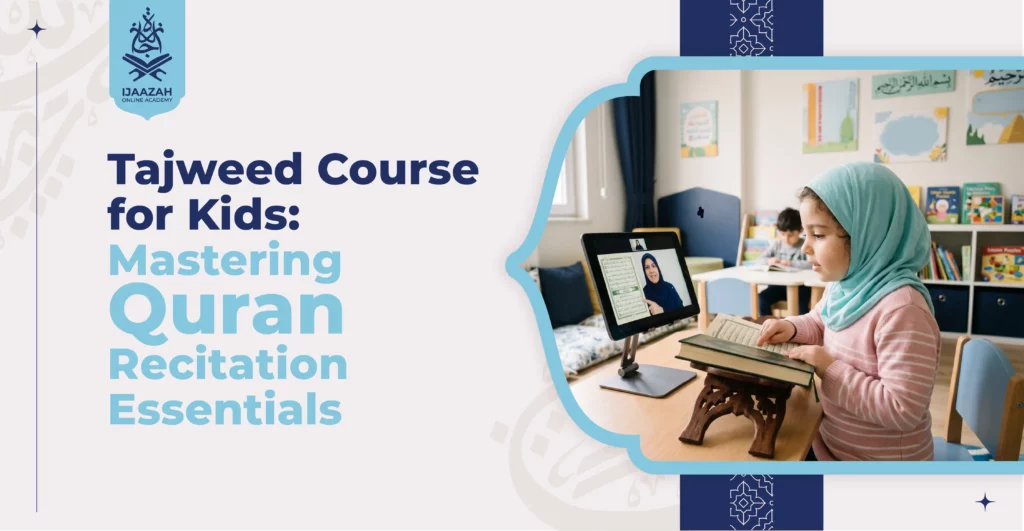
Teaching children to recite the Quran correctly is one of the most meaningful investments a Muslim parent can make. Tajweed—the set of rules governing proper Quranic pronunciation—isn’t just a technical skill. It’s the foundation of a lifelong relationship with the words of Allah. Starting a tajweed course for kids early gives children the tools to recite with confidence, accuracy, and spiritual presence that stays with them into adulthood.
What Tajweed Is and Why It Matters for Children
Tajweed comes from the Arabic root meaning “to make well” or “to improve.” In practice, it refers to the precise rules of pronunciation, elongation, and articulation that govern how the Quran is recited. Every letter has a specific point of articulation (makhraj), and certain letter combinations trigger rules like ghunna (nasalization), idgham (merging), and madd (elongation).
For children, learning these rules early has compounding benefits. Young learners absorb phonetic patterns more naturally than adults—their ears and mouths are still calibrated for new sounds. A child who learns correct Tajweed at age seven will recite with an accuracy that most adults who start later will spend years trying to achieve.
Key Features of an Effective Tajweed Course for Kids
Not every Tajweed course is designed with children in mind. When choosing a program for your child, these features make a genuine difference:
- Age-appropriate teaching methods — Children learn through engagement, not lecture. The best courses use storytelling, games, visual aids, and repetition-based activities that make Tajweed rules memorable rather than mechanical.
- Qualified female tutors — For young girls especially, having a female instructor creates a comfortable, appropriate learning environment. Many Muslim families in the West specifically seek female Quran teachers for their daughters, and reputable platforms like Ijaazah.com make this a standard offering.
- Flexible scheduling across time zones — Families in the USA, Canada, UK, and Australia need courses that work around school hours and family routines. Online platforms with multi-timezone scheduling solve this without compromise.
- One-on-one instruction — Group classes have their place, but Tajweed correction requires individual attention. A tutor who can hear your child recite and correct errors in real time is far more effective than a recorded course.
Basic Tajweed Rules Children Learn First
A well-structured tajweed course for kids typically begins with foundational rules before progressing to more complex ones:
- Madd (elongation) — Learning which letters require extended pronunciation and by how many counts
- Ghunna (nasalization) — The nasal sound produced with certain letters, particularly noon and meem
- Qalqala (echo sound) — The slight bounce in pronunciation of specific letters when they appear with sukoon
- Idgham (merging) — When certain letters blend into the following letter
These rules are introduced gradually, with plenty of practice and positive reinforcement. The goal at the early stages isn’t perfection—it’s building correct habits that become second nature over time.
The Role of Parents in Supporting Tajweed Learning
Children learn best when their home environment reinforces what they’re studying. Parents don’t need to be Tajweed experts to support their child’s progress. Simply listening to your child recite after class, playing Quran recitation audio at home, and showing genuine interest in their progress creates an environment where learning feels valued rather than obligatory.
Many online platforms also provide parents with progress reports and session recordings, so you can stay informed about your child’s development even if you’re not present during lessons.
Give your child the gift of correct Quran recitation. Book a free trial Tajweed class for your child at Ijaazah.com: Register here.
Want to assess your child’s current recitation level first? Use the free evaluation tool at Ijaazah.com.