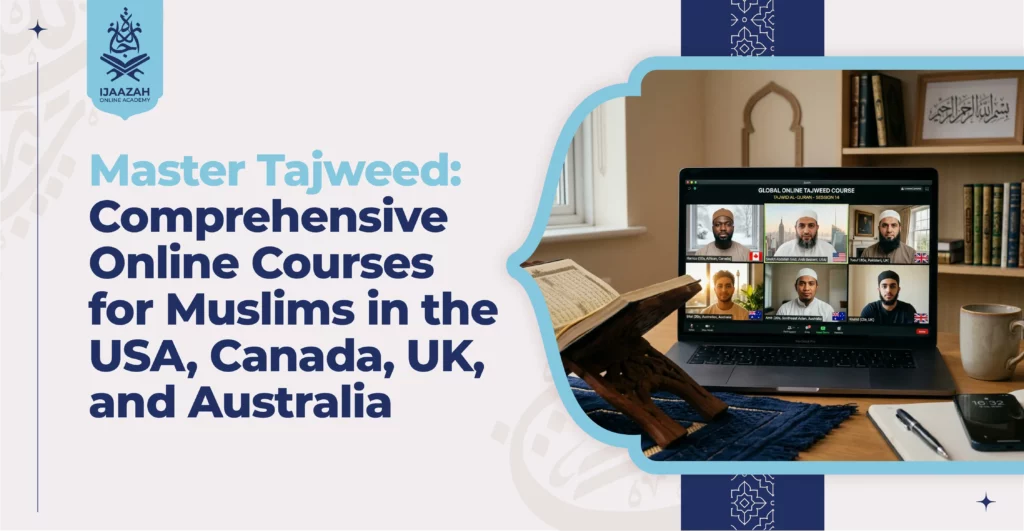
Across four continents of Western Muslim life — from the suburbs of Chicago to the high streets of Birmingham, from the suburbs of Toronto to the neighborhoods of Sydney — a shared commitment unites millions of Muslim families: learning to recite the Quran correctly. Tajweed, the science governing that recitation, is not a peripheral refinement but a foundational obligation for every Muslim who engages with the Quran.
Online Tajweed courses have transformed access to this knowledge. A decade ago, a Muslim family in rural Texas or Northern England had essentially no access to qualified Tajweed instruction outside of occasional mosque workshops. Today, they can connect with a certified Egyptian Tajweed teacher in real time, receive individualized feedback, and progress systematically through a structured curriculum — all from a home computer. This guide surveys the best approaches to online Tajweed education across the four primary Western English-speaking regions.
What Is Tajweed and Why Does It Matter Today?
The word Tajweed (تجويد) comes from the Arabic root meaning excellence, precision, and improvement. As an Islamic discipline, it codifies the rules of Quranic pronunciation that were established during the lifetime of the Prophet Muhammad (PBUH) and transmitted through generations of scholars and reciters. The science was formally systematized by scholars like Ibn Al-Jazari (1350–1429 CE) in foundational texts that remain authoritative today.
For contemporary Muslims in the West, Tajweed matters for two interconnected reasons. First, reciting the Quran with significant errors that alter meaning is prohibited in Islamic jurisprudence — making basic Tajweed not a luxury but a religious obligation. Second, the beauty of Tajweed — the melodic precision of a properly recited verse — is widely understood as one of the Quran’s miracles, its power amplified by correct articulation. Millions of non-Muslims worldwide have found Quranic recitation moving precisely because of the sonic beauty that Tajweed produces.
Key Features to Look for in an Online Tajweed Course
Qualified female tutors are a non-negotiable feature for many students, particularly women and families with daughters. The best platforms maintain dedicated rosters of female teachers who hold formal Tajweed certifications — not merely general Islamic studies degrees. Look for platforms that display teacher credentials transparently, list the specific rewayah (mode of recitation) in which a teacher is certified, and allow you to book a trial lesson before committing.
Interactive learning experience distinguishes the best online courses from simple video lectures. Real-time pronunciation feedback — where a teacher listens to your recitation and corrects errors immediately — is the core of effective Tajweed instruction. Supplementary tools including digital Quran mushaf (text) shared on screen, recording capabilities for asynchronous review, and structured homework assignments between lessons round out a high-quality interactive experience.
Flexible scheduling across time zones is the feature that makes or breaks usability for Western students. Look for platforms that offer scheduling tools with automatic time zone conversion, maintain teacher availability across multiple time zones, and have clear policies on lesson rescheduling.
Tajweed Rules: A Structured Overview
Students beginning a Tajweed course will encounter four major rule categories in the foundational curriculum. Rules of noon sakinah and tanween govern how the letter noon (with no vowel) and double-vowel marks (tanween) are pronounced when followed by specific letters — they may require full nasalization (ghunnah), merging (idgham), conversion (iqlab), or clear pronunciation (izhar). These rules alone cover the pronunciation of hundreds of common Quranic words.
Rules of meem sakinah similarly govern the silent meem and its interaction with following letters. Rules of madd (elongation) specify exactly how long certain vowels must be held — ranging from two to six counts depending on context. Heavy and light letters (tafkhim and tarqiq) require learners to distinguish between Arabic letters pronounced with a “raised” back-of-throat quality versus those pronounced “lightly” — a distinction with no parallel in English and requiring specific focused training for native English speakers.
Choosing the Right Tajweed Course for Your Region
Students in the USA will find a rich ecosystem of online providers, including several US-based Islamic institutions like Bayyinah Institute (Dallas, Texas), Qalam Institute, and SeekersGuidance, which offer Tajweed courses designed specifically for American Muslim contexts.
Canadian students share most of these resources but benefit additionally from Canadian-based programs at institutions like the Islamic Institute of Toronto and AlMaghrib Institute’s Canadian chapters. UK students have access to UK-based platforms and teachers, with some specifically calibrated to British Muslim cultural contexts. Australian students will find fewer domestic resources but have excellent access to global online platforms; connecting with Australian Muslim community groups on social media can help identify teachers with compatible schedules for AEST and AEDT time zones.
Building a Sustainable Tajweed Practice
Course enrollment is the beginning, not the end, of Tajweed development. Sustainable progress requires a daily practice routine built around three components: lesson preparation (reviewing previous session notes before each new lesson), active recitation practice (reading aloud with conscious rule application for fifteen to thirty minutes daily), and listening immersion (playing recordings of master reciters during commutes, meals, or household tasks).
Progress in Tajweed is often non-linear. Students commonly experience plateaus where rules feel consolidated and then encounter a new rule that introduces apparent regression in their overall recitation quality. This is normal and reflects genuine learning: recognizing a new category of error is the first step to correcting it. Trust the process, maintain your schedule, and measure progress over months rather than weeks.
Online Tajweed courses have transformed what was once an elite religious education — accessible only to those near major Islamic institutions — into a widely available resource for Muslims across the Western world. With certified teachers, flexible scheduling, and interactive platforms, there has never been a better time to begin or deepen Tajweed study.
Identify your current level, select a platform with transparent credentials and scheduling flexibility for your time zone, and begin with a free trial lesson. Commit to two weekly sessions of focused practice and supplement with daily self-study. The recitation skills you develop will enhance every prayer, every Quran reading, and every moment of spiritual connection for the rest of your life.