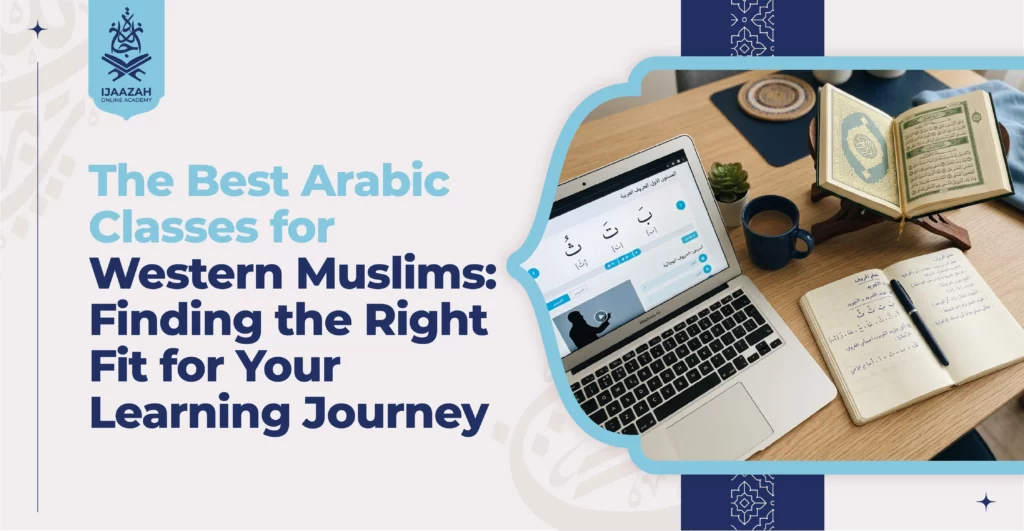
Arabic is simultaneously one of the world’s most widely spoken languages — with over 420 million native speakers across 26 countries — and one of the most structurally distinctive, presenting significant challenges for English-speaking learners. [Source: Ethnologue, 25th Edition, 2022] For Muslims in Western countries, the motivation to learn Arabic extends far beyond professional or cultural interest: understanding the language of the Quran directly, without relying on translation, is a spiritual aspiration that drives millions of learners annually.
Yet the Arabic classroom landscape is uneven. Standard language schools often teach Modern Standard Arabic (MSA) or a regional dialect, neither of which addresses the specific needs of a Muslim learning Quranic Arabic. Finding the right class — one that aligns with your goals, schedule, cultural background, and level — requires informed searching. This guide maps the terrain.
Understanding the Types of Arabic
Before enrolling in any Arabic class, it is essential to understand that “Arabic” is not a single uniform language but a spectrum of distinct varieties. Modern Standard Arabic (MSA, or Fus’ha) is the formal written language used in media, government, and literature across the Arab world. Quranic Arabic (Classical Arabic) is structurally similar to MSA but with important lexical and grammatical distinctions reflecting the linguistic context of seventh-century Arabia. Colloquial dialects — Egyptian, Levantine, Gulf, Moroccan — are mutually intelligible to varying degrees but differ substantially from both MSA and Classical Arabic.
For Western Muslims whose primary goal is Quran comprehension, Quranic Arabic courses are the most direct path. Programs like Bayyinah Institute’s “Arabic with Husna” and “Dream” program, or the Quranic Arabic Corpus learning tools, are specifically designed for this purpose. For those with professional or travel motivations, MSA or dialect courses may be more appropriate.
Online vs. In-Person Arabic Classes
The debate between online and in-person instruction for Arabic is nuanced. In-person classes, typically offered at community centers, mosques, or university continuing education departments, provide social immersion, real-time pronunciation correction from teachers who can hear the entire classroom, and the motivational structure of a physical commitment. In major cities, mosque-based Arabic classes also provide a community of peers with shared Islamic motivations.
Online classes offer flexibility, access to a broader range of qualified teachers (including native Arabic speakers from Egypt, Jordan, and Saudi Arabia with strong pedagogical credentials), and often more personalized instruction in one-on-one formats. For working adults in Western countries whose schedules are incompatible with fixed weekly in-person commitments, online classes are frequently the only viable option.
Group Classes vs. Private Tutoring
Group classes provide the social dimension of language learning — hearing other students’ questions often clarifies your own confusions — and are typically more affordable. They work well for learners at a similar pace who benefit from structured progression. However, group classes sacrifice responsiveness: if you are ahead of the group, you wait; if behind, you struggle.
Private tutoring offers maximum customization. A private Arabic tutor can focus entirely on your weakest areas, progress at your pace, and tailor examples to your specific interests (Quranic study, business communication, travel). For serious adult learners with specific goals and the budget for private instruction, one-on-one lessons with a qualified tutor typically produce faster progress than group classes of equivalent time investment.
Evaluating Teacher Qualifications and Cultural Fit
Qualifications for Arabic teachers vary widely. At minimum, a qualified teacher should be a native or near-native Arabic speaker with formal training in Arabic language instruction — not merely a fluent speaker. For Quranic Arabic specifically, look for teachers with formal Islamic educational credentials who can connect grammatical concepts to Quranic examples, making the language alive and contextually meaningful rather than abstract.
Cultural fit matters for Western Muslim students in ways that are easy to underestimate. A teacher who has themselves navigated Islamic identity in a Western context, or who has extensive experience teaching Western students, will understand the specific reference points, confusions, and motivations of their students. Ask prospective teachers about their experience with Western students and how they adapt their instruction to that context.
Recommended Approaches for Getting Started
For complete beginners, the most effective starting point is mastering the Arabic alphabet and basic voweling before enrolling in a structured class. Apps like Duolingo Arabic, Mango Languages, or dedicated Arabic alphabet apps provide this foundation in one to two weeks of daily practice, making the subsequent formal learning far more productive.
Once you have basic literacy in Arabic script, enroll in a Quranic Arabic course if your primary goal is Quran comprehension, or an MSA course if your goal is broader communication. Set a realistic study commitment — three to five hours per week is sufficient for meaningful progress — and prioritize consistency over intensity. Language learning rewards regularity above all else.
The best Arabic class for a Western Muslim is one that aligns with your specific motivation (Quranic comprehension vs. communication), accommodates your schedule, connects you with a qualified and culturally aware teacher, and provides the social and structural support to maintain consistency.
Take advantage of the growing ecosystem of online Arabic education, which has expanded dramatically in quality and variety. Whether through a structured program, private tutoring, or a combination, the journey toward Arabic literacy is one of the most rewarding investments a Muslim can make — opening the Quran in its original tongue and connecting with a tradition of scholarship spanning fourteen centuries.