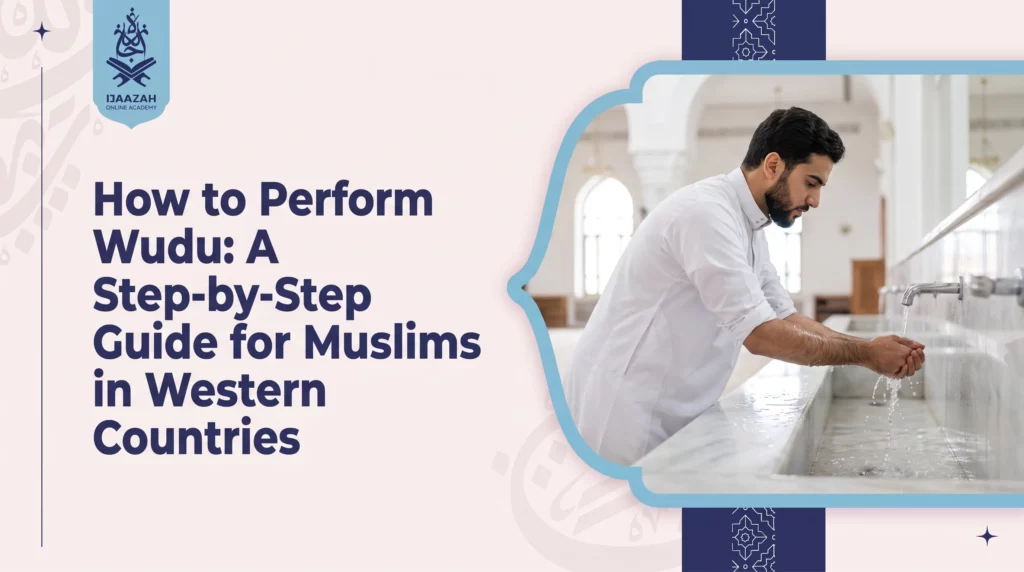
A restroom sink at a London office, a university washroom in Boston, an airport lounge in Dubai on the way home to Melbourne. Western Muslims perform wudu in places that were never designed for it. The steps stay the same wherever you are, and knowing exactly how to perform wudu — what is obligatory, what is sunnah, and what to do when circumstances are awkward — turns a stressful moment into a calm one.
What Wudu Is and Why It Matters
Definition and Significance
Wudu is the ritual washing that a Muslim performs before prayer. Allah commands it directly: “O you who have believed, when you rise to perform prayer, wash your faces and your forearms to the elbows and wipe over your heads and wash your feet to the ankles” (Quran 5:6).
Why You Cannot Pray Without It
The Prophet ﷺ said: “Allah does not accept the prayer of any of you if he has broken his wudu until he performs wudu again” (Sahih al-Bukhari 135 and Sahih Muslim 225). Wudu is also recommended before reciting the Quran, and the majority of scholars require it to touch the mushaf.
Beyond that, wudu carries its own reward. The Prophet ﷺ described sins leaving the body with the water, from the face, the hands, and the feet, until the person emerges purified (Sahih Muslim 244). On the Day of Resurrection, his ummah will come with shining faces, hands, and feet from the traces of wudu (Sahih al-Bukhari 136 and Sahih Muslim 246).
Steps to Perform Wudu
The description below follows the wudu of the Prophet ﷺ as reported by Uthman ibn Affan (Sahih al-Bukhari 159 and Sahih Muslim 226) and Abdullah ibn Zayd (Sahih al-Bukhari 185 and Sahih Muslim 235).
Step 1: Intention (Niyyah)
Intend in your heart that you are performing wudu for worship. The Prophet ﷺ said that actions are judged by intentions (Sahih al-Bukhari 1). Nothing needs to be spoken aloud; the intention lives in the heart. Many scholars recommend saying “Bismillah” at the start, relying on narrations that some scholars graded acceptable.
Step 2: Washing the Hands
Wash both hands up to the wrists three times, making sure water reaches between the fingers. Remove rings or move them so water reaches the skin beneath.
Step 3: Rinsing the Mouth
Take water into your mouth with the right hand, swirl it, and spit it out. Do this three times. The sunnah is to rinse the mouth and nose from the same handful.
Step 4: Cleaning the Nose
Draw water gently into the nose with the right hand and blow it out using the left. Repeat three times. The Prophet ﷺ told Laqit ibn Sabirah to sniff water deeply unless fasting (Sunan Abi Dawud 142, graded sahih), so a fasting person should be gentle.
Step 5: Washing the Face
Wash the whole face three times, from the hairline to the bottom of the chin, and from ear to ear. Men with thick beards should run wet fingers through them.
Step 6: Washing the Arms
Wash the right arm from the fingertips up to and including the elbow three times, then the left arm the same way. Allah specified “to the elbows” (Quran 5:6), and scholars explain that the elbow itself is included.
Step 7: Wiping the Head and Ears
Wet your hands and wipe over your head once: start at the front, move to the back of the head, then return to the front (Sahih al-Bukhari 185). Then wipe the ears, inside with the index fingers and behind with the thumbs, as reported in narrations of Ibn Abbas that scholars graded authentic.
Step 8: Washing the Feet
Wash the right foot up to and including the ankle three times, then the left. Pay attention to the heels and between the toes. The Prophet ﷺ saw people whose heels were dry after wudu and said: “Woe to the heels from the Fire” (Sahih al-Bukhari 60 and Sahih Muslim 241).
After Wudu
Say: “Ashhadu an la ilaha illallahu wahdahu la sharika lah, wa ashhadu anna Muhammadan abduhu wa rasuluh.” The Prophet ﷺ said that the eight gates of Paradise are opened for whoever says this after completing wudu, to enter through whichever he wishes (Sahih Muslim 234).
What Is Obligatory and What Is Sunnah
The obligatory parts come from Quran 5:6: washing the face (which includes rinsing the mouth and nose according to many scholars), washing the arms to the elbows, wiping the head, and washing the feet to the ankles, in that order and without long gaps. Washing three times is sunnah; washing once properly is valid. The Prophet ﷺ himself sometimes washed once, sometimes twice, and sometimes three times (Sahih al-Bukhari 157, 158, and 159).
What Breaks Wudu
- Anything leaving the front or back passage, including wind. The Prophet ﷺ said not to leave prayer for a doubt until one hears a sound or notices a smell (Sahih al-Bukhari 137 and Sahih Muslim 361).
- Deep sleep in which awareness is lost.
- Losing consciousness.
- Eating camel meat, according to the hadith in Sahih Muslim 360, a position held by several scholars.
Scholars differ on other matters, such as touching the private parts directly; ask a qualified teacher which view your community follows.
Cultural Considerations for Western Muslims
Access to Water at Work and School
Office restrooms rarely have space for washing feet, and colleagues may be surprised to see a foot in the sink. A few solutions help:
- Perform wudu at home before leaving, and try to keep it for as long as you can.
- Wear socks after completing wudu. The Prophet ﷺ wiped over his khuffs (leather socks) instead of washing his feet (Sahih al-Bukhari 206 and Sahih Muslim 274). Many scholars extend this to ordinary thick socks. The permission lasts one day and night for a resident, three for a traveller (Sahih Muslim 276).
- Carry a small water bottle for rinsing in a single stall restroom.
When Water Is Not Available
Wet wipes do not replace wudu. When water is truly unavailable or harmful to use, Islam prescribes tayammum, dry ablution with clean earth: “and you find no water, then seek clean earth and wipe over your faces and hands with it” (Quran 5:6). The Prophet ﷺ demonstrated it to Ammar ibn Yasir by striking the ground once and wiping the face and hands (Sahih al-Bukhari 338 and Sahih Muslim 368). This matters for hikers, patients in hospital, and travellers stuck without access.
Practical Tips for Women
Privacy and modesty are the most common concerns. Look for a disabled access restroom or a single stall space where you can remove your hijab briefly. The Prophet ﷺ wiped over part of his head along with his turban (Sahih Muslim 274), and some scholars allowed women to wipe over the khimar under certain conditions; ask a trusted scholar before relying on that. Many workplaces now provide multi faith rooms; asking HR is often easier than expected.
Time Management
Wudu takes two or three minutes. Plan it before prayer breaks, or keep your wudu from home. Travellers benefit from a small bottle and familiarity with airport multi faith rooms.
Teaching Wudu to Children and New Muslims
Children learn by watching. Perform wudu beside them, say each step aloud, and let them copy you. Make a simple picture chart and stick it near the bathroom sink. Many parents begin around age seven, when the Prophet ﷺ instructed that children be taught to pray (Sunan Abi Dawud 495, graded hasan sahih).
New Muslims appreciate a patient demonstration. A female tutor can teach sisters privately, and Ijaazah’s Azhari certified tutors cover purification as part of foundational lessons for adults and children in one on one online sessions, booked in your local time zone.
Questions Readers Ask
What Are the Benefits of Performing Wudu Regularly?
Sins fall away with the water (Sahih Muslim 244), you are ready for prayer at any time, and the habit builds mindfulness through the day.
Can I Perform Wudu Without Water?
No. Without water, or when water would harm you, perform tayammum instead.
How Often Must Wudu Be Renewed?
Only when something breaks it. Renewing it for each prayer is recommended but not required.
How Do I Teach My Children?
Demonstrate, repeat, and praise progress. Short daily practice works better than long lectures.
Purity That Prepares the Heart
Wudu is more than hygiene. It is a daily threshold between the noise of the world and the stillness of prayer. Perform it slowly, remember the sins leaving with the water, and step onto your prayer mat ready to meet your Lord.
Carry Wudu Forward
Sadaqah Jariyah Share
A new Muslim, a young cousin, or a colleague might be unsure about the steps. Share this guide with them. Every prayer they perform with a correct wudu adds to your reward.
The 5 Minute Challenge
Perform your next wudu slowly, counting each step and saying the dua in Sahih Muslim 234 at the end. If you do not know it by heart, spend five minutes memorising it today.
Take the Next Step
Book a Free Trial to learn the fiqh of purification and prayer with an Azhari certified tutor, or Take the Test Me Assessment to check your foundations.