Somebody asks what Arabic actually means to you, expecting an answer about verb conjugations, and instead you find yourself thinking about your grandfather’s voice, a language you can hear but not quite speak. What does the Arabic language mean, past the textbook definition, to someone raised generations away from where it was spoken daily? For many Western Muslims, the honest answer involves loss as much as curiosity.
Arabic is not simply one more language option next to French or Mandarin on a school form. It carries scripture, ancestry, and prayer inside a single set of letters, which is exactly why its absence feels different from any other language gap.
Arabic as More Than a Communication Tool
One Language, Several Layers of Meaning
Arabic functions on at least three levels for a Muslim family: as a spoken mother tongue for some, as the register of daily news and formal writing across the Arab world, and as the untouched classical form in which the Quran was revealed. Confusing these layers explains why fluent speakers of a dialect can still struggle with scripture, and why scripture study alone does not make someone conversational.
Where the Word Itself Comes From
Linguists trace Arabic to the Semitic language family, alongside Hebrew and Aramaic, with roots stretching back well over a thousand years before Islam. Allah then chose this particular language for revelation, describing the Quran as a clear Arabic tongue (Quran 26:195). That choice elevated an already rich language into the vessel for scripture itself.
The Weight Arabic Carries for Muslim Identity
A Thread Connecting You to a Global Ummah
A Friday sermon in Jakarta and one in Detroit both open with the same Arabic phrases, and a traveler who knows even basic Arabic can follow prayer anywhere on earth. Losing the language does not sever faith, but it does sever one particular thread that has connected Muslims across borders for fourteen centuries.
The Quiet Grief of the Third Generation
Grandparents who immigrated often spoke Arabic fluently. Their grandchildren, born and raised abroad, frequently cannot hold a basic conversation in it. That gap rarely gets named directly, yet it shows up as a specific kind of grief when a grandchild cannot understand a grandparent’s dua, spoken from the heart in a language the child only half recognizes.
Why Learning It Changes More Than Vocabulary
Career and Practical Advantages Rarely Discussed at the Mosque
Arabic proficiency opens professional paths in diplomacy, business, translation, and academia that most Muslim families never connect to their own religious education. A student who studies Quranic Arabic seriously often finds the transition into broader Arabic fluency faster than classmates starting from nothing.
Cultural Appreciation That Goes Both Directions
Understanding Arabic deepens appreciation for Islamic art, poetry, and history, and it also gives non Arab Muslims a genuine basis for connecting with Arab Muslim communities rather than relying entirely on translation. Respect grows naturally once you can follow even a portion of what is actually being said.
Learning Arabic Without an Arabic Speaking Household
Starting as an Adult Without a Family Head Start
Plenty of successful Arabic learners had no Arabic speaking relatives at all. What matters is deliberate, structured exposure rather than an accident of birth. A convert or a fourth generation Muslim can reach genuine competence with the same method, simply starting the clock later.
Female Tutors for a Comfortable Learning Pace
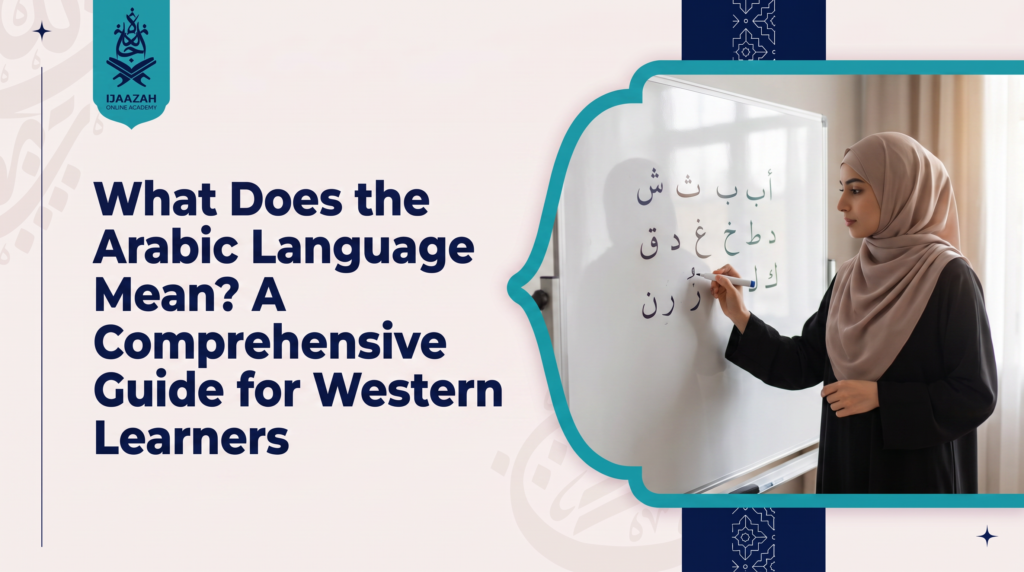
Many women prefer studying with a female instructor, particularly while making early mistakes aloud. Ijaazah’s Azhari certified female tutors work with adult beginners at whatever pace they need, without rushing anyone toward fluency benchmarks that do not fit their actual schedule.
Overcoming the Barriers That Stop Most Learners
Dialects, Grammar, and the Fear of Sounding Foolish
Arabic’s dozens of regional dialects intimidate learners who assume they need to master all of them at once. In reality, classical grammar and Quranic vocabulary provide a stable foundation that transfers across dialects far better than starting from slang alone.
- Focus on classical grammar and core vocabulary before chasing any single dialect.
- Expect early mistakes, since every fluent speaker made the same ones on the way there.
- Practice speaking out loud regularly, even alone, rather than only reading silently.
Time Zones and the Reality of a Western Calendar
Lessons booked around your actual working hours across the USA, Canada, UK, and Australia remove the last excuse for postponing indefinitely. A weekly hour, kept consistently for a year, outperforms an intensive month attempted once and abandoned.
What the Language Gives Back
Arabic returns exactly what you invest in it: connection to scripture, connection to ancestry, and connection to a global community that recites the same words you are learning to say. Begin with the letters, keep going past the awkward early stage, and let the meaning arrive gradually, the way it does for everyone who starts.
Carry This Forward
Sadaqah Jariyah Share
Someone in your family has wondered aloud whether it is too late to learn Arabic properly. Share this article with them and let the answer be no.
The 5 Minute Challenge
Look up the meaning and root of one Arabic word you say daily in prayer. Write it down, along with one place it appears in the Quran.
Take the Next Step
Book a Free Trial with an Azhari certified tutor, or Take the Test Me Assessment to find your starting level.