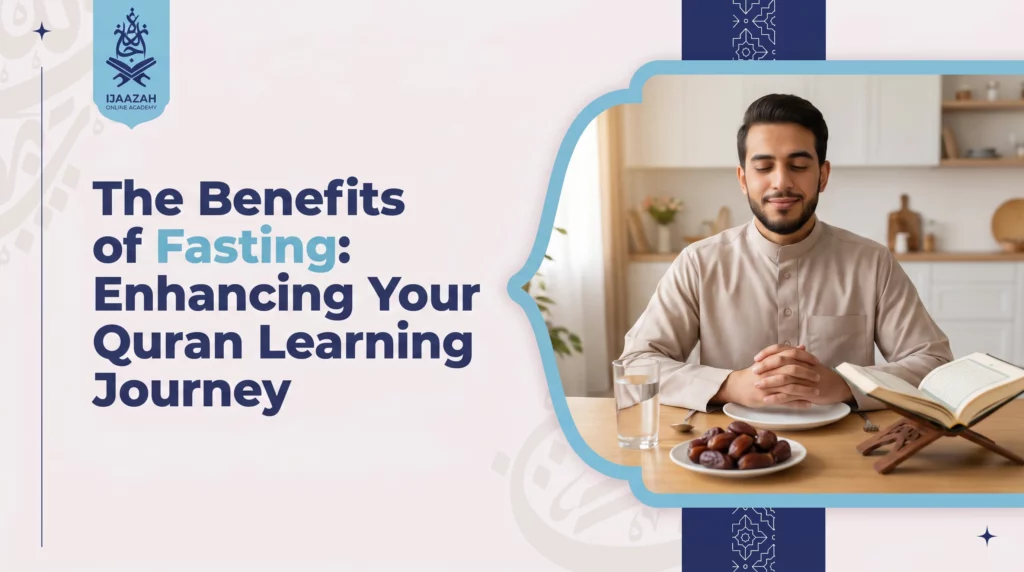
Hunger has a strange way of clearing the room. When the usual snacks, coffee breaks, and idle scrolling disappear from the day, what remains is a quieter mind and a heart that notices more. The benefits of fasting in Islam start with that quiet — and they extend far beyond the dining table. For anyone studying the Quran, the fast can become a partner in learning.
Muslims in Western countries fast under demanding conditions: school and work carry on, colleagues eat lunch nearby, and the daylight hours vary widely by season. This guide explains what fasting gives the believer, how it supports Quran study, and how to arrange lessons so that both flourish together.
Understanding Fasting in Islam
Definitions and Types of Fasting
Fasting means abstaining from food, drink, and marital relations from the break of true dawn until sunset, with the intention of worshipping Allah. Ramadan fasting is an obligation upon every adult Muslim who is able: “O you who have believed, decreed upon you is fasting as it was decreed upon those before you that you may become righteous” (Quran 2:183).
Beyond Ramadan, the Sunnah encourages voluntary fasts. The Prophet ﷺ fasted on Mondays and encouraged fasting the day of Arafah and the day of Ashura (Sahih Muslim 1162), along with six days of Shawwal after Ramadan (Sahih Muslim 1164). He also advised fasting three days each month (Sahih al-Bukhari 1981 and Sahih Muslim 721).
Spiritual Benefits and Self Discipline
The verse above names the goal directly: taqwa, or consciousness of Allah. Fasting trains that consciousness by teaching the believer to hold back from what is normally permitted, purely because Allah asked. The Prophet ﷺ described fasting as a shield (Sahih al-Bukhari 1894 and Sahih Muslim 1151), and he related that Allah said every deed of the son of Adam is for himself except fasting, which is for Allah, who will reward it (Sahih al-Bukhari 1904).
Self discipline follows. A person who can refuse a cup of water at noon finds it easier to refuse a harsh word — or a careless click, or a hurried prayer. That control carries over into study habits, which is why many students find their routines more stable in Ramadan.
The Connection Between Fasting and Learning
Focus and Clarity During Online Quran Classes
Many learners describe a lighter, more focused state in the hours before iftar, when heavy meals are absent and distractions are fewer. That experience varies. Some people concentrate best in the morning of a fasting day, while others struggle as energy dips in the afternoon.
The practical lesson is to notice your own pattern and schedule accordingly. If your mind is clearest after Fajr, book lessons then. Should you tire in the late afternoon, protect that period for rest and dhikr instead of demanding tasks.
Memory Retention: What the Research Can and Cannot Say
Studies on intermittent fasting and cognition have produced mixed results, and researchers caution against drawing strong conclusions for memorisation specifically. Claims that fasting automatically improves memory go further than the evidence allows. A safer position is that regular sleep, hydration at night, and steady revision matter more than any single factor.
What the Islamic tradition does affirm is the connection between Ramadan and the Quran. Allah says that the Quran was revealed in the month of Ramadan (Quran 2:185), and the Prophet ﷺ was at his most generous in that month, when Jibril met him every night to review the Quran with him (Sahih al-Bukhari 6). That prophetic example makes Ramadan the natural season for intensive recitation and revision.
Tailoring Online Quran Learning for Those Who Fast
Flexible Class Schedules Across Time Zones
Students in the USA, Canada, the UK, and Australia have different fasting hours, and daylight changes through the year. Over the years, Ramadan moves through every season, so a short winter fast one decade can become a long summer fast in another. Lessons should adjust to that reality.
Ijaazah’s one on one sessions are booked around your time zone and your fasting hours. Many students choose mid morning lessons in Ramadan, or short sessions after Taraweeh. The learning management system lets you review recordings and assignments when your energy is best.
Female Tutors for Comfort and Accessibility
Some sisters prefer to discuss fasting questions, such as making up missed days after menstruation, with a female teacher. The Prophet’s wife Aisha reported that women were commanded to make up the fasts they missed but not the prayers (Sahih Muslim 335). Ijaazah’s Azhari certified female tutors can explain these rulings and help sisters plan their Ramadan study around them.
Cultural Considerations for Fasting and Learning
Respecting Fasting Hours
Avoid scheduling lessons in the final hour before iftar, when hunger and fatigue peak and the household is preparing food. Suhoor offers a peaceful window for young learners and early risers, though sleep must not be sacrificed to the point of exhaustion. Families with children should agree on a rhythm before Ramadan begins.
If you work or study during daylight, tell your instructor in advance and ask for shorter, focused lessons. A twenty minute lesson with full attention beats an hour of struggling to keep your eyes open.
Community Support During Ramadan
Fasting is easier in company — and so is studying. Join an online circle, share your revision goals, and encourage others to keep theirs. Muslims across the West run virtual iftars, recitation challenges, and study halaqahs during Ramadan, and those gatherings supply the sense of belonging that a workplace or school may not provide.
Cultural differences also appear. Some families break the fast with dates and soup, others with sweet drinks or pastries, and each community has its own traditions. Respect this variety, and focus on what unites you: the fast, the Quran, and the remembrance of Allah.
Straight Answers About Fasting and Study
What Are the Health Effects of Fasting During Ramadan?
Researchers continue to study the effects, and results differ by individual and by circumstance. Healthy adults generally fast without difficulty, but people with medical conditions, pregnant women, and those on medication should ask a doctor and a scholar before fasting. Islam grants concessions for illness and travel (Quran 2:184).
How Can Fasting Improve My Focus When Studying?
Regular sleep, a balanced suhoor, and a fixed study slot all support concentration. Some students find that a lighter stomach helps them think clearly, while others need a short rest first. Track your own energy for a week, then book lessons at your best hour.
Can Fasting Deepen My Understanding of the Quran?
It creates the conditions for it. A fasting person tends to recite more, pray more, and reflect more, and those habits bring the Quran closer. Understanding still requires study, so pair your recitation with reliable tafsir and a teacher.
The Fast and the Book Together
The benefits of fasting reach their fullest when the fast and the Book travel together. A believer who fasts by day and recites by night is living the pattern that Allah set for the month. Let your hunger remind you to be grateful, and let your recitation remind you why you fast. Ask Allah to accept your effort and to keep you consistent long after Ramadan ends.
Carry Fasting Forward
Sadaqah Jariyah Share
Somebody you know wants to make more of Ramadan and does not know where to begin. Send this article to them. Every person who studies better because of a link you shared adds to your reward.
The 5 Minute Challenge
Choose one voluntary fast this month, such as a Monday or a Thursday. Spend five minutes tonight setting your intention, planning your suhoor, and choosing a single page of Quran to revise during the day.
Take the Next Step
Book a Free Trial with an Azhari certified tutor, or Take the Test Me Assessment to plan your study around your fast.