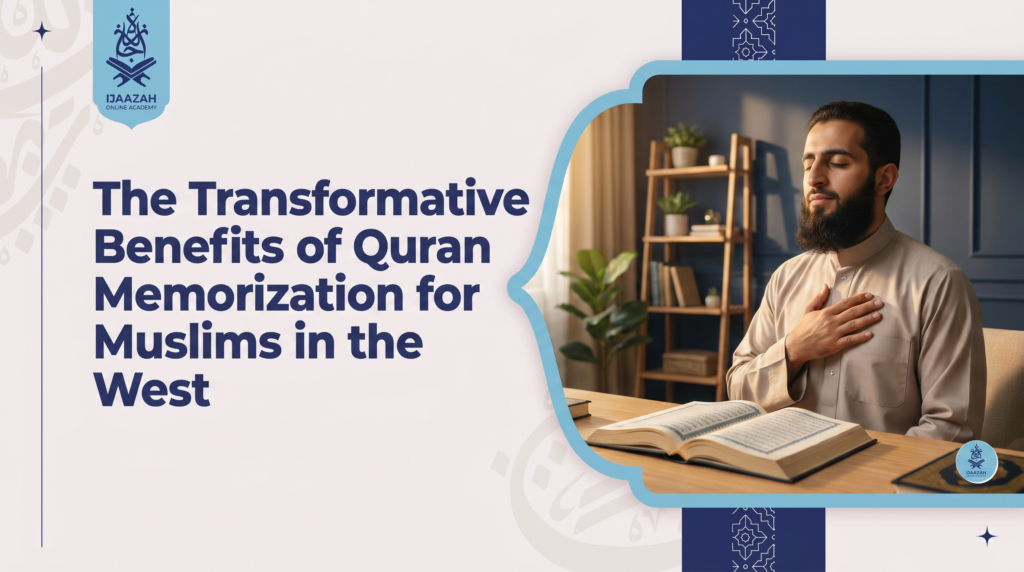
A student once told her tutor that she couldn’t explain why Surah Al-Mulk felt different in her chest after she’d memorized it versus simply reading it. That difference is not sentiment. It is the documented, tangible result of what happens when a person commits divine speech to memory rather than borrowing it temporarily from a page. The benefits of Quran memorization extend across three distinct domains , spiritual, cognitive, and social , and each domain reinforces the others in ways that few other disciplines can claim.
For Muslim families living in London, Toronto, Houston, or Sydney, this conversation carries added weight. Hifz was once assumed to be the default outcome of growing up in a Muslim-majority country, absorbed almost by osmosis through mosque culture and daily recitation heard on every street corner. That ambient exposure does not exist in a Western suburb. Memorization there becomes a deliberate choice, scheduled against school runs, shift work, and time zones that rarely cooperate. Understanding exactly why the effort is worth making tends to be the difference between a family that commits and one that quietly lets the goal slide.
The Spiritual Weight of Carrying Allah’s Words Within You
Scholars across the four madhabs describe the huffaz , those who have memorized the Quran , as carriers of a trust unlike any other. The Prophet ﷺ said that the one who recites the Quran with proficiency will be with the noble, righteous scribes, and the one who recites with difficulty, struggling through it, receives a double reward. Neither category excludes the memorizer; both describe the memorizer’s daily companionship with revelation.
Daily prayer changes texture once a person holds more surahs by heart. Salah stops being five checkpoints filled with the same short chapters and becomes a rotating conversation with a wider portion of the Book. Reciting from memory during qiyam al-layl, during a long car ride, or beside a sick relative in a hospital room, requires no book, no phone, no light. That portability is itself a spiritual asset , the words are simply present, available in any circumstance a servant might need them.
A Memory Athlete’s Brain: What Cognitive Science Says About Repetition and Recall
Set the theology aside for a moment and cognitive research still supports the practice. Repeated, spaced retrieval , precisely the method used in traditional talaqqi and murajaʿah cycles , is the same mechanism researchers point to when explaining why spaced repetition strengthens long-term memory formation more effectively than passive rereading. Hifz students are, functionally, running a rigorous memory-training protocol every single day.
Three cognitive gains show up consistently among long-term memorizers:
- Working memory expands, since holding a page of Arabic verses in sequence trains the brain to retain and manipulate larger chunks of information at once, a skill that transfers to academic reading and lecture retention.
- Arabic fluency accelerates in a way vocabulary drills alone rarely achieve, because memorization forces exposure to grammatical structures, root patterns, and classical vocabulary in their natural, functioning context rather than as isolated flashcards.
- Sustained attention improves, and parents frequently report that children who memorize consistently show longer concentration spans in unrelated subjects like math and reading comprehension.
None of this requires abandoning a child’s regular schooling or a professional’s career track. It requires structure , the same structure a serious student would apply to any demanding second discipline.
Beyond Solo Study: The Communal Architecture of Hifz
Traditional Islamic scholarship never treated memorization as a private, isolated pursuit. Circles of students recited to a teacher and to one another, catching each other’s mistakes and reinforcing retention through peer accountability. That communal model matters even more in the West, where a lone student sitting with a mushaf in an otherwise empty room can drift without noticing.
Why Female-Led Circles Matter for Muslim Women
Many mothers and adult women prefer, or specifically require, a female instructor for reasons of comfort, privacy during sessions conducted from home, and simple pedagogical fit. Yet finding female Quran tutors in the USA has historically meant relying on word-of-mouth through a local masjid, which limits both scheduling flexibility and access to instructors trained to an Azhari standard. A properly vetted, credentialed female tutor changes that equation entirely, giving women a structured, private, one-on-one path to hifz that fits around childcare and household responsibilities rather than around a mosque’s fixed class calendar.
Fitting Revelation Into a Rush-Hour Life
The single largest obstacle Western Muslims report is not motivation. It is logistics. Managing time for memorization while balancing work and family requires a different rhythm than the leisurely pace assumed in classical hifz literature written for full-time students.
The Age Question: When Should Memorization Begin
Parents frequently ask about the best age to start memorizing, and the honest answer is that there is no single universal number. Children between four and seven often absorb short surahs remarkably fast due to natural rote-learning ability at that developmental stage, while older children and teenagers benefit from a slower, comprehension-linked approach that ties memorization to meaning. Adults are not too late; adult memorizers simply need a method suited to a busier schedule and a mind already trained for analytical rather than purely rote learning.
Small Sessions, Real Tools
- Ten focused minutes before Fajr tends to outperform an hour attempted late at night, since retention research consistently favors short sessions distributed across the day over single long cramming blocks.
- Recitation-tracking apps with repetition counters, verse-by-verse audio, and mistake logs give a self-paced student the same feedback loop a live tutor would otherwise provide between sessions.
- A shared family tracker on the refrigerator, a simple checklist visible to everyone in the house, does more for consistency than any app because it turns memorization into a household norm rather than a private secret.
Memorizing Across Time Zones and Two Cultures
Online memorization classes for Muslims in Canada, and across the diaspora generally, introduce a scheduling puzzle that classical hifz guides never anticipated: a tutor teaching from Cairo at what feels like a normal afternoon hour might be asking a Vancouver family to log on at four in the morning. Reliable programs solve this by offering rolling availability across multiple time zones rather than a single fixed slot, and families should treat time zone compatibility as a genuine enrollment criterion, not an afterthought.
Cultural context adds a second layer of complexity. A Malaysian household, a Nigerian household, and a convert household in rural Ohio may all pursue hifz with entirely different levels of ambient Arabic exposure, different community support structures, and different comfort levels asking questions during class. A tutor experienced with diverse diaspora communities adjusts pacing and explanation style accordingly, rather than assuming every student arrives with the same background knowledge.
Where This Leaves You
Every benefit outlined here , the spiritual companionship of carried revelation, the measurable cognitive gains, the community and accountability, the practical accommodations for a Western schedule , points toward the same conclusion. Memorization is not reserved for the exceptionally gifted or the exceptionally free. It is built through short, consistent sessions, supported by the right teacher and the right household environment, sustained one verse at a time.
Sadaqah Jariyah Share Knowledge that reaches another person and changes how they see their own relationship with the Quran continues generating reward long after you’ve closed this page. Share this article with a parent weighing whether to start their child in hifz, or with a friend who assumes memorization is only for those raised in a Muslim-majority country. That single share may be the reason someone begins.
The 5-Minute Challenge Open your mushaf or Quran app right now and recite the shortest surah you already know by heart, slowly, out loud, paying attention to each word’s meaning rather than rushing to the end. That single act of intentional recitation is the same mechanism that builds a lifetime of hifz , repeated, deliberate, unhurried.
Ready to see what a structured, one-on-one hifz path with an Azhari-certified tutor actually feels like? Book a Free Trial. Not sure where your current level stands? Take the Test Me assessment.