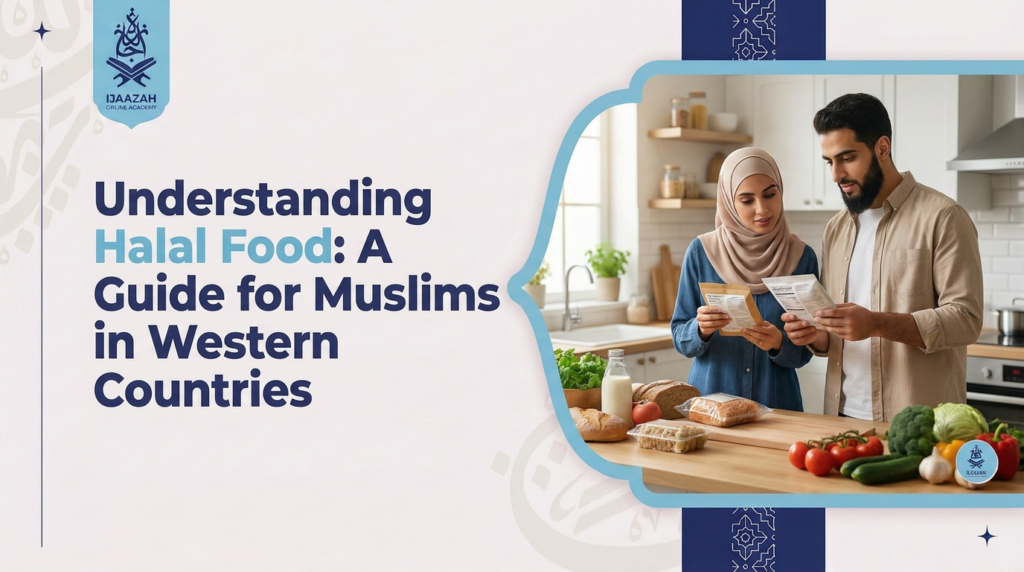
Ask ten Muslims what is halal food, and most will start with meat. That answer is true but incomplete. Halal, an Arabic term meaning “permissible,” describes a full category of dietary law rooted in the Quran and the Sunnah of the Prophet Muhammad ﷺ. Pork and its by-products are forbidden outright. Alcohol is excluded from any beverage or ingredient list. Meat must come from an animal slaughtered according to prescribed method , a swift cut, a blessing spoken over the animal, and blood fully drained. Anything touching or processed alongside forbidden substances loses its halal status, which is why cross-contamination in shared kitchens or factories matters so much to observant families.
The opposite category, haram, covers what is expressly forbidden. A third category, makruh, covers what is discouraged but not sinful. These distinctions trace back over fourteen centuries, yet they remain as practical today as they were in Madinah, guiding grocery runs in Ohio and restaurant choices in Manchester alike.
Why Halal Nutrition Shapes a Muslim’s Daily Rhythm
Halal eating is not a dietary preference the way “organic” or “gluten-free” might be. It functions as an act of worship. Every meal becomes a small, repeated declaration of obedience, which is precisely why Muslim parents raising children abroad treat the halal question with such seriousness. Skipping the question, even once, feels like skipping a prayer.
Beyond the spiritual dimension, halal slaughter requirements tend to produce meat with lower bacterial contamination, since full blood drainage reduces the medium in which pathogens thrive. Nutritionists studying halal-certified supply chains have noted stricter animal welfare and hygiene documentation compared to unregulated conventional processing. None of this replaces the primary motive , obedience to Allah , but it explains why many non-Muslim consumers now seek halal-labeled products for perceived freshness and traceability.
Certification Standards Across the USA, Canada, UK, and Australia
Western Muslims rarely slaughter their own meat, so certification becomes the trust mechanism. Recognized halal certification bodies inspect slaughterhouses, audit supply chains, and issue a seal that appears on packaging or storefront windows. Standards differ slightly by country, but reputable certifiers generally verify:
- That the slaughterer is a sane, adult Muslim who recites the required invocation at the moment of slaughter, not beforehand or in bulk.
- Full drainage of blood before packaging, since retained blood invalidates the meat regardless of how the animal was killed.
- Separation of halal products from pork or alcohol at every stage , storage, transport, and even the cleaning agents used on shared equipment.
- Documented, traceable sourcing that a customer or auditor could follow back to the farm if questioned.
In the United States, Canada, the United Kingdom, and Australia, families should look for a certifier’s logo rather than assume “no pork listed” equals halal. A restaurant advertising “halal-friendly” without a certification seal deserves a follow-up question, not automatic trust.
Locating Halal Groceries and Restaurants Without Guesswork
Finding halal food nearby in the USA has become considerably easier over the last decade. Dense Muslim communities in cities like Dearborn, Houston, and Brooklyn support entire halal grocery corridors, but smaller towns require more effort. A few reliable approaches:
- Search dedicated halal directory apps, which crowdsource restaurant reviews and certification status from local Muslim users.
- Check whether a nearby Middle Eastern, South Asian, or West African grocer stocks halal meat counters, since ethnic grocery stores frequently carry certified products even without heavy marketing.
- Call ahead to chain restaurants in areas with large Muslim populations , some regional franchise locations source halal meat exclusively, a detail rarely advertised on national menus.
- Ask the local mosque community, since congregants usually maintain informal lists of trustworthy butchers and eateries long before any app catches up.
Online halal meat delivery services have also expanded reach for Muslims in rural or suburban areas where physical options remain thin.
The Quiet Link Between Halal Food and Quranic Focus
Scholars of tazkiyah, the purification of the soul, have long taught that what enters the body affects what leaves the heart. A student memorizing Surah Al-Baqarah needs sustained concentration, and food sourced from questionable or forbidden origins is described in classical texts as a barrier to spiritual clarity. Practically speaking, halal eating also tends to correlate with mindful eating , smaller portions, fewer processed additives, and household rhythms built around prayer times rather than convenience.
Parents enrolling children in Quran memorization programs often report that consistent halal habits at home reinforce the discipline being taught in lessons. The two practices reinforce each other: a mind unclouded by heavy, questionable food, and a heart oriented by regular recitation, together support the kind of sustained attention that Hifz and Tajweed study demand.
Navigating Non-Halal Settings With Grace
Business dinners, school events, and family gatherings with non-Muslim relatives place Muslims in rooms where halal options may not exist. Scholars generally advise choosing seafood, eggs, or plant-based dishes when no certified meat is available, since these options avoid the slaughter question entirely. Politely declining a dish without turning the moment into a lecture preserves relationships while maintaining personal conviction.
Differences also exist within the Muslim community itself. Some households only trust hand-slaughtered meat, while others accept mechanically slaughtered, certified products without hesitation. Neither position should be treated as more “authentically” Muslim than the other. Respecting a host’s more cautious standard, or a guest’s more lenient one, reflects the same humility the Quran asks of believers in matters of personal jurisprudence.
Correcting Common Misconceptions About Halal Practices
Non-Muslim colleagues sometimes assume halal slaughter is inhumane, cruel, or identical to kosher practice by default. In reality, Islamic slaughter requirements mandate a swift cut designed to minimize suffering, and while halal and kosher share overlapping origins, the invocation, the acceptable animals, and the certifying authorities differ meaningfully. Another persistent myth holds that halal food costs more without added value , yet the certification, documentation, and welfare auditing behind a halal label often represent real supply-chain rigor, not a markup for its own sake.
Growing Demand, Growing Community: Halal Food’s Rise in Western Markets
Grocery chains across North America and Europe have expanded halal sections noticeably over the past five years, driven by demographic growth and rising purchasing power among Muslim households. Local businesses that once treated halal certification as a niche cost now market it as a competitive advantage, since halal-seeking customers tend toward strong brand loyalty once trust is established. Community support accelerates this shift further , mosque bulletin boards, WhatsApp groups, and local Islamic centers routinely promote new halal businesses long before mainstream advertising notices them. Educating non-Muslim neighbors, coworkers, and shop owners about what halal actually requires also expands the market, turning curious skeptics into willing suppliers.
Female Tutors and Time Zones: Rounding Out Your Islamic Education
Halal eating rarely stands alone as a spiritual practice; it sits alongside structured Quran learning, Tajweed correction, and Arabic study. Families seeking a learning environment that mirrors their home values often look specifically for female tutors, particularly for daughters or for mothers who prefer a same-gender learning space during recitation practice. Ijaazah’s Azhari-certified instructors include qualified women teachers precisely for this reason, offering the same rigorous 1-on-1 methodology without compromising on comfort or modesty preferences.
Scheduling matters just as much as instructor choice. Students in Sydney, London, Toronto, and New York all require class times that respect their evening routines rather than forcing early-morning fatigue onto young learners. A professional LMS with flexible booking , the kind Ijaazah maintains , removes this friction, letting a family in Melbourne book a 7 PM session as easily as one in Chicago books its own evening slot.
Halal food, careful Quran study, and thoughtful scheduling are not separate boxes to check. They form one coherent picture of a household ordering its daily life around conviction rather than convenience. Muslim expats raising children far from majority-Muslim countries often find that mastering one discipline, whether reading ingredient labels or completing a Tajweed lesson, builds the habit muscle needed for the next.
Sadaqah Jariyah Share Knowledge that reaches another household keeps earning reward long after you’ve closed this page. Share this article with a friend, a parent group, or a new Muslim still learning the basics of halal food , a small act of sharing can become sadaqah jariyah that outlives the moment you sent it.
The 5-Minute Challenge Open your pantry right now and check three packaged items for a halal certification seal. If one is missing or unclear, note it down and look up the manufacturer’s halal policy before your next grocery trip.
Ready to pair halal living with structured Quran learning? Book a Free Trial with an Azhari-certified tutor. Not sure where you or your child currently stand in Quran and Tajweed? Take the Test Me assessment.