The technology to learn Quran online has existed for over a decade. The question was never whether a student and teacher could connect across continents through a screen. The question,one that Muslim families in Western countries are still navigating,is whether the quality of online Quran instruction matches the rigour that the Quran’s transmission has demanded for fourteen centuries.
The answer, when the right platform and the right teacher are in place, is yes.
Why Reciting Quran Online Is Not the Same as Watching YouTube Videos
YouTube carries thousands of Quran recitation videos. Tarteel apps provide AI feedback on pronunciation. Audio libraries store the recitations of Mahmoud Khalil Al-Husary, Abdul Basit Abdul Samad, and every major Qari of the 20th and 21st centuries.
None of these replace a qualified teacher listening to you specifically.
The Islamic tradition of Quran transmission has always been oral and individualised. The Prophet ﷺ recited to Jibreel (AS). The Companions recited to the Prophet ﷺ and received corrections. Those Companions taught their students, who taught theirs,and the chain of direct, one-to-one recitation correction is how the Quran has arrived in its current, preserved form.
A student who learns only by mimicking recorded recitation will eventually correct their gross errors but will miss the systematic Tajweed mistakes that only become visible when a trained teacher hears your specific voice, your specific articulation patterns, and your specific bad habits. The Makhaarij (articulation points) for ح versus ه, the distinction between ض and ظ, the subtle Ghunnah duration requirements,these are correctable only in real-time, responsive feedback.
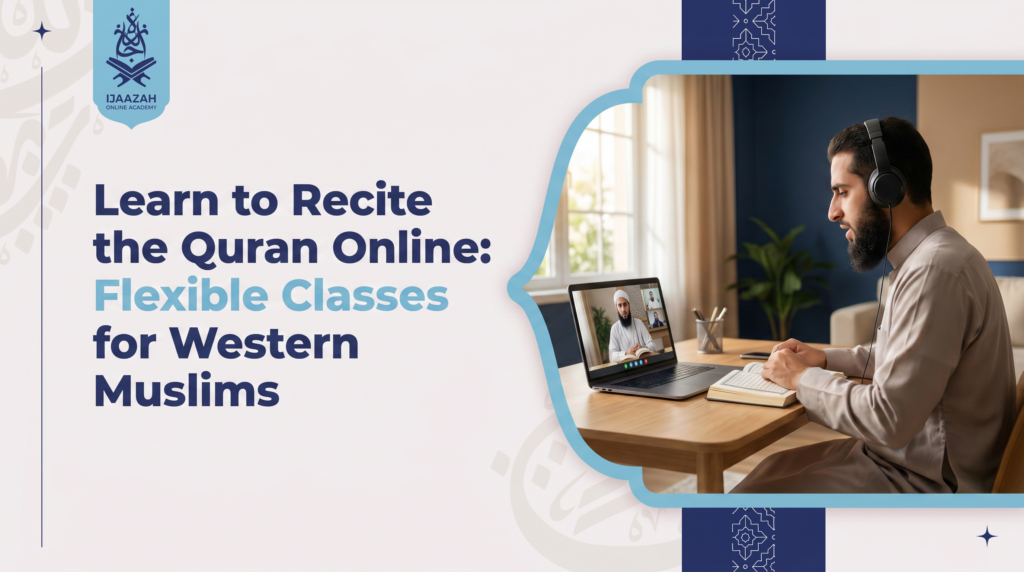
Online one-on-one Quran recitation classes provide exactly that. The teacher hears you. You hear their correction. You practice. They confirm. That is the Quranic learning tradition,transmitted through a screen rather than across a classroom carpet, but structurally identical.
What a Quality Online Quran Recitation Class Contains
Not all online Quran classes are equivalent. Evaluating a platform before committing requires knowing what the lesson structure should actually look like:
Opening assessment: A qualified teacher begins the first real instructional session by listening to the student recite without interruption for a few minutes,Surah Al-Fatiha and a short surah. This assessment reveals the student’s Tajweed baseline, their existing error patterns, and their memorisation level.
Systematic Tajweed instruction: Tajweed rules are not a list of arbitrary regulations. They form a coherent system,and qualified instruction teaches them as a system, not a random sequence of isolated rules. The sequence typically follows: Makhaarij al-Huroof → Sifaat al-Huroof → Noon Sakinah and Tanwin rules (Idgham, Ithhar, Ikhfaa, Iqlab) → Meem Sakinah → Rules of Lam and Raa → Madd (elongation) categories → Waqf and Ibtida (stopping and starting).
Applied recitation in sequence: Rules learned in isolation don’t stick. Applied recitation,practicing each rule within actual Quranic text, not just isolated examples,cements the lesson.
Regular revision cycles: New memorisation without revision cycles produces fast decay. Quality programmes build in explicit revision of previously covered material before introducing new content.
The Session Length That Actually Works for Western Learners
Children learning Quran online typically reach optimal concentration at sessions of 30-45 minutes, two to three times per week. Adult learners can sustain 45-60 minute sessions but benefit more from frequent shorter sessions than rare longer ones.
The reason: Tajweed correction requires immediate practice, not passive reception. A 60-minute session in which a student hears 50 rules explained produces less retention than a 30-minute session in which 5 rules are explained, practiced, corrected, and confirmed. Quality instructors pace sessions around learning consolidation, not topic coverage.
Female Tutors for Online Quran Recitation,Why Availability Matters
For Muslim women in Western countries,whether mothers learning alongside their children, or adult female learners pursuing recitation improvement independently,the question of who is on the other side of the screen matters.
Many families hold to the position that a woman’s regular one-on-one sessions with a male stranger, even for religious education, is not preferable. Others have no concern. Regardless of the family’s position, the availability of qualified female Quran tutors ensures that no woman has to choose between her preferred learning environment and qualification standards.
Qualified female tutors with Ijazah certification are available through platforms like Ijaazah, covering time zones from the United States East Coast to Australian Eastern Time. A mother in Manchester who wants her daughter taught by a female teacher certified at Azhar level should not have to settle for a local community class of uncertain quality,online access has solved that.
Navigating Time Zones for Western Muslim Families
The scheduling reality for online Quran learning from the USA, UK, Canada, or Australia is straightforward once understood:
- UK and Europe: Best overlap with tutors in Egypt, Jordan, and Saudi Arabia. UK evenings (6-9 PM) correspond to Cairo’s 8-11 PM and Riyadh’s 9 PM-midnight.
- Eastern USA and Canada: Evening slots (7-10 PM EST) correspond to Cairo’s early morning (2-5 AM),making Middle East tutors unavailable. South Asian tutors (Pakistan, Bangladesh) operate at IST (+5:30), making 7-10 PM EST correspond to 5:30-8:30 AM IST,which works well.
- Australia: Australia Eastern Standard Time (AEST) is GMT+10 to +11. Egyptian morning sessions (8-11 AM Cairo) correspond to Australian late afternoon and early evening,the sweet spot for families.
Platforms that explicitly map their tutor availability to Western time zones,and that maintain consistent weekly scheduling rather than rotating booking systems,save families the frustration of constantly rebooking around availability gaps.
The Benchmark: What Progress in Online Quran Recitation Should Look Like
A realistic six-month benchmark for a student beginning online Quran recitation with qualified instruction three times per week:
- Correct identification and pronunciation of all Arabic letters with their vowel combinations
- Full fluent recitation of Surah Al-Fatiha with accurate Tajweed
- Memorisation and fluent recitation of at least the last ten surahs of the Quran (Juz Amma)
- Correct application of the Noon Sakinah and Tanwin rules (the most commonly occurring Tajweed rules in the Quran)
- Ability to identify Madd letters and observe basic elongation rules in new recitation
These benchmarks represent achievable outcomes from consistent qualified instruction,not exceptional talent.
Know a Muslim family in the West looking to give their children proper Quran education from a certified teacher? Share this article,connecting a family to qualified Islamic education is Sadaqah Jariyah.
Your 5-Minute Challenge: Record yourself reciting Surah Al-Fatiha on your phone right now. Listen back once, slowly. Notice where you rush, where pronunciation feels uncertain, where you cannot identify whether the Tajweed is correct. That recording is your starting point,and a qualified teacher can tell you exactly what it contains.
Start learning to recite Quran online with a certified Azhari tutor.
Book a Free Trial Class , or Test Your Recitation Level to find the right starting point.