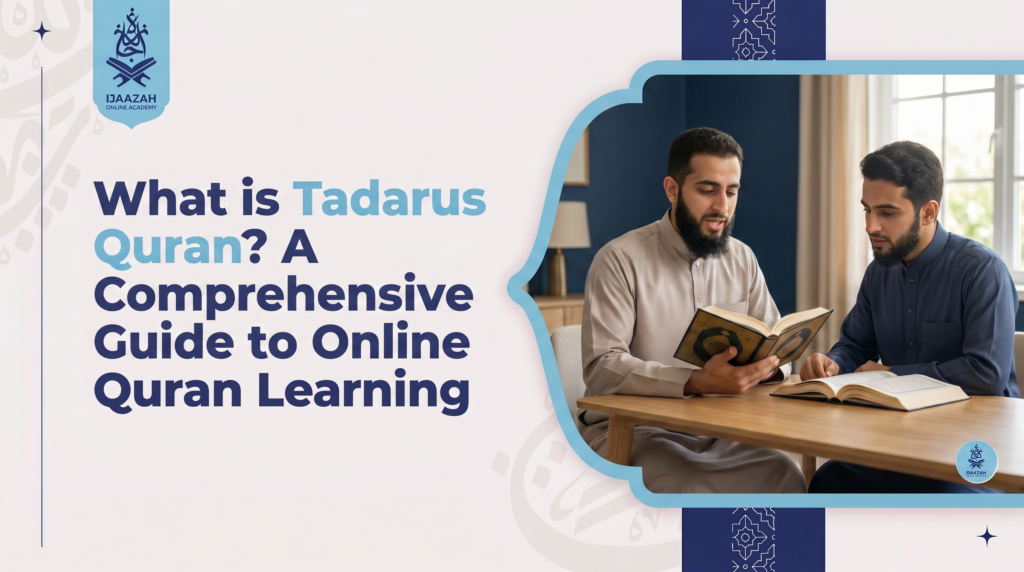
Most Muslims know Tadarus by experience before they know it by name. It’s the sound of two or more people taking turns reciting the Quran,one reads, the other listens, then they switch. It’s the Ramadan masjid corner where brothers sit in a circle with their masahif open. It’s the family gathering where the older generation reads and the children follow with their fingers on the page.
The formal term is Tadarus Al-Quran (sometimes written Tadarrus), and its roots go all the way back to the Sunnah of the Prophet Muhammad ﷺ.
The Word Itself,What Tadarus Means
Tadarus comes from the Arabic root D-R-S (دَرَسَ), which means to study, to learn through recitation, or to read something in a way that leaves a lasting impression. The verb form tadarasa is a mutual/reciprocal form of the root, meaning to study together,each participant teaching and learning from the other simultaneously.
In Quranic usage, the root appears in Surah Al-An’am (6:105): “wa li-nadrusakum”,”so that We may make it clear to people who know.” The link between the word and the act of recitation-for-learning is embedded in the Quran’s own vocabulary.
Tadarus is therefore not casual reading. It is purposeful, mutual, reciprocal recitation,the practice of two or more people reviewing, correcting, and reinforcing each other’s connection to the Quran.
The Prophetic Precedent That Established Tadarus
The strongest evidence for Tadarus comes from the Sunnah. Jibreel (AS) would meet the Prophet ﷺ every Ramadan and they would review the entire Quran together (yudarisahu Al-Quran). In the final year of the Prophet’s ﷺ life, this review occurred twice. (Sahih al-Bukhari 3554)
This specific narration establishes several things simultaneously:
- Tadarus is a Ramadan-intensified Sunnah that is specifically Prophetic in character
- The mutual review format,where even the Prophet ﷺ recited to Jibreel and received review,normalises correction as part of the practice
- The doubling of the review in the Prophet’s final year signals its spiritual gravity
Scholars across the classical tradition have cited this hadith as the basis for making Tadarus,especially during Ramadan,among the highest-reward Quranic activities a Muslim can perform.
Tadarus vs. Regular Quran Recitation,What Makes It Different
Solitary tilawah (recitation) is an individual act of worship. Tadarus adds a relational dimension that changes the spiritual dynamics:
Correction becomes a gift, not a criticism. In solitary recitation, Tajweed errors go unheard. In Tadarus, the listening partner catches what the reader cannot self-detect. This is not humiliation,in classical Islamic pedagogy, being corrected in Quran recitation is considered an honour extended by the corrector, not a failure exposed.
The listener earns reward too. Classical scholars including Ibn Kathir noted that the listener in a Tadarus session earns reward for every verse heard with the intention of learning and worship,not merely for verses personally recited.
Social accountability sustains the practice. The single most effective predictor of long-term Quran engagement is accountability to another person. Tadarus builds that accountability into its structure,your partner is waiting for you.
Why Ramadan and Tadarus Are Inseparable
The Prophet ﷺ was described as being “more generous in Ramadan than the swift wind” when it came to Quranic engagement. (Sahih al-Bukhari 6)
The specific word used in the narration describing his review with Jibreel,yudarisahu,is the very root of Tadarus. Scholars have drawn the direct line: the Prophet’s Ramadan practice of Quran review with Jibreel is the precedent Muslims are following when they sit together in Tadarus during Ramadan.
The classical goal of completing the Quran at least once during Ramadan through Tadarus is achievable through daily increments. Reading three juz per day in a Tadarus session of sixty to ninety minutes brings completion within ten days. Many dedicated groups aim for two or three full completions in the month.
Tadarus for Muslim Families in Western Countries,The Online Adaptation
The traditional Tadarus format requires physical proximity. In Muslim-majority countries, this is the masjid corner, the family living room, or the neighbourhood study circle. In London, Chicago, Perth, or Calgary, physical Quran study circles are less accessible,smaller Muslim populations, greater geographic dispersion, competing schedules.
Online Tadarus has emerged as the genuine solution,not a compromise but a viable adaptation with its own advantages:
- No geographic limitation: A family in Glasgow can do Tadarus with a sibling in Toronto, a parent in Karachi, or a certified tutor in Cairo
- Recording capability: Online sessions can be recorded (with consent) so children can review their recitation errors privately
- Flexible scheduling: Sessions can occur at times that work across multiple time zones, particularly between Western cities and tutor locations in the Middle East or South Asia
- Tutor-facilitated Tadarus: Rather than peer Tadarus between learners of similar level, a certified online Quran tutor can facilitate Tadarus,listening, correcting Tajweed in real time, and guiding the session’s pace
Building a Family Tadarus Routine in Non-Muslim Environments
For parents in the West who want to revive Tadarus as a family practice, structure matters more than length:
- Start small: Even fifteen minutes of Tadarus between a parent and child three times weekly builds more long-term habit than one-hour sessions that can’t be sustained
- Assign roles: Alternate who reads and who listens. Younger children benefit from listening to a parent’s correct recitation; parents benefit from the attentiveness that being a listener requires
- Use Ramadan as the launch: The heightened motivation of Ramadan is the ideal time to establish a Tadarus routine,but the goal is to maintain it year-round, even at reduced frequency
- Supplement with an online tutor: For families without a member confident in Tajweed, a weekly session with a certified tutor can serve as the quality-control anchor for family Tadarus during the week
Ijaazah provides Azhari-certified tutors,including female tutors for mothers and daughters,available across time zones from the USA, UK, Canada, and Australia. A tutor-facilitated Tadarus session provides the correction, the structure, and the accountability that pure family Tadarus sometimes lacks.
The Reward That Makes Tadarus Worth Prioritising
The Prophet ﷺ said: “Whoever recites a letter of the Book of Allah will have a reward, and that reward will be multiplied by ten.” (Tirmidhi 2910, authenticated)
Every letter in a Tadarus session,whether recited or heard with worship intention,generates this reward. For a family completing even one juz in Tadarus during Ramadan, the accumulated reward is incalculable.
That is not hyperbole. That is exactly why Jibreel came to the Prophet ﷺ every Ramadan without exception.
Know a Muslim family looking for ways to connect with the Quran in a country where Ramadan feels isolated? Share this article,every beneficial reminder is Sadaqah Jariyah.
Your 5-Minute Challenge: Open the Quran with a family member right now. Read one page aloud while they follow silently, then switch. That is Tadarus,five minutes of one of the most Sunnah-confirmed practices in the Islamic tradition.
Establish consistent Quran learning with a certified online tutor.
Book a Free Trial Class , or Test Your Recitation Level to find the right starting point.