The most serious conversations tend to happen in the quietest hours. Tahajjud—the voluntary night prayer—is Islam’s answer to the question of what a believer does with their private time when the world has gone to sleep and no audience remains except Allah ﷻ. Understanding what is Tahajjud begins with that framing: it is not primarily about technique or timing. It is about the kind of relationship a Muslim chooses to build with their Creator when no social obligation compels them to.
What Tahajjud Is — Its Place in Islamic Law
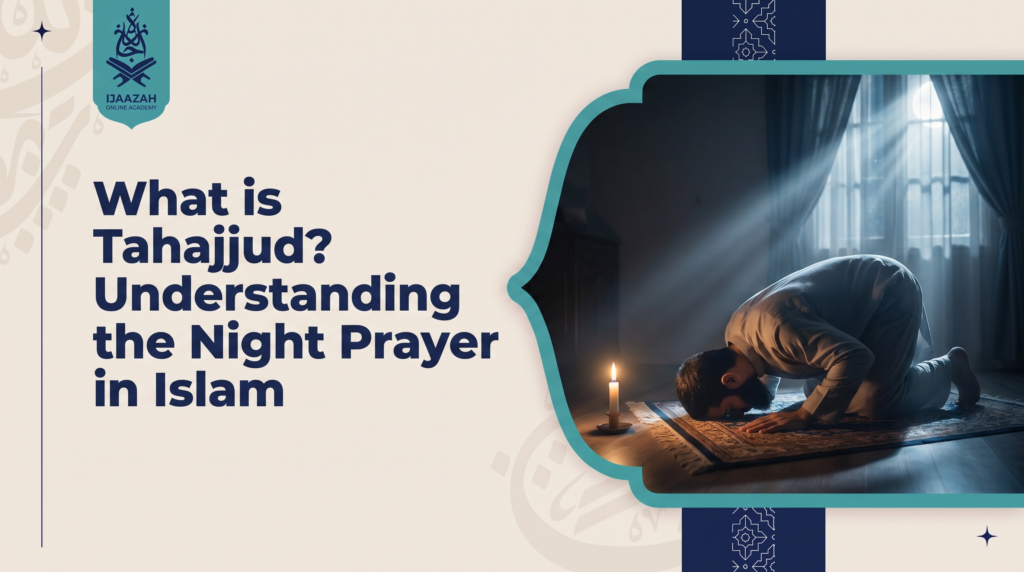
Tahajjud is a voluntary (nafl) prayer performed after the obligatory Isha prayer and before the Fajr prayer, specifically after sleeping and waking up. This distinction—waking after sleep—is significant. It is what differentiates Tahajjud from simply praying extra rak’ahs before bed.
The Prophet ﷺ prayed Tahajjud consistently throughout his life. For the believers, it carries an elevated recommendation that goes beyond ordinary voluntary prayers.
Allah ﷻ addressed it with a specific command to the Prophet ﷺ:
“And from [part of] the night, pray with it as additional [worship] for you; it is expected that your Lord will resurrect you to a praised station.” — Surah Al-Isra 17:79 (quran.com/17/79)
The “praised station” referred to in this verse—al-maqam al-mahmood—is understood by scholars to be the Station of Intercession (maqam ash-shafa’ah). The night prayer is presented as the path toward it.
The Hour Allah Descends—Why Timing Transforms the Prayer
The Tahajjud prayer is specifically recommended during the last third of the night—a timing that the Prophet ﷺ identified as carrying unparalleled spiritual weight:
“Our Lord descends to the lowest heaven during the last third of every night, saying: ‘Who is calling upon Me, that I may answer? Who is asking Me, that I may give? Who is seeking My forgiveness, that I may forgive?'” — Sahih al-Bukhari 1145 (sunnah.com)
The concept of divine nuzool (descent) in this hadith is one of the attributes of Allah ﷻ that Muslims affirm without specifying how—following the methodology of Ahl al-Sunnah wa al-Jama’ah in accepting the apparent meaning without anthropomorphism or denial.
The practical implication is straightforward: the last third of the night is the hour of maximum responsiveness. A Muslim who stands in prayer during that window is petitioning directly during the time Allah has specifically identified as the hour of granting.
How Many Rak’ahs? The Scholarly Consensus Made Simple
The number of rak’ahs in Tahajjud is flexible. The Prophet ﷺ generally prayed eight rak’ahs followed by Witr (an odd-numbered closing prayer), but he did not fix a mandatory number. Scholars agree that even two rak’ahs—preceded by sleeping and followed by sincere intention—constitute valid Tahajjud.
The Prophet ﷺ stated:
“The best prayer after the obligatory prayers is the night prayer.” — Sahih Muslim 1163 (sunnah.com)
That ranking places Tahajjud above all other voluntary prayers—above the sunnah rawatib, above Duha, above any other optional act. The Muslim who establishes it, even minimally and imperfectly, is occupying the highest tier of voluntary worship.
For Western Muslims—Tahajjud When the Alarm Feels Impossible
Tahajjud’s timing creates a genuine challenge in Western contexts. A Muslim working standard office hours who prays Isha at 10 PM needs to wake at approximately 2-3 AM to catch the last third of the night—and then function at work the following day. That is not a spiritual weakness. It is an arithmetic problem.
Practical strategies that Western Muslims have successfully implemented include:
- The split-sleep method: Sleeping immediately after Isha—around 9-10 PM—and setting an alarm for the last third. This requires earlier bedtimes than most Western schedules assume, but it is sustainable.
- The night-shift approach: For those who cannot sleep early, praying Tahajjud in the gap between work and sleep—during what would otherwise be late-night recreational time.
- The Ramadan foundation: Using Ramadan’s built-in late-night rhythm (particularly the last ten nights) to establish a Tahajjud habit and then maintain a reduced version afterward.
- Witr as a minimum: If full Tahajjud is not possible every night, maintaining at least Witr—prayed after Isha before sleep—preserves a night-prayer practice.
The Prophet ﷺ warned against abandoning Tahajjud once established, and encouraged gradual increase over sudden intensity that cannot be maintained.
Time Zones and the Last Third of the Night
The last third of the night is calculated from the time of Maghrib (sunset) to Fajr (sunrise). Dividing that period into three equal parts gives the start of the final third. Prayer time apps can calculate this automatically, removing the mathematical burden. The challenge is not calculation—it is the alarm.
For Muslims in the UK during winter, Fajr arrives around 6:30-7 AM and Isha ends around 7 PM, meaning the last third begins around 3 AM. In summer, Fajr arrives before 4 AM and the last third begins around 1:30-2 AM. These variations require ongoing awareness rather than a fixed alarm setting.
Online Quran Learning and the Night Prayer
Understanding Tahajjud at this depth—its Quranic basis, its hadith documentation, its jurisprudential details, and its spiritual dimension—is the kind of knowledge that a structured online Quran education provides. Western Muslims who study Islamic knowledge with Azhari-certified instructors build the comprehensive understanding that turns a practice from obligation into longing.
Know a Muslim who has always wanted to establish Tahajjud but hasn’t started? Share this article. Every prayer they make because of your share is a form of Sadaqah Jariyah that continues indefinitely.
The 5-Minute Challenge: Set an alarm for ten minutes before Fajr tomorrow—just once. Pray two rak’ahs. No pressure, no expectation of a permanent routine. Just try the hour once, and let the experience speak for itself.
Ready to deepen your Islamic knowledge with a certified tutor? Book a Free Trial | Test Your Level