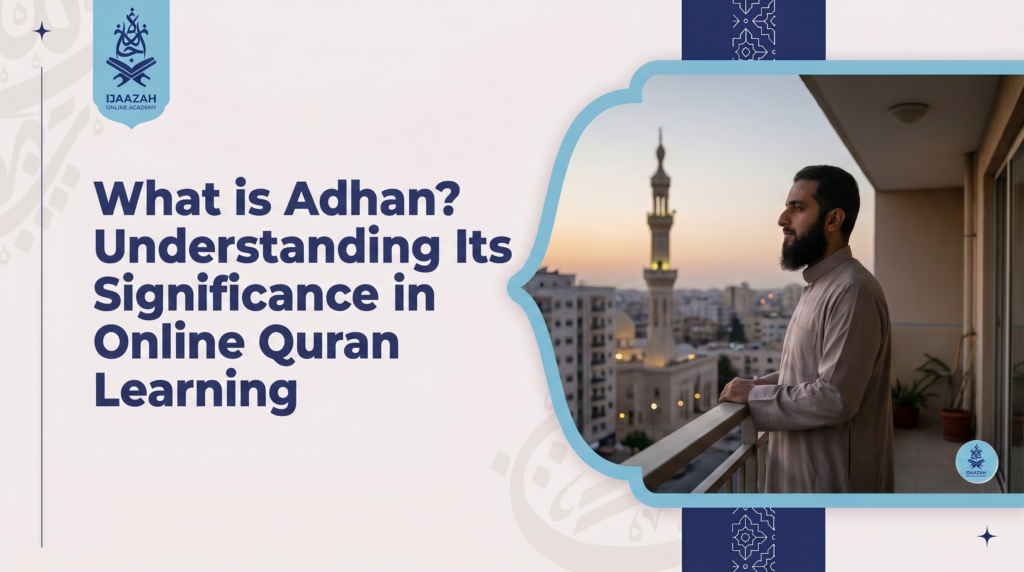
Five times a day, before most of the world has picked up their phones, a voice cuts through traffic, notifications, and the noise of modern life to announce something more permanent than all of them. The Adhan—the Islamic call to prayer—is among the most recognized sounds on earth. Understanding what is Adhan requires more than a translation of its Arabic words. It requires understanding what those words are actually doing.
More Than an Announcement—A Declaration Repeated Five Times Daily
The word adhan (أَذَان) derives from the Arabic root meaning “to announce” or “to inform.” At its most literal, the Adhan is a public proclamation that the time for prayer has arrived. At its most complete, it is a recurring theological statement—a declaration of Allah’s greatness, a testimony that Muhammad ﷺ is His messenger, and an invitation to the two things every Muslim is called toward: prayer and success.
The Adhan is not background noise. Each of its phrases carries doctrinal weight that took the first Muslim community years to establish.
The Words of the Adhan — Line by Line
The standard Adhan contains the following phrases, repeated in a specific sequence:
Allahu Akbar — Allah is the Greatest (repeated four times) Ashhadu alla ilaha illallah — I bear witness that there is no god but Allah (twice) Ashhadu anna Muhammadan rasulullah — I bear witness that Muhammad is the Messenger of Allah (twice) Hayya ‘ala as-salah — Come to prayer (twice) Hayya ‘ala al-falah — Come to success (twice) Allahu Akbar — Allah is the Greatest (twice) La ilaha illallah — There is no god but Allah (once)
The Fajr Adhan—the call before dawn—includes an additional phrase: “As-salatu khayrun min an-nawm” (Prayer is better than sleep). This phrase was reportedly added at the instruction of the Prophet ﷺ himself.
The Historical Appointment of Bilal ibn Rabah
The first person to deliver the Adhan was not chosen for the quality of his voice. Bilal ibn Rabah (رضي الله عنه) was a formerly enslaved Abyssinian man—a freed captive who had been tortured for his faith before the Muslims of Makkah migrated to Madinah. His selection as the first Mu’adhdhin (caller) carried an intentional message about who belongs at the center of Islamic practice.
The Adhan was established after a consultation among the Companions about how best to call Muslims to prayer. Some proposed bells; others suggested trumpets. The revelation of its words came through a dream experienced by the Companion Abdullah ibn Zayd, which was confirmed by the Prophet ﷺ.
What the Adhan Does to a Muslim’s Day
The spiritual function of the Adhan goes beyond time-keeping. Allah ﷻ addresses its communal dimension in the Quran:
“O you who have believed, when [the adhan] is called for the prayer on the day of Jumu’ah, then proceed to the remembrance of Allah and leave trade.” — Surah Al-Jumu’ah 62:9 (quran.com/62/9)
The instruction is not merely logistical—it is a reordering of priorities. Commerce stops. Movement toward prayer begins. The Adhan functions as a structured interruption of worldly preoccupation, repeated five times before the sun has completed its arc.
The Prophet ﷺ described one of its effects on spiritual opposition:
“When the call to prayer is given, Shaytan flees with flatulence until he cannot hear the adhan.” — Sahih al-Bukhari 589 (sunnah.com)
The Adhan in Western Life—Between Apartment Walls and Office Culture
For Muslims living in non-Muslim majority countries, the Adhan presents a practical and spiritual challenge simultaneously. Without loudspeakers echoing across a city, the responsibility for answering the call falls entirely on the individual. Prayer time apps, digital reminders, and wristwatch alerts have replaced the Mu’adhdhin for millions of Western Muslims—functional tools, but ones that require the individual to have already internalized the desire to respond.
This internalization is not automatic. It is built through Islamic education—through understanding not just what the Adhan says but why each phrase was chosen and what it demands of the person who hears it.
Time Zones and Prayer Times—A Genuine Logistical Challenge
Prayer times shift daily based on solar position, meaning a Muslim in Glasgow faces Fajr times that arrive before 3 AM in June and after 7 AM in December. Navigating these variations while maintaining consistent salah requires both knowledge and structured habit—two things that online Quran education can actively support.
Learning About the Adhan Through Proper Quran Study
Understanding the Adhan at depth—its Arabic vocabulary, its Quranic context, its historical origin—requires the same kind of guided study that any aspect of Islamic knowledge deserves. Online Quran platforms that address the Adhan as part of a broader Islamic education curriculum, taught by Azhari-certified instructors, give Western Muslim families access to grounded, authentic scholarship regardless of where they live.
For Muslim women in particular, learning these topics from qualified female instructors—in a space designed for their comfort—makes the difference between acquiring surface-level knowledge and building genuine understanding.
Responding to the Adhan—A Practice Many Have Forgotten
The Prophet ﷺ instructed that a Muslim who hears the Adhan should repeat each phrase after the Mu’adhdhin—with specific responses at particular phrases. This practice, documented in Sahih al-Bukhari and Sahih Muslim, transforms the Adhan from a passive auditory experience into an active act of worship. Many Western Muslims have never been taught this response practice, which represents an accessible and daily-repeatable way to deepen engagement with the call to prayer.
Know a Muslim family navigating Islamic practice in the West? Share this article. Every piece of knowledge shared is a form of Sadaqah Jariyah.
The 5-Minute Challenge: The next time the Adhan plays on your phone or speaker, pause everything for 30 seconds and repeat each phrase after the Mu’adhdhin. Respond as the Prophet ﷺ instructed—with conscious repetition. Five minutes of that today will anchor the habit for a lifetime.
Ready to deepen your understanding of Islamic foundations? Book a Free Trial | Test Your Level