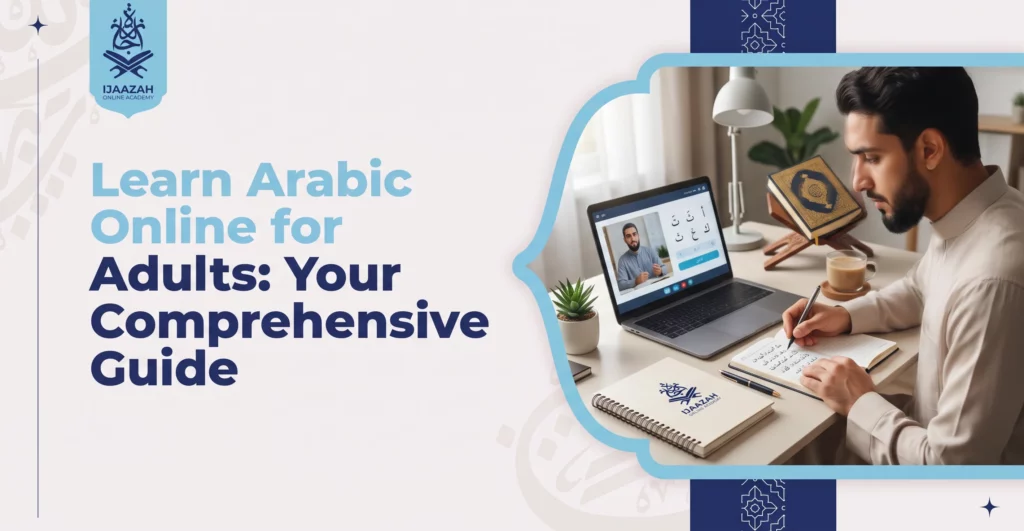
The motivation to learn Arabic online for adults most often arrives through one of three doors: a Muslim who wants to understand the Quran directly, without translation layered between them and the words of Allah; a professional who recognizes Arabic’s strategic value in a shifting global economy; or someone returning to a heritage language they were not given as children. Each path is legitimate. Each path requires a different approach — which is why generic language app subscriptions so frequently end in frustrated abandonment.
Arabic demands a structured foundation. Without one, even motivated adults plateau quickly.
The Arabic You Want to Learn — and the Arabic That Builds It
Modern Standard Arabic (MSA) is the formal written language used across Arab media, literature, and official communication. Quranic Arabic is a classical register of the language, precise and fixed, in which every word has been analyzed and transmitted across fourteen centuries of scholarship. Colloquial dialects — Egyptian, Levantine, Gulf — are the spoken variants that differ enough from one another that native speakers from different regions sometimes struggle to communicate.
Adults who want to learn Arabic online for adults need to identify their primary goal early:
- Quranic comprehension requires classical Arabic with a focus on grammar (Nahw), morphology (Sarf), and Quranic vocabulary
- Professional communication typically requires MSA as a foundation with a specific dialect added later
- Heritage reconnection often involves both a specific dialect and enough classical Arabic to engage with Islamic texts
Starting with the wrong register wastes time. An Azhari-certified tutor who specializes in Quranic Arabic will not teach the same curriculum as a conversational Arabic instructor — nor should they.
Why Adults Learn Arabic Differently Than Children
Children acquire language through immersion, repetition, and an absence of self-consciousness about errors. Adults learn through pattern recognition, explicit grammar instruction, and the cognitive machinery of an already-developed brain. That machinery is an advantage, not a liability.
An adult with a university education and existing knowledge of English grammar can internalize Arabic grammatical concepts at a pace a child cannot match. The Arabic broken plural system, the trilateral root structure, the system of grammatical case endings — these abstract structures are navigable for an adult mind trained in analytical thinking.
What adults struggle with is what children do effortlessly: sustained daily exposure over months without visible progress. The plateau between beginner and intermediate Arabic is where most adults disengage. Knowing this in advance changes the psychological relationship with the plateau. It is not failure. It is the period during which the foundation is settling.
The Practical Architecture of an Effective Adult Arabic Program
A well-designed program to learn Arabic online for adults typically involves:
- Three to five sessions per week, each lasting forty-five to sixty minutes
- Grammar instruction paired immediately with Quranic text examples, not abstracted into workbook exercises alone
- Vocabulary acquisition organized around root patterns rather than individual words, allowing one learned root to unlock dozens of related words
- Regular recitation practice with Tajweed, which reinforces pronunciation and trains the ear simultaneously
Scheduling across time zones is genuinely manageable. An adult in London studying with an Azhari tutor in Cairo, or a parent in Chicago connecting with a tutor for an evening session — the logistics that once made this impossible are now solved by any stable internet connection.
Know an adult Muslim who has always wanted to understand the Quran in Arabic? Share this post. Spreading knowledge is a form of Sadaqah Jariyah.
The 5-Minute Challenge: Open Surah Al-Fatiha right now and look at just the first verse: بِسۡمِ ٱللَّهِ ٱلرَّحۡمَٰنِ ٱلرَّحِيمِ. Identify the three roots present in those four words. Search each one. That five-minute exercise is the method at work.
Ready to Begin?Book a Free Trial