Reciting the Quran isn’t simply reading Arabic text aloud. It’s a disciplined art form with rules that have been preserved and transmitted across fourteen centuries—from the Prophet ﷺ through an unbroken chain of scholars to the teachers available to you today. Finding the best Tajweed course means finding instruction that honors that tradition while meeting you where you are as a modern learner.
What Separates a Good Tajweed Course from a Great One
Most online Tajweed courses will teach you the rules. The best ones will teach you to hear them, apply them automatically, and recite with the kind of fluency that comes from deep internalization rather than conscious rule-checking. That distinction matters enormously in practice.
The best Tajweed course for you will have these characteristics:
Certified instructors with ijazah — An ijazah in Tajweed isn’t just a certificate; it’s a documented chain of transmission connecting your teacher to the Prophet ﷺ through generations of scholars. This is the traditional standard of Quranic authority, and it’s the benchmark you should hold your tutor to.
Comprehensive curriculum — A serious Tajweed course covers Makharij al-Huruf (articulation points), Sifaat al-Huruf (letter characteristics), rules of noon sakinah and tanween, rules of meem sakinah, madd rules, and waqf (stopping) rules. If a course skips or glosses over any of these, it’s incomplete.
Flexible scheduling — The best course is one you can actually attend consistently. For students in the USA, UK, Canada, and Australia, this means a platform that offers classes across multiple time zones and doesn’t penalize you for the reality of Western working hours.
The Case for Female Tajweed Tutors
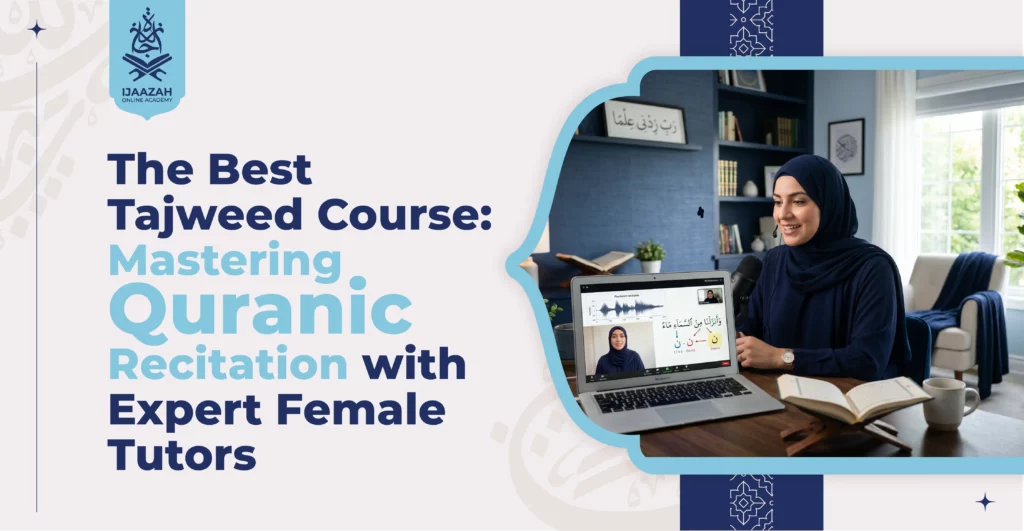
For Muslim women and families with daughters, the availability of qualified female Tajweed instructors isn’t a secondary consideration—it’s often the deciding factor. The best Tajweed courses maintain a dedicated roster of female educators who hold the same credentials as their male counterparts.
Beyond the religious and cultural appropriateness, female tutors often bring particular sensitivity to the learning experience of women and girls, creating an environment where students feel comfortable asking questions, making mistakes, and progressing at their own pace.
One-on-One vs. Group Tajweed Classes
Both formats have legitimate value, but they serve different purposes:
One-on-one classes are the most effective for Tajweed correction. Pronunciation errors are individual—your specific mistakes require specific correction, and that’s only possible when a tutor is listening exclusively to you. For serious Tajweed study, private instruction is the standard.
Group classes work well for learning the theoretical rules of Tajweed—understanding what ghunna is, how idgham works, when to apply ikhfa. They’re also more affordable and can provide motivating peer interaction. Many students use group classes for theory and private sessions for recitation practice.
How to Evaluate Your Current Tajweed Level
Before enrolling in any course, it helps to know where you stand. Common self-assessment questions include: Can you identify the articulation point of every Arabic letter? Do you apply madd rules consistently? Can you recite Surah Al-Fatiha with correct Tajweed without thinking about the rules?
If any of these feel uncertain, a structured Tajweed course—starting from the foundations—is the right move. Many platforms offer placement assessments that match you to the appropriate level automatically.
Find the best Tajweed course for your level and goals. Start with a free trial class at Ijaazah.com: Book your session here.
Not sure of your current Tajweed level? Take the free assessment at Ijaazah.com before you begin.